By insideSail
Published without technical review · version 2 ·
CO in accommodation: recognising exposure without assuming seasickness
Sources, entry paths and symptoms are distinct parts of a risk that smell cannot reveal.
In this guide
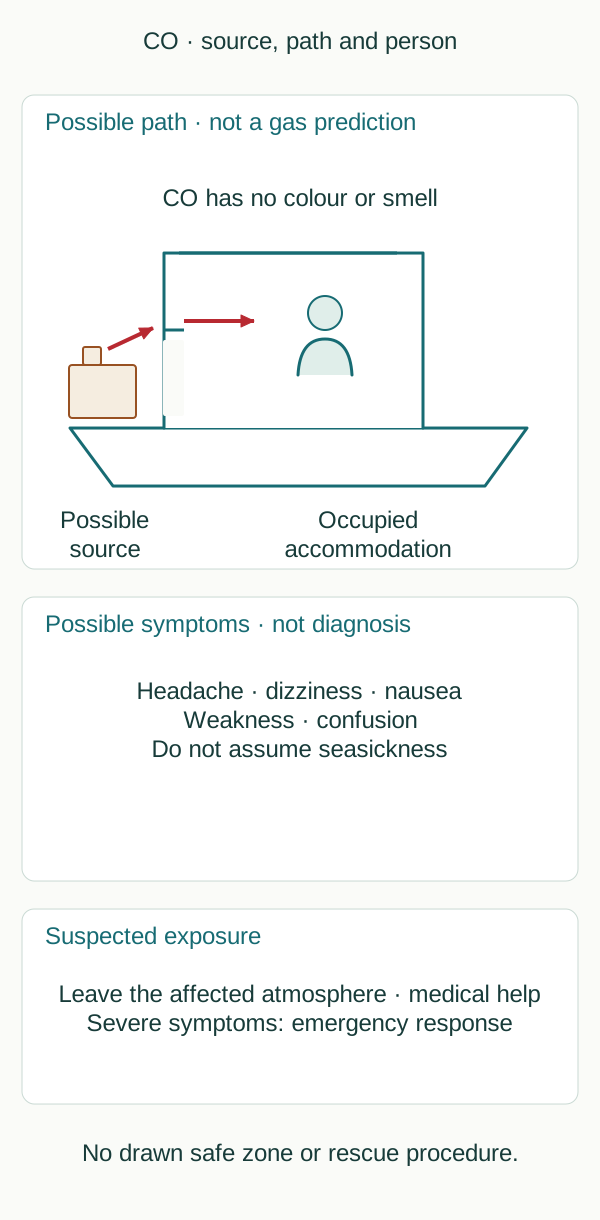
Original conceptual schematic, not to scale; fictional cases, not a manoeuvre procedure.
insideSailOriginal insideSail artwork — all rights reservedEnlarge the diagram
The gas gives no smell warning
Carbon monoxide, CO, is a poisonous gas without colour or smell. It can result from incomplete combustion of fuels used in engines, generators, heaters and cookers.
Lack of visible smoke must not be confused with absence of CO, nor should a characteristic smell be sought to exclude exposure. On a boat, understanding the risk requires relating combustion source, gas path and the spaces occupied by people.
Accommodation can receive gases from the boat itself or another nearby. The source need not be inside that compartment: exhaust gases may reach openings and occupied areas.
The figure shows a conceptual possibility, not a flow prediction for an actual marina. Wind, movement, opening geometry and installation influence the path.
The word outside does not make a generator or exhaust automatically safe for people inside.
Nonspecific symptoms are not reassuring
NHS clinical guidance includes headache, dizziness, nausea, weakness and confusion among possible symptoms. These may resemble seasickness, fatigue or another illness, but resemblance does not exclude CO.
Several people affected in one space provide important contextual information, not a diagnostic test. One person may be affected differently from others; absence of symptoms in the remaining occupants does not certify safety.
Suspected exposure requires leaving the risk
For suspected exposure, the consulted guidance is to leave the affected atmosphere for fresh air and seek medical help promptly. NHS guidance includes breathing difficulty, sudden confusion, loss of consciousness, chest pain, weakness or muscle pain after suspected exposure among reasons for emergency response.
This enumeration is neither a diagnostic test nor an exhaustive severity list. The contact must suit the location; NHS services are British.
This explanation prescribes neither oxygen nor a safe time to remain exposed.
Not re-entering until advised that it is safe is an important protective element. Impulsive entry to switch off equipment or recover someone may create another casualty.
An incapacitated person in a contaminated space requires appropriate rescue services and capabilities; this lesson does not teach rescue in a hazardous atmosphere. Stopping a source where safely possible does not itself prove that the space has become safe.
Prevention and detection are not substitutes
Competent installation, maintenance, intended appliance use and adequate ventilation address causes and exposure paths. An alarm suitable for marine use adds detection, but does not repair a defective installation or authorise blocking ventilation.
Boat Safety Scheme refers to equipment certified to BS EN 50291-2 for the marine context. Actual choice and positioning follow the manufacturer and applicable scope, without an invented universal height for all interiors.
A test button, power supply and replacement date concern device readiness, not proof of gas absence at every point. Knowing the alarm means understanding the manufacturer’s checks and distinguishing a fault indication from a CO warning.
Silencing an inconvenient warning does not resolve its cause. A household smoke detector is not an equivalent substitute for a CO detector either.
Another comparison distinguishes two warnings: a person reports symptoms, or a device gives an alarm. Absence of one does not cancel the other.
A useful description preserves time, reported symptoms and device indication without waiting for both to coincide before considering exposure. Recording must not delay protecting people or seeking clinical help; the exercise concerns recognition rather than establishing a diagnosis from matching signs.
The diagram neither quantifies concentrations nor draws a guaranteed safe zone. Its three elements support useful questions: what source may exist, how gases could reach people and what symptoms or warnings were observed.
Clinical sources support recognition and urgency; boating sources support exposure paths and prevention. Diagnosis, installation and a real response require capabilities that an educational figure does not supply.
Sources and references
- Carbon monoxide poisoning ↗
NHS · Symptoms; what to do if poisoning is suspected; urgent/emergency care distinctions; causes and prevention.
Clinical public guidance directly consulted. UK service numbers are not transferred to Portugal; no dose, oxygen protocol or diagnostic algorithm reproduced.
Checked on - Carbon Monoxide (CO) ↗
Boat Safety Scheme · So what is the risk; combustion, appliances/exhaust/flue gases, ventilation, maintenance and CO alarm context.
Directly consulted. Original explanation of mechanisms; BSS examination requirements are not asserted as Europe-wide law.
Checked on - CO alarms save lives ↗
Boat Safety Scheme · Choosing an alarm for marine use and certification to BS EN 50291-2; following manufacturer instructions.
Alarm compatibility context; no installation dimensions or universally sufficient alarm count taught.
Checked on - Act Quickly if exposed to CO ↗
Boat Safety Scheme · Leaving exposure, medical help and not re-entering until advice; response to suspected exposure.
Directly consulted for boat context, not a confined-space rescue procedure.
Checked on - Beware Killer Exhaust Gases ↗
Boat Safety Scheme · Engine/generator exhaust entering accommodation, neighbouring boats and openings.
Boat-specific safety explanation; does not establish a common European statutory inspection regime. Original teaching, no copied booklet or diagram.
Checked on
Discuss this concept
Loading the conversation…