By insideSail
Published without technical review · version 2 ·
Confirmed communication: meaning, recipient and result
Hearing a word does not confirm agreement about person, task or reference.
In this guide
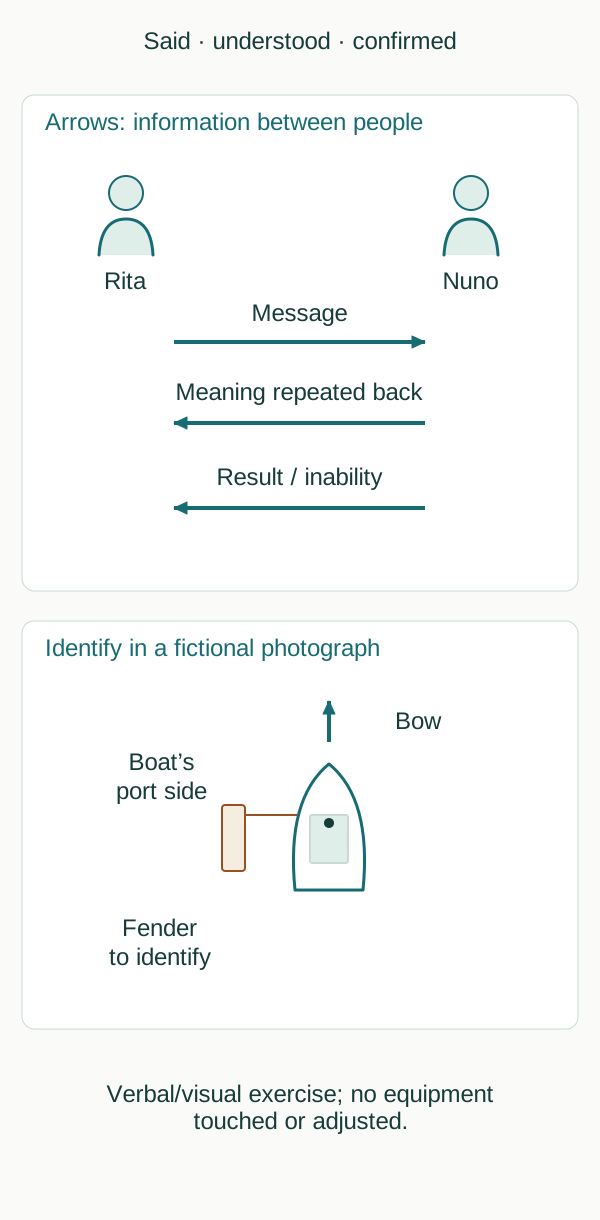
Original conceptual schematic, not to scale; fictional cases, not a manoeuvre procedure.
insideSailOriginal insideSail artwork — all rights reservedEnlarge the diagram
A message can fail in several ways
A person may not hear a message, hear but interpret something else, understand but be unable to act, or act without reporting the result. These are different states.
“Yes” may only acknowledge that someone spoke. In a crew with unequal experience, technical words make that difference more likely: the sender believes an exact object was identified while the recipient is still discovering which one it is.
MCA guidance recommends clear, concise, confirmed communication, including repeating back received meaning. HSE adds the importance of suitable recipients, media, timing and language.
These principles are applied to an onboard recognition exercise without creating VHF phraseology or universal manoeuvring commands. The aim is to detect a difference in understanding before treating it as shared understanding.
What owns the reference?
“On the right” may mean the speaker’s right, the listener’s right or the right of a photograph both are viewing. Port belongs to the boat, but an unfamiliar person may not yet know which side it is.
“The front line” is ambiguous where several lines exist and two people face different ways. Naming the object, position and reference reduces ambiguity provided the recipient genuinely understands those terms.
Understanding and execution need different states
The figure distinguishes message, repeated meaning and reported result. They are not three orders to execute automatically.
The second element permits an interpretation to be corrected; the third establishes whether the intended state was reached, remained incomplete or was impossible. “Understood” must not be recorded as “completed”.
Similarly, silence after a request proves neither acceptance nor success.
Confirmation may be “I have not identified the object” or “I cannot do that”. These are useful results because they expose a concrete limitation.
A culture in which questions feel embarrassing encourages agreement without understanding. An exercise should permit a presumption to be interrupted and vocabulary corrected without making the beginner responsible for the ambiguity.
The sender also bears responsibility for meaning and available information.
Noise, distance and groups increase uncertainty
When several people hear an unaddressed call, each may assume another will respond. Noise and motion can remove parts of a message; mechanical repetition may repeat only the heard fragment.
Useful confirmation therefore retains relevant content rather than merely the last word. Choice of medium must consider context without assuming gestures or eye contact will always be available or interpreted identically.
Written information can support names, positions and responsibilities before an activity, but does not replace checking understanding. A clear label on an object does not guarantee a person can find it in poor light.
An old photograph may show an altered configuration. Communication must connect information to the present boat and person, retaining uncertainty where that correspondence has not been confirmed.
There may also be a partial result: a person identified the object but did not confirm the requested state. The exercise records these as separate facts rather than one success.
This matters where observation and execution are distinct parts of a task. Learning from a photograph remains recognition; it must not silently become authorisation to operate a real fitting or proof of practical competence aboard.
This lesson supplies no distress messages, standard radio phraseology or clinical decisions. When reviewing an exercise, locate the first divergence between what was said, understood and happened.
That record offers a specific improvement: clarify a reference, select a recipient or distinguish completion from inability. Success is not speaking more; it is knowing which meaning and result were actually confirmed.
Sources and references
- Safety critical communications: Overview ↗
Health and Safety Executive · Key principles: who needs information, medium, timing, language and written support; signs are not a substitute for communication.
Workplace human-factor guidance; not a private-yacht legal equipment specification.
Checked on - Leading for safety — 5. Communication and teamwork ↗
Maritime and Coastguard Agency · Sections 5.1 concise understandable messages and repeated-back meaning; 5.2 shared task/roles; 5.3 briefings/debriefings; 5.4 bystander effect.
Professional-context source supporting original fictional small-crew case studies. No claim that editorial vocabulary replaces standard marine radio phraseology.
Checked on
Discuss this concept
Loading the conversation…