By insideSail
Published without technical review · version 2 ·
Emergency plan: testing dependence on one person or resource
A tabletop exercise can expose functions disappearing together when a shared resource is lost.
In this guide
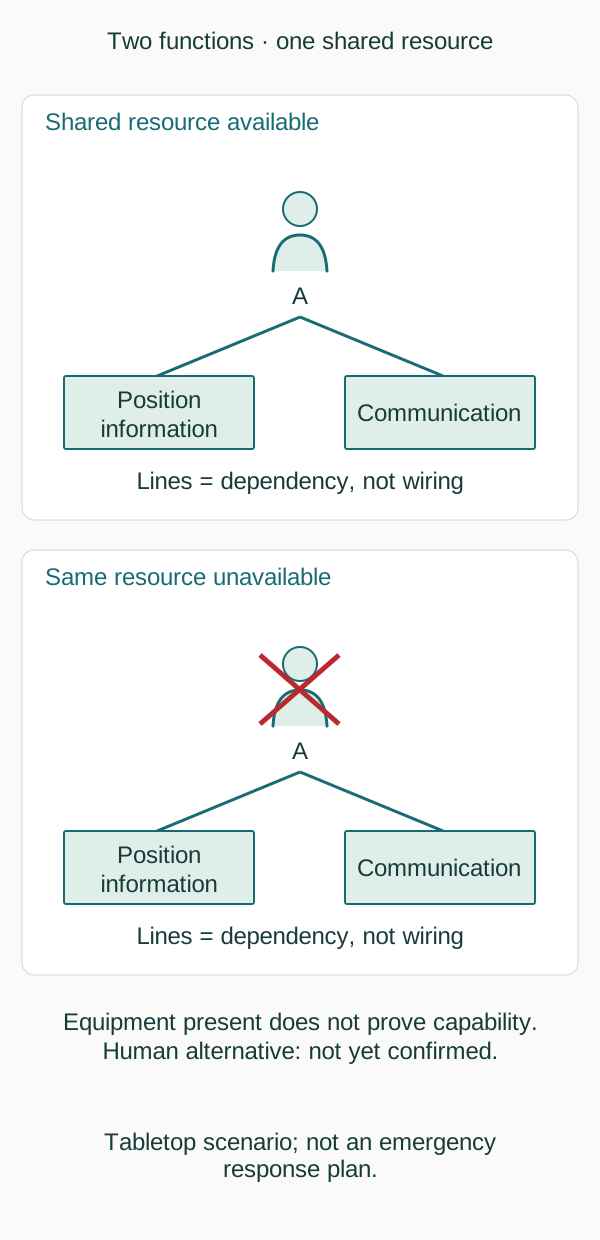
Original conceptual schematic, not to scale; fictional cases, not a manoeuvre procedure.
insideSailOriginal insideSail artwork — all rights reservedEnlarge the diagram
A plan can contain a hidden dependency
An equipment list does not show who can use it, where it is or what it needs to function. A plan may assign communication, position information and decisions to one person without recognising that dependency.
It may also count two information paths sharing one electrical supply. This lesson’s exercise does not simulate a real emergency: discussion, without activating systems, examines which functions would become unavailable in a declared scenario.
RNLI recommends an emergency action plan and onboard briefing. MCA emphasises shared understanding of tasks, roles and resources.
Our dependency analysis is an editorial application of those principles, not an officially certified model. The distinction matters: finding a gap in discussion is useful, but does not establish that a practical response has been trained or that everyone can perform their roles in actual conditions.
Choose one loss without inventing a whole emergency
To make reasoning checkable, the scenario needs one concrete change. For example, person A becomes unavailable, or one power resource is lost.
That must not be treated as equivalent to every failure occurring at once. Retaining the remaining conditions makes the mechanism visible.
If scenario, crew and equipment continually change, it becomes difficult to identify which dependency was actually found.
Independence requires examining shared resources
Two devices are not necessarily two independent alternatives. They may depend on the same battery, antenna, accessible compartment or familiar person.
The figure shows one shared resource connected to two functions. Lines represent dependency rather than wiring or a recommended architecture.
If the central resource becomes unavailable, two boxes to its right do not themselves provide continuity for both functions.
An alternative may have different limitations: endurance, coverage, access, training or available information. The exercise should record them instead of calling any similar-looking object equivalent.
No alerts are transmitted or circuits disturbed to prove a hypothesis. Such tests have their own requirements and risks.
Tabletop analysis identifies questions for competent familiarisation and verification, remaining separate from execution.
Parallel functions do not automatically fit one person
If one person takes on previously shared tasks, workload changes. Saying B will do everything describes neither time, attention nor competence.
Some needs may occur simultaneously while others require access to different places. The record must expose that competition.
The aim is not a universal priority sequence, because emergency type and actual conditions change what is urgent.
A useful conclusion identifies the gap and confirmation status: information inaccessible without A, an unfamiliar alternative or an unverified shared electrical dependency. “Plan approved” would be excessive after this exercise.
Even if discussion resolves a question, explaining an action remains different from performing it in suitable training. Documentation should preserve who verified what and when.
A second round can remove a different resource while retaining the first. Compare affected functions to discover whether the scenarios genuinely share a dependency.
Describing both only as “general failure” loses that information. Exercise quality comes from a bounded change and explained consequences, not adding dramatic failures to make discussion more impressive.
Distinct records allow a later review to see which assumption was actually tested.
The diagram is not an abandonment, fire, recovery or treatment plan. It is a way of critically reading preparation for those subjects without pretending they share one response.
Subsequent review may lead to training, maintenance or clarified roles according to the finding. Value lies in a demonstrated concrete dependency, not filling an emergency grid with words nobody aboard can connect to current resources.
Sources and references
- Yacht sailing and motorboating ↗
RNLI · Emergency action plan and onboard briefing; means of calling for help and familiarisation.
Current public preparation guidance directly read; original dependency exercise is editorial and hypothetical.
Checked on - How to brief your crew ↗
Royal National Lifeboat Institution · Crew briefing: shared situation, roles, boat layout, safety equipment and emergency procedures; article October 2019.
Preparation context, not evidence that an informal table exercise certifies a crew or replaces practical training.
Checked on - Leading for safety — 5. Communication and teamwork ↗
Maritime and Coastguard Agency · Sections 5.1 concise understandable messages and repeated-back meaning; 5.2 shared task/roles; 5.3 briefings/debriefings; 5.4 bystander effect.
Professional-context source supporting original fictional small-crew case studies. No claim that editorial vocabulary replaces standard marine radio phraseology.
Checked on - Leading for safety — 3. Performance influencing factors ↗
Maritime and Coastguard Agency · Sections 3.2 fatigue, 3.4 high/low workload, 3.5 environment and physical limitations; page updated 18 June 2026.
Human-factor principles in professional maritime guidance; MLC work/rest legal requirements are not asserted to apply to every private yacht.
Checked on
Discuss this concept
Loading the conversation…