By insideSail
Automated technical check · version 1 ·
Miles and knots: distance is not speed
A nautical mile is 1,852 metres. A knot is one nautical mile per hour.
In this guide
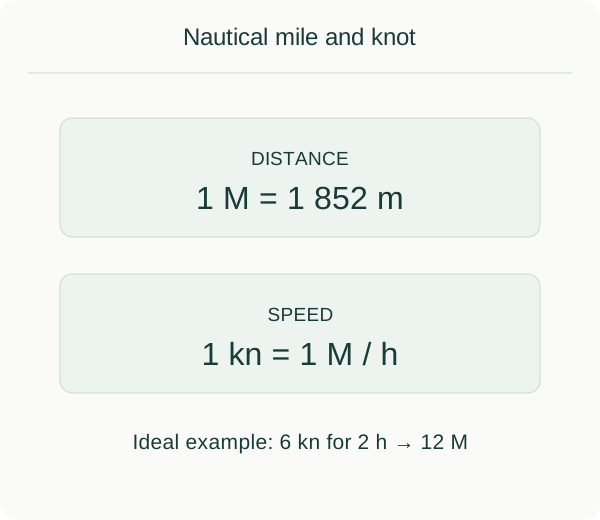
Original schematic illustration. Read the explanation and limitations in the lesson.
insideSailOriginal insideSail artwork — all rights reservedEnlarge the diagram
A number becomes clear when its unit accompanies it. “Five miles” describes distance; “five knots” describes speed. Mixing them prevents even a simple comparison. insideSail primarily uses metres for boat dimensions and knots for speed.
The relationship in numbers
1 nautical mile = 1,852 m; 1 knot = 1 nautical mile/hour
m, nautical mile, kn, h
Speed relative to what?
Original schematic illustration. Read the explanation and limitations in the lesson.
insideSailOriginal insideSail artwork — all rights reservedEnlarge the diagram
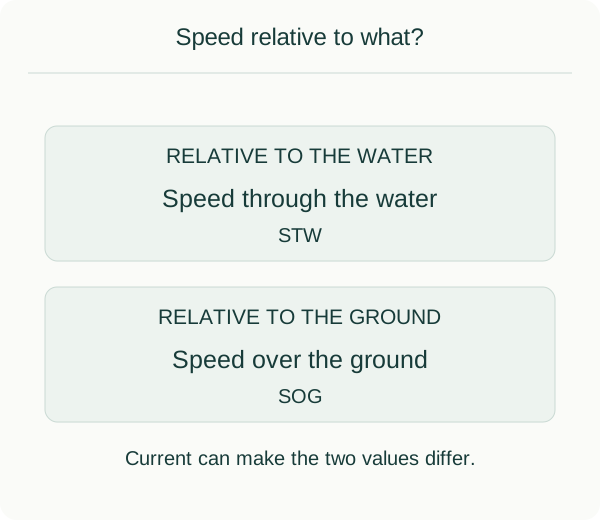
Speed through the water and speed over the ground use different references. On a display, STW commonly means speed through water and SOG means speed over ground. Both can use knots. A shared unit does not mean an identical measurement, and the terms alone do not identify sensor method or quality.
When reading a performance description, look for units, reference and conditions. An owner’s observed speed should remain labelled as an observation rather than automatically replacing model data. The multiplication example assumes constant speed; acceleration, pauses and changing conditions are outside that exercise.
Concepts in this lesson
Knot — speed
A speed unit: one nautical mile per hour. Distinct from a rope knot.
Nautical mile
A distance unit equal to 1,852 metres.
Sources and references
- C-51 — A Manual on Technical Aspects of UNCLOS (TALOS) ↗
International Hydrographic Organization · Edition 6.0.0, May 2020 · Chapter 3 §§3.6.1, 3.11.2: international nautical mile
Version: Edition 6.0.0, May 2020. Jurisdiction: International. Used solely for distance-unit definition, not maritime-boundary advice.
Checked on - MGN 379 (M+F) Amendment 1 — electronic navigational aids ↗
Maritime and Coastguard Agency · Amendment 1 · Course and speed over ground / through the water terminology
Version: Amendment 1. Jurisdiction: United Kingdom. Terminology only; operational radar and collision advice not reproduced.
Checked on
Discuss this concept
Loading the conversation…