By insideSail
Automated technical check · version 2 ·
Tides: astronomical rhythm and local response
Moon geometry helps explain the cycle, but supplies no local tide table.
In this guide
Tides relate to differences in gravitational attraction across Earth and to Earth–Moon–Sun dynamics. Imagining all water simply running towards the point nearest the Moon is insufficient.
Rotation, ocean basins, depth and coastlines shape the actual response. An astronomical diagram teaches a relationship rather than predicting a harbour tide’s time and amplitude.
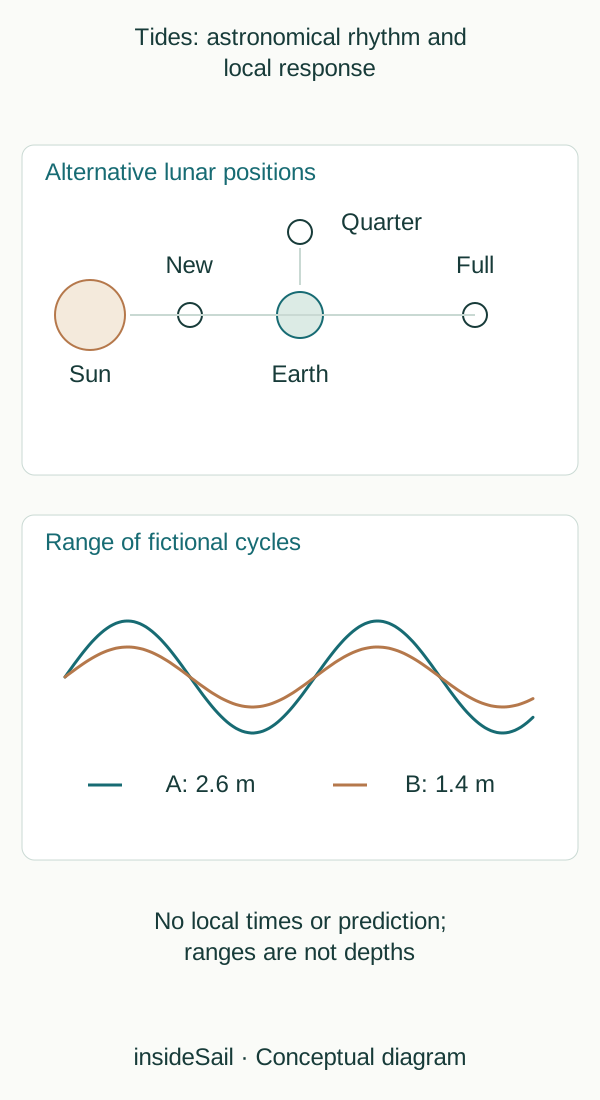
Conceptual schematic not to scale; no local forecast or operational decision.
insideSailOriginal insideSail artwork — all rights reservedEnlarge the diagram
Spring and neap tides
Near new and full moon, astronomical relationships generally favour larger tidal ranges: spring tides. Near quarter phases, they generally favour smaller ranges: neap tides.
“Spring” does not mean the season. Tidal range is the difference between high- and low-water levels rather than an absolute depth or individual wave height.
Local response can have delays and different forms. Regimes have diurnal, semidiurnal or mixed characteristics; one sinusoid does not describe every location.
Basin geometry can amplify or modify oscillation. Actual times and heights belong to appropriate local predictions.
Moon phase alone does not supply those values.
Associated horizontal movement is tidal current, also developed in the navigation lessons. Local high water does not universally coincide with no current.
Wind, pressure and other effects can modify observed level relative to astronomical prediction. Here we explain cycles and variables; available depths, table interpolation and access decisions need local data and navigation appraisal.
Near a coast, oscillation can be described through components with their own periods and phases. Their combination produces a curve changing through the cycle.
Two conceptual oscillations explain why maxima and minima do not result from one arrow pointing at the Moon. Harmonic predictions use their own observed and astronomical relationships; this lesson invents no local coefficients or times.
Distance between bodies varies too, adding modulation to phase relationships. “Full moon” does not alone mean “largest tide of the year”.
A large range does not automatically determine maximum-current time at a passage either. Tide names a process family, while height, range, phase and current remain distinct fields.
Relating them requires context rather than turning a lunar calendar into a nautical table.
- Spring and neap describe range variation.
- Moon phase alone does not determine a local tide.
- Height, range and current are different quantities.
Concepts in this lesson
Neap tide
Part of the cycle with generally smaller ranges, associated with astronomical geometry near quarter phases.
Spring tide
Part of the cycle with generally larger ranges, associated with astronomical alignment near new and full moon.
Tidal range
Difference between high- and low-water levels referred to the same datum.
Sources and references
- Types and causes of tidal cycles ↗
NOAA National Ocean Service · Diurnal, semidiurnal and mixed patterns; continental/basin influence.
Pattern families only; no regional times or amplitude prediction.
Checked on - Storm surge ↗
Met Office · What causes a surge? Negative surge; coastline and timing effects.
No inverse-barometer local correction, hazard threshold or historical casualty narrative reproduced.
Checked on - Tidal variations — influence of position and distance ↗
NOAA National Ocean Service · Astronomical geometry; changing relative positions and distances.
No two-bulge model asserted to predict actual coastal tides.
Checked on - What are spring and neap tides? ↗
NOAA National Ocean Service · Lunar phases, alignment and tidal range.
Physical cyclic relationship only; local times and amplitudes require local information.
Checked on
Discuss this concept
Loading the conversation…