By insideSail
Published without technical review · version 2 ·
Workload: where the look-out gap appears
Sharing tasks requires checking available attention, not merely counting people aboard.
In this guide
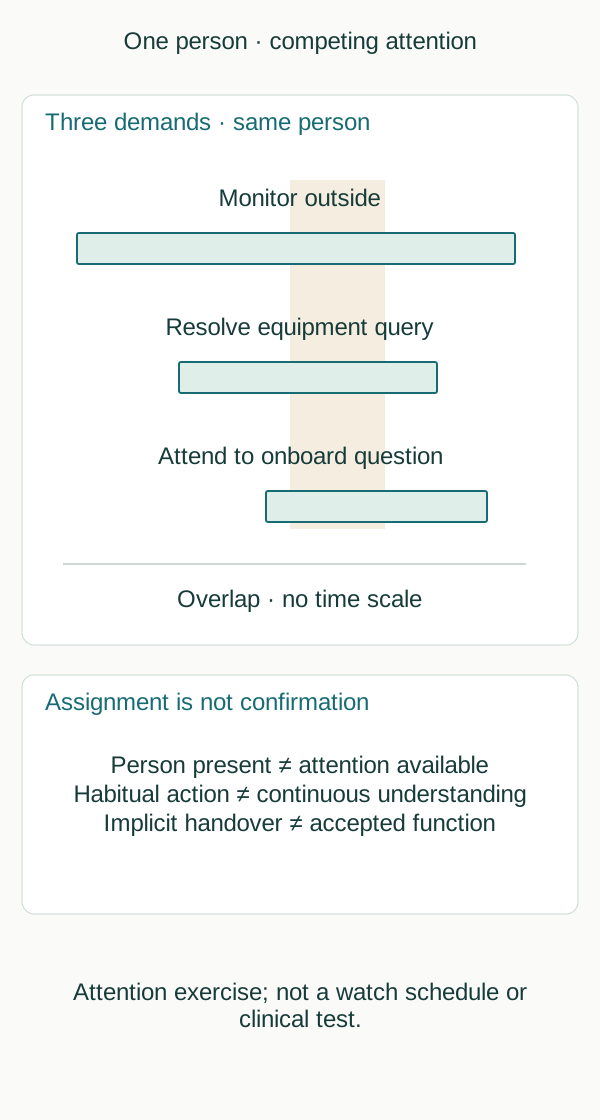
Original conceptual schematic, not to scale; fictional cases, not a manoeuvre procedure.
insideSailOriginal insideSail artwork — all rights reservedEnlarge the diagram
Being busy is not being attentive
In a small crew, one person may steer, consult information, answer a question and assist with another task. Each activity needs attention, and switching between them has a cost too.
The problem is not merely excessive physical work: repeated interruptions may leave developments around the boat unmonitored. Counting four people aboard does not demonstrate that anyone is actually maintaining the necessary look-out.
MCA guidance on performance factors distinguishes high and low workload. Time pressure, complexity, task switching and familiarity influence available capacity.
A routine activity may seem easy to someone proficient while consuming almost all a learner’s attention. Allocation must not assume equal capabilities or treat an unfamiliar person as an automatically usable reserve of labour.
The example shows overlap, not a watch schedule
In the figure, three bands represent demands on the same person: monitoring outside, resolving an equipment query and attending to an onboard question. Their shared interval marks competing attention.
It is neither a clinical measure of human capacity nor a regulatory limit in seconds. Its value is showing how individually small tasks can become problematic when they coincide.
Delegating a function needs confirmation
A useful handover identifies who takes a function and confirms understanding of what is now being monitored. “Stay there a moment” does not establish whether steering, look-out, both or neither were transferred.
The recipient may not know about a visual obstruction or information the other person was following. Communication must expose that difference before the handover is treated as complete.
This does not mean anyone can assume any responsibility after one sentence. Boat knowledge, experience, conditions and training limit what each person can do.
A division that seems comfortable in quiet conditions may be inadequate with motion, cold or poor visibility. An honest description records who is available, who is occupied and what each can monitor, rather than relying only on informal titles.
Fatigue and monotony change attention too
MCA relates fatigue to concentration, memory, decisions, reactions and communication. A person may continue habitual actions while monitoring the situation less effectively.
Low workload and monotony can also reduce engagement; they are not evidence of effective rest. Recognition should consider conditions and behaviour without waiting for a major error or clinically diagnosing someone from a crew impression.
Professional work and rest rules cited in the source have their own scope. They are not converted into a universal private-yacht table or a fitness guarantee.
Recorded hours alone do not describe sleep quality, illness, seasickness or accumulated exertion. This lesson uses limited capacity to analyse tasks and interruptions; it supplies neither a watch schedule nor a personal fitness certification.
In the exercise, add one task without changing crew numbers. Ask who receives it and which function becomes unmonitored during that interval.
If the answer is “nothing is left”, ask for capabilities and confirmation to be explained rather than good intentions alone. The panel exposes the difference between imagined allocation and actual monitoring; it measures neither intelligence nor personal worth and is not a competence examination.
After an exercise, the concrete question is where attention was assumed without confirmation: a competing request, an implicit handover or an interval presumed covered. The record should reveal the mechanism and improve preparation and training rather than merely praising or criticising people.
The figure helps locate the gap; actual organisation of crew and look-out still depends on the boat, people and real conditions.
Sources and references
- Leading for safety — 5. Communication and teamwork ↗
Maritime and Coastguard Agency · Sections 5.1 concise understandable messages and repeated-back meaning; 5.2 shared task/roles; 5.3 briefings/debriefings; 5.4 bystander effect.
Professional-context source supporting original fictional small-crew case studies. No claim that editorial vocabulary replaces standard marine radio phraseology.
Checked on - Leading for safety — 3. Performance influencing factors ↗
Maritime and Coastguard Agency · Sections 3.2 fatigue, 3.4 high/low workload, 3.5 environment and physical limitations; page updated 18 June 2026.
Human-factor principles in professional maritime guidance; MLC work/rest legal requirements are not asserted to apply to every private yacht.
Checked on - Leading for safety — 4. Situational awareness ↗
Maritime and Coastguard Agency · Section 4.1 perception/understanding and changing conditions; task familiarity and team capability.
Conceptual human-factor support; no borrowed flowchart or operational manoeuvre sequence.
Checked on
Discuss this concept
Loading the conversation…