By insideSail
Automated technical check · version 2 ·
Clouds: form, layers and development
Classification organises observations without turning the sky into a recipe.
In this guide
A visible cloud contains small water droplets, ice crystals or both. Water vapour is invisible; calling the white part “vapour” confuses phases of matter.
Observed form results from condensation, growth, mixing and movement. Recognising a shape provides language to describe it without identifying the entire atmospheric structure or subsequent development by itself.
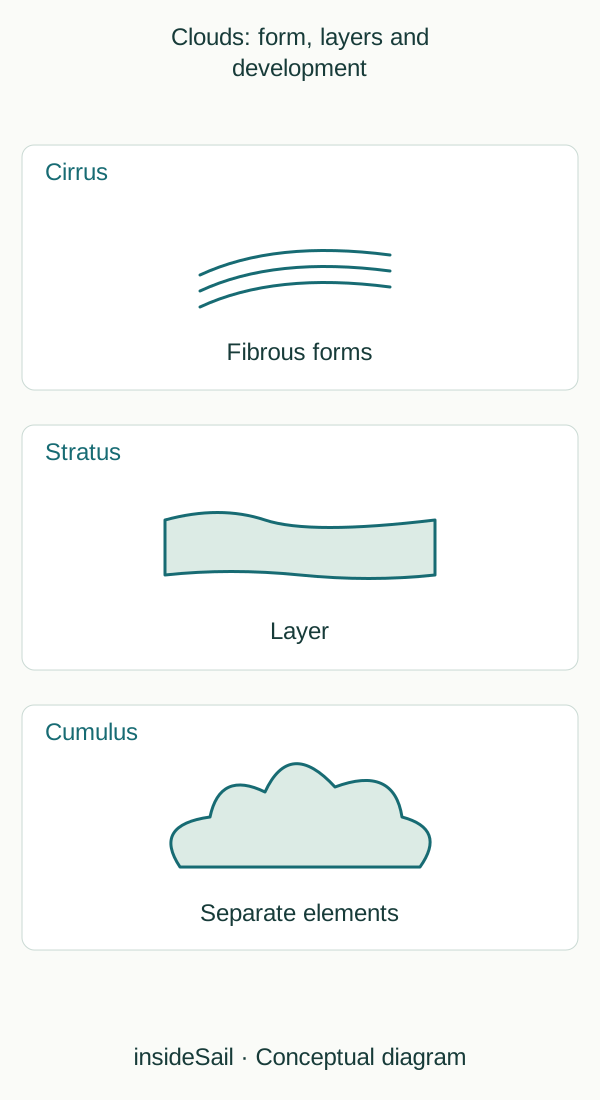
Conceptual schematic not to scale; no local forecast or operational decision.
insideSailOriginal insideSail artwork — all rights reservedEnlarge the diagram
Three starting points for observation
The WMO International Cloud Atlas organises ten genera. We use three schematic examples: cirrus commonly has fibrous forms, stratus forms a layer, and cumulus consists of separate mound-like elements.
These drawings are not classifiable photographs and do not cover every species or variety. Taxonomy is richer than “high, middle and low”, and apparent form can change with perspective.
Vertical structure matters too. Rising air can cool sufficiently to favour condensation; broader or stratified movement can produce layers.
Cloud vertical development relates to moisture, stability and movement rather than base colour alone. Darkness can result from thickness and lighting.
Colour should not be used as a direct measure of wind speed or rain distance.
Clouds can obscure other layers, while horizon curvature and distance alter what is visible. Their apparent motion can differ from surface wind because flow varies with height.
A genus name helps communicate an observation; relating it to navigation decisions requires appropriate forecasts and warnings. The hazardous-weather lesson develops the physical mechanisms.
Coverage and genus answer different questions. Genus describes form, while coverage describes how much sky is occupied in an observation.
Cumulus elements may be isolated or occupy more of the visible sky. Photographs of similar coverage can show different structures.
Descriptions may also include development, apparent height and other observations, retaining what was actually seen rather than turning every field into a weather conclusion.
Light changes appearance. One layer can look white in sunlight and dark against light.
A flat base viewed at distance can be hidden by terrain or other clouds. These relationships explain why a recognition illustration shows main features rather than automatically identifying any photograph.
Learning names improves observation and communication; relating them to an atmospheric profile requires additional information.
- Visible cloud is not invisible vapour.
- Form, layer and development are different observations.
- A genus name alone does not supply a forecast.
The concept in a few words
Cloud genus
Main cloud-classification category distinguished by form characteristics.
Sources and references
- International Cloud Atlas — Cumulus ↗
World Meteorological Organization · 2017 Edition, §2.2.2.1.9, definition.
Selected separate/cloud-mound appearance only; no source image.
Checked on - International Cloud Atlas — Clouds ↗
World Meteorological Organization · 2017 Edition, §2.1.1 definition of a cloud.
Liquid/ice constitution only; no translated standard text or source imagery.
Checked on - International Cloud Atlas — Genera ↗
World Meteorological Organization · 2017 Edition, §2.2.2.1; list of ten genera.
Taxonomy and selected identities only. Original schematic artwork; no WMO photography or classification text reproduced.
Checked on - International Cloud Atlas — Cirrus ↗
World Meteorological Organization · 2017 Edition, §2.2.2.1.1, definition.
Selected distinguishing shape only; no source image.
Checked on - International Cloud Atlas — Stratus ↗
World Meteorological Organization · 2017 Edition, §2.2.2.1.8, definition.
Selected layer appearance only; no source image.
Checked on
Keep discovering
The next piece of the puzzle
Discuss this concept
Loading the conversation…