By insideSail
Automated technical check · version 2 ·
Converting references without mixing signs
A worked angular example with declared conventions.
In this guide
A course is a direction expressed from a reference. Here, angles run clockwise from north and use three digits: 005°, 080° or 275°.
The same physical line can have different values when measured from different north references. Converting a course changes the measurement reference; it does not automatically turn the boat or remove current.
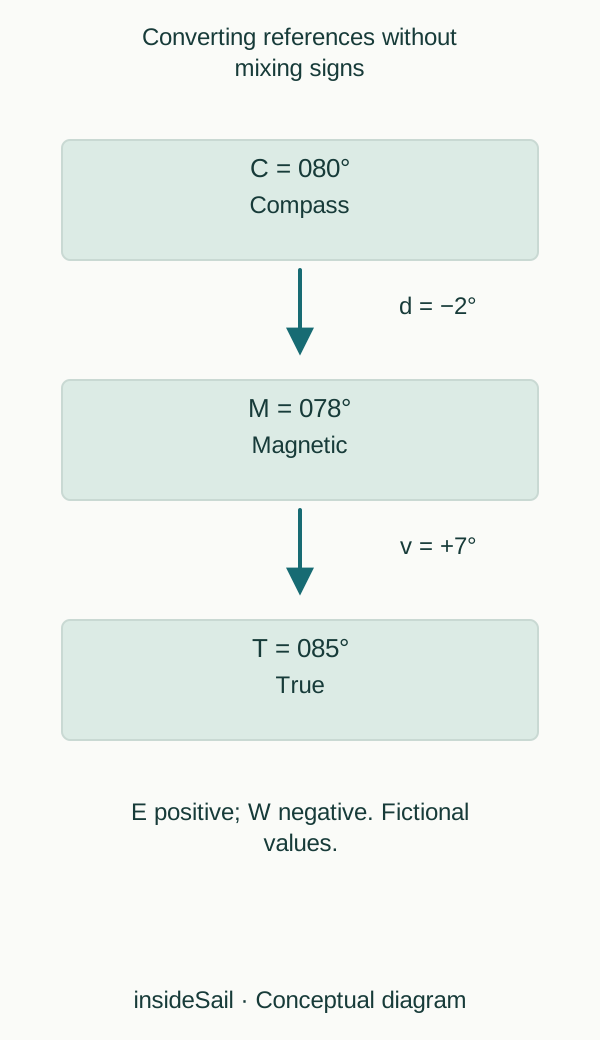
Teaching schematic not to scale; without local data or operational approval.
insideSailOriginal insideSail artwork — all rights reservedEnlarge the diagram
Building the chain
Let C be the compass value, M the magnetic value and T the true value. Deviation d and variation v are positive east and negative west.
Under this convention, M = C + d and T = M + v. Reversing the chain subtracts the same components.
The relationship must be applied to compatible quantities: correcting a compass heading does not turn it into course over the ground.
The relationship in numbers
T = C + d + v (modulo 360°)
All angular terms in degrees; E positive, W negative.
A circle does not continue beyond 360°. A total of 363° is represented as 003°; −4° becomes 356°.
This is circular arithmetic. Prematurely rounding every component can change the result.
Written precision should remain proportionate to the source information: extra decimal places produced by calculation do not improve the underlying data.
A source may use different abbreviations or present a combined compass error. Before transferring a formula, identify what each symbol means and its sign convention.
These calculations are angular theory without an actual route, position or deviation table. Navigation application needs information valid for the context and an understanding of its use, not merely arithmetic that balances.
Compare two people measuring one line from different zero directions. If one reference is rotated 7° east, measuring from it can give a value 7° smaller than measuring from true north.
Conversion brings both into the same reference. This geometrical reasoning checks calculation direction without relying on a memorised “add east” phrase.
Each value still needs its symbol: 085° should state whether it is T, M or C.
A reciprocal direction points oppositely along the same line. Adding 180° and normalising gives the reciprocal: 085° T becomes 265° T, while 275° T becomes 095° T.
The reference is retained. “Reciprocal” differs from “convert to magnetic”: the former reverses direction, the latter changes measurement zero.
Distinguishing them avoids misorienting an observation line by mixing two operations.
- Identify starting and finishing references.
- Write the sign convention beside the formula.
- A magnetic conversion does not compensate for current or leeway.
Sources and references
- Geomagnetism frequently asked questions ↗
NOAA National Centers for Environmental Information · Compass direction; declination sign; converting magnetic to true direction.
No historic WMM edition, regional declination or numerical forecast imported.
Checked on - Boat Crew Handbook — Navigation and Piloting, BCH16114.3 ↗
United States Coast Guard · Chapter 3 D.6–D.8 pp.3-56–3-60; D.12 pp.3-69–3-73.
Variation/deviation/course vocabulary only; no compass-adjustment procedure.
Checked on
Keep discovering
The next piece of the puzzle
Discuss this concept
Loading the conversation…