By insideSail
Automated technical check · version 2 ·
Variation and deviation: two different causes
Distinguish Earth’s magnetic field from local vessel effects.
In this guide
A magnetic compass responds to the magnetic field where it is located. It does not simply point towards a distant point called the magnetic pole.
Magnetic variation, also called declination, is the angle between true north and the direction of local magnetic north. It depends on position and changes with time.
Variation information therefore needs a location and epoch as well as a number of degrees.
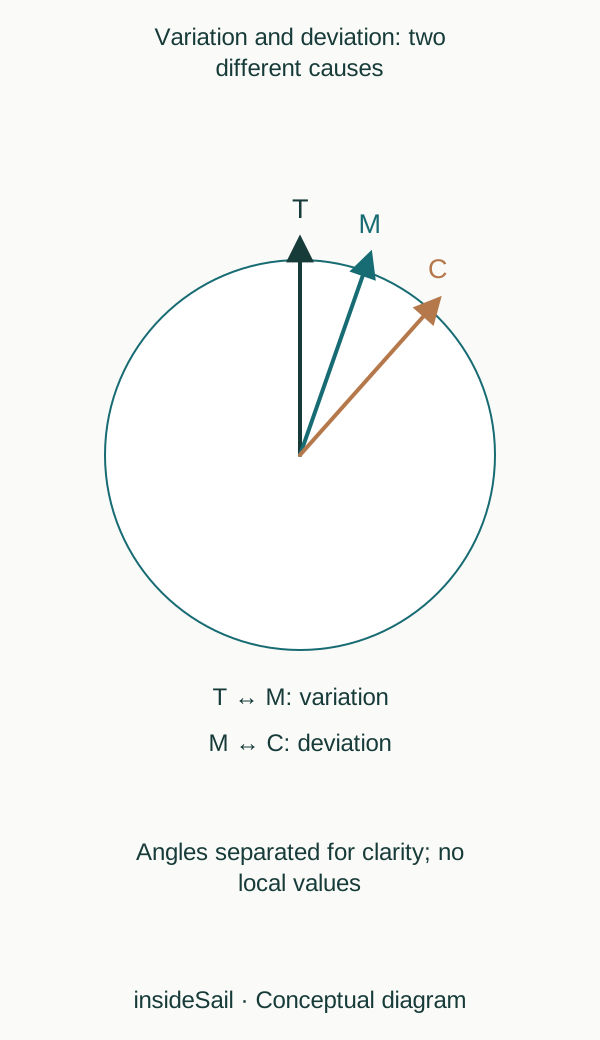
Teaching schematic not to scale; without local data or operational approval.
insideSailOriginal insideSail artwork — all rights reservedEnlarge the diagram
The boat adds another influence
Compass deviation is the difference between magnetic north and the reference indicated by the installed compass. Magnetised materials and local fields can influence that indication.
The effect may vary with vessel orientation and configuration. A deviation table belongs to a compass and the circumstances in which it was determined: it is not a universal manufacturer property or a fixed value for every example of a boat model.
In English marine terminology, “variation” describes the Earth-related relationship, while “deviation” describes the local influence on the compass. “Compass error” may refer to the combined effect.
Confusing that total with either component can count a correction twice. The diagram deliberately separates three references without representing actual angles for any harbour or vessel.
Our calculations use an explicit convention: east is positive and west negative. A sign convention represents relationships; it does not replace their physical meaning.
“7° E” becomes +7° in that system, while “2° W” becomes −2°. The next lesson keeps these components separate and identifies whether the starting angle is true, magnetic or compass.
Variation can be represented by equal-value lines on a magnetic map. It need not be constant across a region, and temporal change need not be uniform.
A chart note may state a value and annual change for an epoch. Reading it requires separating initial value, change direction and elapsed time.
This lesson uses no current regional value and does not indefinitely extrapolate an old rate.
Deviation can change with heading because the relationship between the boat’s local fields and Earth’s field changes as the boat rotates. A compass is not merely a drawn planar arrow: it is a device installed in a physical environment.
Similar boats can have different equipment positions and influences. This explains why a table belongs to an installation and why a value copied from another vessel does not automatically retain its meaning.
- Variation: true-to-magnetic relationship.
- Deviation: local influence on the compass.
- Location, date, compass and configuration provide context.
Concepts in this lesson
Compass deviation
Difference between magnetic reference and compass indication under local influences.
Magnetic variation
Angle between true north and local magnetic north; depends on location and epoch.
Sources and references
- Geomagnetism frequently asked questions ↗
NOAA National Centers for Environmental Information · Compass direction; declination sign; converting magnetic to true direction.
No historic WMM edition, regional declination or numerical forecast imported.
Checked on - Boat Crew Handbook — Navigation and Piloting, BCH16114.3 ↗
United States Coast Guard · Chapter 3 D.6–D.8 pp.3-56–3-60; D.12 pp.3-69–3-73.
Variation/deviation/course vocabulary only; no compass-adjustment procedure.
Checked on
Keep discovering
The next piece of the puzzle
Discuss this concept
Loading the conversation…