By insideSail
AI-assisted editorial review · version 3 ·
Distress signals: recognise the message without rehearsing an emergency
Rule 37 and Annex IV identify distress and need of assistance.
In this guide
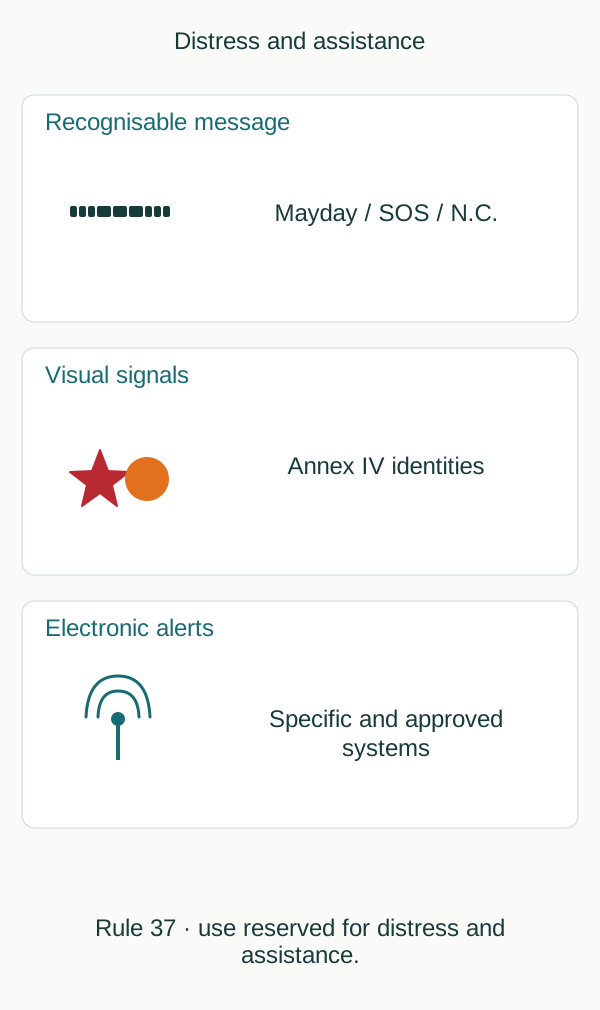
Original recognition schematic, not to scale; not navigation instruction.
insideSailOriginal insideSail artwork — all rights reservedEnlarge the diagram
A distress signal communicates distress with need of assistance. It differs from a light making a vessel visible or a manoeuvring warning.
Rule 37 refers to the signals in Annex IV, giving them normative identity without teaching radio, pyrotechnic or beacon operation. The drawing presents message families rather than buttons, operating frequencies, firing methods or activation sequences.
Recognition education and operational preparation remain distinct. A person can learn why a signal has a particular meaning without that lesson establishing competence to produce or respond to it in an actual emergency.
Annex IV: signals together or separately
Annex IV paragraph 1 identifies signals that indicate distress and need of assistance when used together or separately. They include continuous sounding of a fog-signalling appliance, Morse SOS, radiotelephony Mayday, International Code signal N.C., and a square flag with a ball above or below.
Specified visual and pyrotechnic signals, electronic alerts and approved radiocommunication signals are also included. These are identities with their own conditions; the list need not become an execution exercise for its meaning to be understood.
Recognition does not select equipment or an appropriate operational method.
Colour and form matter: red stars, a red flare and orange smoke do not describe any light or smoke. The reference to slowly and repeatedly raising and lowering outstretched arms identifies a specific signal, not a conclusion that every waving person is in distress.
An identity should retain its elements and reference without replacing technical colours with site colours. The illustration uses text where a simplified drawing might resemble hazardous operating instruction.
A static symbol cannot reproduce timing, actual visibility or all conditions of recognition.
Message, carrier and equipment are different layers
Mayday identifies a radiotelephony message; DSC a digital selective-calling alerting means; a beacon transmits through its own system. These are not different names for one button.
Annex IV includes ship-to-shore alerts from mobile satellite ship earth stations and signals from beacons and approved systems. Consolidated editions reflect amendments; an old table can contain outdated system or frequency references.
This lesson avoids configuration instruction and retains source and version for future communications-specific review. Equipment carriage, registration and operation belong to additional applicable documentation and training.
Reserved use and prohibited confusion
Paragraph 2 prohibits using these signals except to indicate distress and need of assistance, together with signals liable to be confused with them. We therefore provide neither an interaction sending an actual alert nor directions to test distress signals at sea.
An on-screen animation should not resemble an operational tool. Educational identification is sufficient to distinguish this chapter from Rule 34 manoeuvring signals and Rule 36 attention signals.
The meaning is reserved; it is not decoration or a convenient way of requesting ordinary service.
Paragraph 3 additionally refers to the International Code of Signals and IAMSAR Volume III, drawing attention to air-identification material and dye markers. That reference does not make generic orange canvas equivalent to an electronic alert, nor does a photograph establish what assistance is required.
Observed state, message and response have different scopes. Recognition teaching retains the reference without copying protected tables or inventing a rescue sequence.
Separate instruction would be needed for actual equipment handling, communications and response, together with the applicable professional review.
- Rule 37 points to Annex IV identities.
- Recognition is not equipment operation or rescue response.
- Use and confusing signals are specifically constrained by Annex IV(2).
The concept in a few words
Distress signal
An Annex IV signal communicating distress and need of assistance; not a generic equivalent of Rule 36 attention signals.
Educational definition; consult the scope of the identified rule.
Sources and references
- COLREGs Annex IV — Distress signals ↗
Instituto Hidrográfico / International Maritime Organization · Annex IV; printed p.79, PDF p.85; International cross-check USCG.
Annex IV, IH printed p.79 (PDF p.85); cross-check International annex in USCG handbook. Installation/approval is not taught.
Checked on - RIEAM / COLREGs — Rule 36: Signals to attract attention ↗
Instituto Hidrográfico / International Maritime Organization · Rule 37, normative Portuguese printed p.59 (PDF p.65); International English cross-check in USCG handbook. Rule 36, normative Portuguese printed p.59 (PDF p.65); International English cross-check in USCG handbook.
Rule 37; IH normative Portuguese printed p.59, PDF p.65; English International column cross-check. Individual provision commencement not established: valid_from remains null. Rule 36; IH normative Portuguese printed p.59, PDF p.65; English International column cross-check. Individual provision commencement not established: valid_from remains null.
Checked on - Navigation Rules and Regulations Handbook — corrected August 2024 ↗
United States Coast Guard Navigation Center · International column only, Rules 1–38 and Annexes I–IV. The adjacent U.S. Inland column is excluded.
Official PDF directly consulted. International/Inland differences are not European rules. Filename says 08-12-2024; landing page says corrected 8 August 2024: no unsupported exact correction day inferred.
Checked on
Regulatory references
- Annex IV — Distress signals ↗
COLREG 1972 as amended; consolidated documents consulted 11 October 2026 · International Maritime Organization · International; flag authority approval
Verified on - Regra 37 / Rule 37 — Sinais de perigo / Distress signals ↗
COLREG 1972 as amended; IH 9th edition September 2025 / International cross-check August 2024 · International Maritime Organization · International convention; national/local implementation must be checked
Verified on - Regra 36 / Rule 36 — Sinais para chamar a atenção / Signals to attract attention ↗
COLREG 1972 as amended; IH 9th edition September 2025 / International cross-check August 2024 · International Maritime Organization · International convention; national/local implementation must be checked
Verified on
Keep discovering
The next piece of the puzzle
Discuss this concept
Loading the conversation…