By insideSail
AI-assisted editorial review · version 3 ·
Sound and light signals: counts need context
Rules 32–36 separate definition, equipment, manoeuvring and restricted visibility.
In this guide
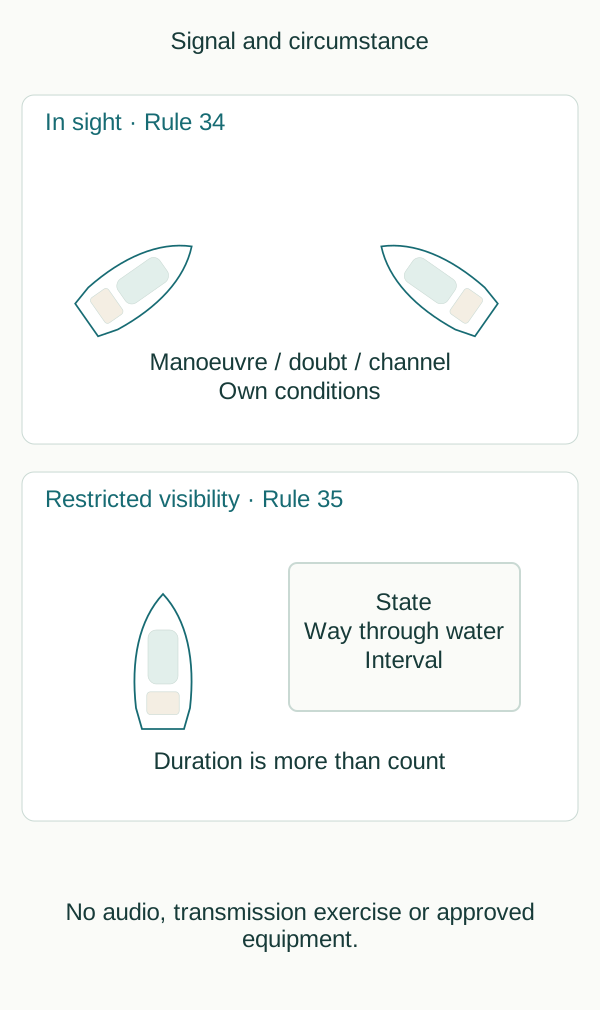
Original recognition schematic, not to scale; not navigation instruction.
insideSailOriginal insideSail artwork — all rights reservedEnlarge the diagram
Counting blasts is insufficient for interpretation. Rule 34 concerns manoeuvring and warning under specified conditions, Rule 35 restricted visibility, and Rule 36 attention without confusion.
Before counting, identify situation, vessel state, duration and sequence. The figure keeps contexts separate rather than providing audio for use at sea.
Equal numbers of sounds can differ through duration and scope. A summary omitting those conditions teaches incomplete recognition.
This chapter explains signals and preserves their regulatory identity without acting as an operational substitute for the complete provisions.
Rules 32 and 33: duration and equipment
Rule 32 defines a short blast as about one second and a prolonged blast as four to six seconds. A whistle is equipment conforming to Annex III rather than any high-pitched noise.
Rule 33 requires a whistle from 12 metres, adds a bell from 20 metres, and a gong of distinct sound from 100 metres. Below 12 metres, another efficient signalling means is required if prescribed appliances are not carried.
The older “12 metres: bell” summary found on some pages should not be adopted as current normative wording; device conformity and use are separate questions.
Rule 34: manoeuvre, doubt and channel
Under Rule 34(a), a power-driven vessel underway, in sight and manoeuvring as authorised or required communicates one short for alteration to starboard, two for port, and three for operating astern propulsion. The third does not assert that the hull is already moving astern.
Paragraph (b) permits a light supplement under its stated conditions without removing the sound signal. Paragraph (d) requires at least five short rapid blasts for misunderstood intentions or doubt about sufficient action under its specified approach and visual conditions.
Counting alone therefore loses important information about both scope and action.
Paragraph (c) gives intention and agreement signals for channel overtaking under 9(e): two prolonged followed by one short for overtaking on the other vessel’s starboard, two prolonged followed by two short on its port; agreement is prolonged, short, prolonged, short. These are not general authorisations for any overtaking and do not remove Rule 13.
Paragraph (e) concerns a bend or obstruction-hiding area: one prolonged, answered by one prolonged under its conditions. The side references the overtaken vessel, not the page edge or observer’s shore viewpoint.
Rule 35: state and relation to water
In or near restricted visibility by day or night, Rule 35 distinguishes power-driven making way through water, one prolonged, from underway but stopped and making no way, two prolonged separated by about two seconds. Signal intervals do not exceed two minutes.
Paragraph (c) groups other states with one prolonged and two short, while (d) addresses fishing at anchor and restricted-ability work at anchor. Manned tows, composite units, anchoring and grounding have their own provisions.
The list should not be reduced to motor versus sail, nor should speed over ground replace the rule’s through-water distinction.
Rule 36 permits attracting attention without confusion with prescribed signals or embarrassing other vessels; it includes avoiding confusion with navigation aids and high-intensity intermittent or revolving lights. Attention is distinct from declaring distress under Rule 37.
Annex III addresses performance and appliance approval beyond what a drawing can show. Signal recognition and appliance approval are different matters; drawings neither simulate certified equipment nor demonstrate installation compliance.
National implementation and local context must accompany any later practical teaching.
Concepts in this lesson
Prolonged blast
A four-to-six-second blast under Rule 32(c), distinct from the interval between signals.
Educational definition; consult the scope of the identified rule.
Short blast
A blast of about one second under Rule 32(b); sequence interpretation depends on the applicable rule and conditions.
Educational definition; consult the scope of the identified rule.
Sources and references
- RIEAM / COLREGs — Rule 9: Narrow channels ↗
Instituto Hidrográfico / International Maritime Organization · Rule 9, normative Portuguese printed p.11 (PDF p.17); International English cross-check in USCG handbook.
Rule 9; IH normative Portuguese printed p.11, PDF p.17; English International column cross-check. Individual provision commencement not established: valid_from remains null.
Checked on - RIEAM / COLREGs — Rule 13: Overtaking ↗
Instituto Hidrográfico / International Maritime Organization · Rule 13, normative Portuguese printed p.19 (PDF p.25); International English cross-check in USCG handbook.
Rule 13; IH normative Portuguese printed p.19, PDF p.25; English International column cross-check. Individual provision commencement not established: valid_from remains null.
Checked on - RIEAM / COLREGs — Rule 36: Signals to attract attention ↗
Instituto Hidrográfico / International Maritime Organization · Rule 36, normative Portuguese printed p.59 (PDF p.65); International English cross-check in USCG handbook.
Rule 36; IH normative Portuguese printed p.59, PDF p.65; English International column cross-check. Individual provision commencement not established: valid_from remains null.
Checked on - Navigation Rules and Regulations Handbook — corrected August 2024 ↗
United States Coast Guard Navigation Center · International column only, Rules 1–38 and Annexes I–IV. The adjacent U.S. Inland column is excluded.
Official PDF directly consulted. International/Inland differences are not European rules. Filename says 08-12-2024; landing page says corrected 8 August 2024: no unsupported exact correction day inferred.
Checked on - MGN 369 (M+F) Amendment 1 ↗
Maritime and Coastguard Agency · Sections 4–8 and 11: Rules 4–10/19, lights, sound signals and terminology in restricted visibility.
UK guidance supporting declared interpretation; no universal CPA limit, manoeuvre recipe or local pilotage.
Checked on - RIEAM / COLREGs — Rule 35: Sound signals in restricted visibility ↗
Instituto Hidrográfico / International Maritime Organization · Rule 35, normative Portuguese printed p.55 (PDF p.61); International English cross-check in USCG handbook.
Rule 35; IH normative Portuguese printed p.55, PDF p.61; English International column cross-check. Individual provision commencement not established: valid_from remains null. Review discrepancy: IH English appendix printed pp.89–90 omits current paragraph (j), the under-12m alternative, and labels pilot clause (j). USCG International Rule35(j)/(k) supplies the current distinction; Editorial source concordance checked 2026-10-11: IH Portuguese normative Rule35(j)/(k), PDF61, and USCG INTERNATIONAL Rule35(j)/(k), PDF113, agree. The IH English appendix omission/misnumbering remains recorded; no professional approval is claimed.
Checked on - RIEAM / COLREGs — Rule 32: Definitions of sound signals ↗
Instituto Hidrográfico / International Maritime Organization · Rule 32, normative Portuguese printed p.53 (PDF p.59); International English cross-check in USCG handbook. Rule 33, normative Portuguese printed p.53 (PDF p.59); International English cross-check in USCG handbook. Rule 34, normative Portuguese printed p.53 (PDF p.59); International English cross-check in USCG handbook.
Rule 32; IH normative Portuguese printed p.53, PDF p.59; English International column cross-check. Individual provision commencement not established: valid_from remains null. Rule 33; IH normative Portuguese printed p.53, PDF p.59; English International column cross-check. Individual provision commencement not established: valid_from remains null. Rule 34; IH normative Portuguese printed p.53, PDF p.59; English International column cross-check. Individual provision commencement not established: valid_from remains null.
Checked on - COLREGs Annex III — Technical details of sound signal appliances ↗
Instituto Hidrográfico / International Maritime Organization · Annex III; printed p.77, PDF p.83; International cross-check USCG.
Annex III, IH printed p.77 (PDF p.83); cross-check International annex in USCG handbook. Installation/approval is not taught.
Checked on
Regulatory references
- Regra 33 / Rule 33 — Equipamento de sinais sonoros / Equipment for sound signals ↗
COLREG 1972 as amended; IH 9th edition September 2025 / International cross-check August 2024 · International Maritime Organization · International convention; national/local implementation must be checked
Verified on - Regra 36 / Rule 36 — Sinais para chamar a atenção / Signals to attract attention ↗
COLREG 1972 as amended; IH 9th edition September 2025 / International cross-check August 2024 · International Maritime Organization · International convention; national/local implementation must be checked
Verified on - Regra 34 / Rule 34 — Sinais de manobra e de advertência / Manoeuvring and warning signals ↗
COLREG 1972 as amended; IH 9th edition September 2025 / International cross-check August 2024 · International Maritime Organization · International convention; national/local implementation must be checked
Verified on - Regra 13 / Rule 13 — Ultrapassagem / Overtaking ↗
COLREG 1972 as amended; IH 9th edition September 2025 / International cross-check August 2024 · International Maritime Organization · International convention; national/local implementation must be checked
Verified on - Regra 32 / Rule 32 — Definições de sinais sonoros / Definitions of sound signals ↗
COLREG 1972 as amended; IH 9th edition September 2025 / International cross-check August 2024 · International Maritime Organization · International convention; national/local implementation must be checked
Verified on - Regra 35 / Rule 35 — Sinais sonoros em condições de visibilidade reduzida / Sound signals in restricted visibility ↗
COLREG Rule35 — IH2025 Portuguese / USCG International; source review2026-10-11 · International Maritime Organization · International convention; national/local implementation must be checked
Verified on - Regra 9 / Rule 9 — Canais estreitos / Narrow channels ↗
COLREG 1972 as amended; IH 9th edition September 2025 / International cross-check August 2024 · International Maritime Organization · International convention; national/local implementation must be checked
Verified on - Annex III — Technical details of sound signal appliances ↗
COLREG 1972 as amended; consolidated documents consulted 11 October 2026 · International Maritime Organization · International; flag authority approval
Verified on
Keep discovering
The next piece of the puzzle
Discuss this concept
Loading the conversation…