By insideSail
AI-assisted editorial review · version 3 ·
Restricted visibility: read Rule 19 without importing slogans
No visual contact, radar-alone detection and heard signals have distinct conditions.
In this guide
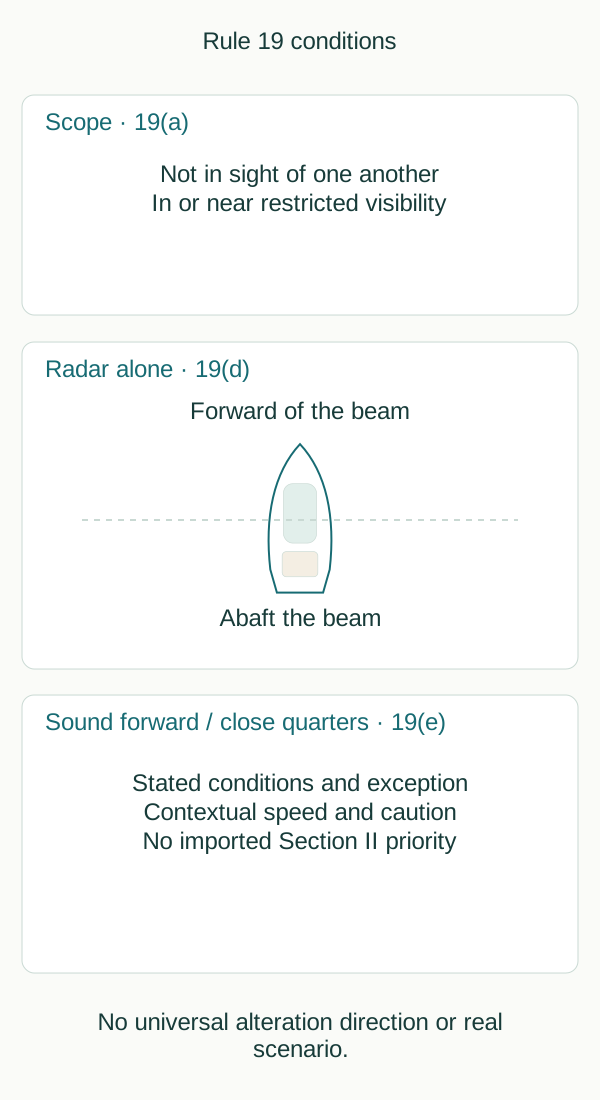
Original recognition schematic, not to scale; not navigation instruction.
insideSailOriginal insideSail artwork — all rights reservedEnlarge the diagram
Fog, mist, snow, heavy rain and similar causes can restrict visibility under Rule 3(l). Rule 19(a) concerns vessels not in sight while navigating in or near such an area.
It requires neither every target to be invisible in all directions nor merely nighttime. The framework includes visual condition between the vessels and visibility context.
MCA MGN 369 Amendment 1 distinguishes this scope from Section II without creating a universal speed or CPA figure. A radar target’s plotted geometry does not independently turn the encounter into Rule 15 crossing.
The Section I foundation remains
Rule 19(b) requires safe speed adapted to circumstances and conditions, with power-driven vessels’ engines ready for immediate manoeuvre. Paragraph (c) preserves due regard to those conditions when complying with Section I.
Lookout, available means, radar limitations and systematic appraisal continue under Rules 5–7. Application does not consist of replacing everything with “always turn starboard”.
Rule 19 does not assign Section II stand-on and give-way roles: both vessels have duties within its own framework. Readiness, speed and observation therefore belong to one continuing appraisal.
Rule 19(d): a vessel detected by radar alone
Paragraph (d) requires determining whether a close-quarters situation is developing and/or collision risk exists. If so, avoiding action is required in ample time.
Where that action is a course alteration, two cases are to be avoided so far as possible: port alteration for a vessel forward of the beam, except a vessel being overtaken; and alteration towards a vessel abeam or abaft. The overtaking exception belongs to the first case.
Neither so far as possible nor the two separate conditions should disappear into one universal arrow or automatic helm response.
Beam, forward and abaft reference our vessel in that wording. A target left of a north-up screen is not necessarily on our port side.
The figure identifies bow and relative references without alteration angles or tracks. Radar alone describes the means by which another vessel’s presence was detected; it does not establish all its characteristics.
Limitations, scanty information and other traffic remain in appraisal. The relationship between screen orientation and vessel-relative bearings is a technical learning topic, rather than an excuse to apply a diagram without confirming its reference.
Rule 19(e): sound forward or unavoidable close quarters
Except where no collision risk has been determined, paragraph (e) concerns hearing another vessel’s fog signal apparently forward of the beam, or being unable to avoid close quarters with another forward of the beam. It requires reducing to the minimum speed at which course can be kept, taking all way off if necessary, and in any event navigating with extreme caution until danger is over.
This is not a recommended knot value. Neither does hearing any sound anywhere justify keeping speed unchanged because the vessel is invisible.
Lights and signals retain their own conditions
Rule 20 addresses lights in restricted visibility also by day, while Rule 35 concerns sound signals in or near the area, day or night. Lack of visual contact does not dispense with those signals.
Underway and making way through the water remain important distinctions between sound provisions. MCA references are identified as UK guidance; international text and national implementation remain linked to their sources.
Limited visibility changes the conditions that must be recognised; it does not turn partial information into an automatic priority. The account supplies no radar settings, CPA limits or real-location navigation advice.
The concept in a few words
Restricted visibility
Visibility restricted by Rule 3(l) causes such as fog, snow or heavy rain; Rule 19 additionally requires vessels not in sight in or near the area.
Educational definition; consult the scope of the identified rule.
Sources and references
- RIEAM / COLREGs — Rule 19: Conduct of vessels in restricted visibility ↗
Instituto Hidrográfico / International Maritime Organization · Rule 19, normative Portuguese printed p.26 (PDF p.32); International English cross-check in USCG handbook.
Rule 19; IH normative Portuguese printed p.26, PDF p.32; English International column cross-check. Individual provision commencement not established: valid_from remains null.
Checked on - RIEAM / COLREGs — Rule 20: Application of lights and shapes ↗
Instituto Hidrográfico / International Maritime Organization · Rule 20, normative Portuguese printed p.29 (PDF p.35); International English cross-check in USCG handbook.
Rule 20; IH normative Portuguese printed p.29, PDF p.35; English International column cross-check. Individual provision commencement not established: valid_from remains null.
Checked on - MGN 369 (M+F) Amendment 1 ↗
Maritime and Coastguard Agency · Sections 4–8 and 11: Rules 4–10/19, lights, sound signals and terminology in restricted visibility.
UK guidance supporting declared interpretation; no universal CPA limit, manoeuvre recipe or local pilotage.
Checked on - RIEAM / COLREGs — Rule 4: Application of Section I ↗
Instituto Hidrográfico / International Maritime Organization · Rule 4, normative Portuguese printed p.7 (PDF p.13); International English cross-check in USCG handbook. Rule 5, normative Portuguese printed p.7 (PDF p.13); International English cross-check in USCG handbook.
Rule 4; IH normative Portuguese printed p.7, PDF p.13; English International column cross-check. Individual provision commencement not established: valid_from remains null. Rule 5; IH normative Portuguese printed p.7, PDF p.13; English International column cross-check. Individual provision commencement not established: valid_from remains null.
Checked on - RIEAM / COLREGs — Rule 35: Sound signals in restricted visibility ↗
Instituto Hidrográfico / International Maritime Organization · Rule 35, normative Portuguese printed p.55 (PDF p.61); International English cross-check in USCG handbook.
Rule 35; IH normative Portuguese printed p.55, PDF p.61; English International column cross-check. Individual provision commencement not established: valid_from remains null. Review discrepancy: IH English appendix printed pp.89–90 omits current paragraph (j), the under-12m alternative, and labels pilot clause (j). USCG International Rule35(j)/(k) supplies the current distinction; Editorial source concordance checked 2026-10-11: IH Portuguese normative Rule35(j)/(k), PDF61, and USCG INTERNATIONAL Rule35(j)/(k), PDF113, agree. The IH English appendix omission/misnumbering remains recorded; no professional approval is claimed.
Checked on - RIEAM / COLREGs — Rule 2: Responsibility ↗
Instituto Hidrográfico / International Maritime Organization · Rule 3, normative Portuguese printed p.3 (PDF p.9); International English cross-check in USCG handbook.
Rule 3; IH normative Portuguese printed p.3, PDF p.9; English International column cross-check. Individual provision commencement not established: valid_from remains null.
Checked on - RIEAM / COLREGs — Rule 6: Safe speed ↗
Instituto Hidrográfico / International Maritime Organization · Rule 6, normative Portuguese printed p.8 (PDF p.14); International English cross-check in USCG handbook. Rule 7, normative Portuguese printed p.8 (PDF p.14); International English cross-check in USCG handbook.
Rule 6; IH normative Portuguese printed p.8, PDF p.14; English International column cross-check. Individual provision commencement not established: valid_from remains null. Rule 7; IH normative Portuguese printed p.8, PDF p.14; English International column cross-check. Individual provision commencement not established: valid_from remains null.
Checked on
Regulatory references
- Regra 3 / Rule 3 — Definições gerais / General definitions ↗
COLREG 1972 as amended; IH 9th edition September 2025 / International cross-check August 2024 · International Maritime Organization · International convention; national/local implementation must be checked
Verified on - Regra 4 / Rule 4 — Aplicação da Secção I / Application of Section I ↗
COLREG 1972 as amended; IH 9th edition September 2025 / International cross-check August 2024 · International Maritime Organization · International convention; national/local implementation must be checked
Verified on - Regra 19 / Rule 19 — Condução dos navios em condições de visibilidade reduzida / Conduct of vessels in restricted visibility ↗
COLREG 1972 as amended; IH 9th edition September 2025 / International cross-check August 2024 · International Maritime Organization · International convention; national/local implementation must be checked
Verified on - Regra 6 / Rule 6 — Velocidade de segurança / Safe speed ↗
COLREG 1972 as amended; IH 9th edition September 2025 / International cross-check August 2024 · International Maritime Organization · International convention; national/local implementation must be checked
Verified on - Regra 5 / Rule 5 — Vigilância / Look-out ↗
COLREG 1972 as amended; IH 9th edition September 2025 / International cross-check August 2024 · International Maritime Organization · International convention; national/local implementation must be checked
Verified on - Regra 20 / Rule 20 — Aplicação de luzes e balões / Application of lights and shapes ↗
COLREG 1972 as amended; IH 9th edition September 2025 / International cross-check August 2024 · International Maritime Organization · International convention; national/local implementation must be checked
Verified on - Regra 7 / Rule 7 — Risco de abalroamento / Risk of collision ↗
COLREG 1972 as amended; IH 9th edition September 2025 / International cross-check August 2024 · International Maritime Organization · International convention; national/local implementation must be checked
Verified on - Regra 35 / Rule 35 — Sinais sonoros em condições de visibilidade reduzida / Sound signals in restricted visibility ↗
COLREG Rule35 — IH2025 Portuguese / USCG International; source review2026-10-11 · International Maritime Organization · International convention; national/local implementation must be checked
Verified on
Keep discovering
The next piece of the puzzle
Discuss this concept
Loading the conversation…