By insideSail
AI-assisted editorial review · version 3 ·
In sight: an application condition, not a distance
Rule 11 and Rule 3(k) delimit Section II.
In this guide
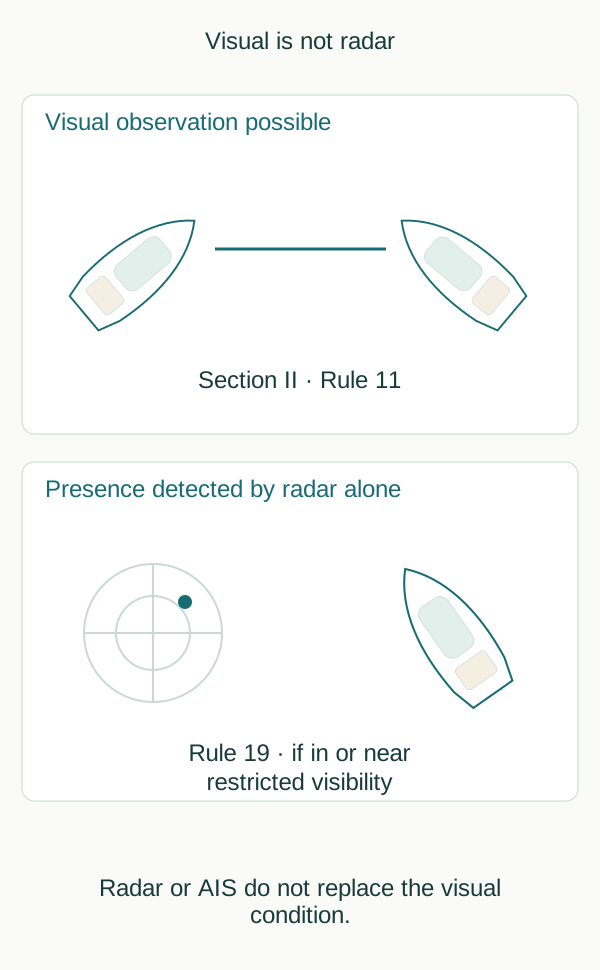
Original recognition schematic, not to scale; not navigation instruction.
insideSailOriginal insideSail artwork — all rights reservedEnlarge the diagram
Saying that another vessel was detected does not say how it was detected. Rule 3(k) considers vessels in sight when one can be observed visually from the other.
Rule 11 applies Rules 11–18 to that condition. An AIS position or radar echo alone does not constitute visual contact.
This small distinction changes which encounter rules are relevant and should be resolved before using a crossing, sailing or overtaking sketch. The condition belongs to the legal framework, rather than being an optional label added after a decision.
Detection, observation and interpretation differ
Detection identifies presence through a particular means. Observation adds what was actually seen or measured.
Interpretation relates that evidence to a classification. A display can supply range, velocity or a declared identity without showing the vessel visually.
A visible silhouette can establish presence without proving its activity. Rule 7 prohibits assumptions from scanty information, making visual contact and sufficient information related but distinct questions.
A useful account describes the means and evidence rather than promoting every electronic label into an established legal status.
Rule 11 sets no fixed distance making every vessel in sight. Scale, conditions and possibility of observation belong to the actual facts.
Night is not automatically restricted visibility: observable lights and good visibility can coexist. Conversely, heavy rain, snow or mist can reduce visibility by day.
Rule 3(l) identifies causes rather than a time of day. The drawing separates daylight, detection means and visual condition so that these dimensions are not confused.
A dark background in an illustration is not itself evidence that Rule 19 applies.
Section I remains active
Rules 4–10 remain applicable in any visibility. Being in sight does not suspend lookout, safe speed, risk appraisal or channel and traffic-separation obligations.
Rules 12–18 add provisions for particular vessels and encounters. Rule 13, for example, addresses overtaking with the overriding obligation it states.
Classifying propulsion first and then ignoring overtaking can produce an incorrect conclusion even when both boats are clearly visible. Sections work together; they are not independent menus from which a preferred rule can be selected.
When Rule 19 becomes relevant
Rule 19(a) concerns vessels not in sight of one another navigating in or near restricted visibility. Momentary absence of a photograph on our map does not establish all those conditions.
Where they apply, Section II stand-on and give-way roles cannot simply be carried into Rule 19. MCA guidance explains that distinction in MGN 369 Amendment 1.
The restricted-visibility lesson develops radar-alone detection, heard signals and each paragraph’s conditions, rather than turning the change of section into one universal direction of alteration.
A useful encounter description separates time, visibility, observation means, vessel states and risk development. If those facts change, appraisal must follow them; a label is not preserved just because it was chosen first.
This discipline makes educational explanation clearer and reveals what remains unknown. It does not replace lookout training or establish correct application from one colour or silhouette.
Reading scope accurately is the foundation on which the more specific rules are then considered, together with the continuing obligations of Section I.
The concept in a few words
In sight of one another
Rule 3(k) condition: one vessel can be observed visually from the other. Radar or AIS detection alone is insufficient.
Educational definition; consult the scope of the identified rule.
Sources and references
- RIEAM / COLREGs — Rule 11: Application of Section II ↗
Instituto Hidrográfico / International Maritime Organization · Rule 11, normative Portuguese printed p.17 (PDF p.23); International English cross-check in USCG handbook.
Rule 11; IH normative Portuguese printed p.17, PDF p.23; English International column cross-check. Individual provision commencement not established: valid_from remains null.
Checked on - RIEAM / COLREGs — Rule 19: Conduct of vessels in restricted visibility ↗
Instituto Hidrográfico / International Maritime Organization · Rule 19, normative Portuguese printed p.26 (PDF p.32); International English cross-check in USCG handbook.
Rule 19; IH normative Portuguese printed p.26, PDF p.32; English International column cross-check. Individual provision commencement not established: valid_from remains null.
Checked on - MGN 369 (M+F) Amendment 1 ↗
Maritime and Coastguard Agency · Sections 4–8 and 11: Rules 4–10/19, lights, sound signals and terminology in restricted visibility.
UK guidance supporting declared interpretation; no universal CPA limit, manoeuvre recipe or local pilotage.
Checked on - RIEAM / COLREGs — Rule 4: Application of Section I ↗
Instituto Hidrográfico / International Maritime Organization · Rule 4, normative Portuguese printed p.7 (PDF p.13); International English cross-check in USCG handbook.
Rule 4; IH normative Portuguese printed p.7, PDF p.13; English International column cross-check. Individual provision commencement not established: valid_from remains null.
Checked on - RIEAM / COLREGs — Rule 2: Responsibility ↗
Instituto Hidrográfico / International Maritime Organization · Rule 3, normative Portuguese printed p.3 (PDF p.9); International English cross-check in USCG handbook.
Rule 3; IH normative Portuguese printed p.3, PDF p.9; English International column cross-check. Individual provision commencement not established: valid_from remains null.
Checked on - RIEAM / COLREGs — Rule 6: Safe speed ↗
Instituto Hidrográfico / International Maritime Organization · Rule 7, normative Portuguese printed p.8 (PDF p.14); International English cross-check in USCG handbook.
Rule 7; IH normative Portuguese printed p.8, PDF p.14; English International column cross-check. Individual provision commencement not established: valid_from remains null.
Checked on
Regulatory references
- Regra 3 / Rule 3 — Definições gerais / General definitions ↗
COLREG 1972 as amended; IH 9th edition September 2025 / International cross-check August 2024 · International Maritime Organization · International convention; national/local implementation must be checked
Verified on - Regra 19 / Rule 19 — Condução dos navios em condições de visibilidade reduzida / Conduct of vessels in restricted visibility ↗
COLREG 1972 as amended; IH 9th edition September 2025 / International cross-check August 2024 · International Maritime Organization · International convention; national/local implementation must be checked
Verified on - Regra 4 / Rule 4 — Aplicação da Secção I / Application of Section I ↗
COLREG 1972 as amended; IH 9th edition September 2025 / International cross-check August 2024 · International Maritime Organization · International convention; national/local implementation must be checked
Verified on - Regra 11 / Rule 11 — Aplicação da Secção II / Application of Section II ↗
COLREG 1972 as amended; IH 9th edition September 2025 / International cross-check August 2024 · International Maritime Organization · International convention; national/local implementation must be checked
Verified on - Regra 7 / Rule 7 — Risco de abalroamento / Risk of collision ↗
COLREG 1972 as amended; IH 9th edition September 2025 / International cross-check August 2024 · International Maritime Organization · International convention; national/local implementation must be checked
Verified on
Keep discovering
The next piece of the puzzle
Discuss this concept
Loading the conversation…