By insideSail
AI-assisted editorial review · version 3 ·
Overtaking, head-on and crossing: identify before deciding
Geometry, propulsion and scope delimit Rules 13–15.
In this guide
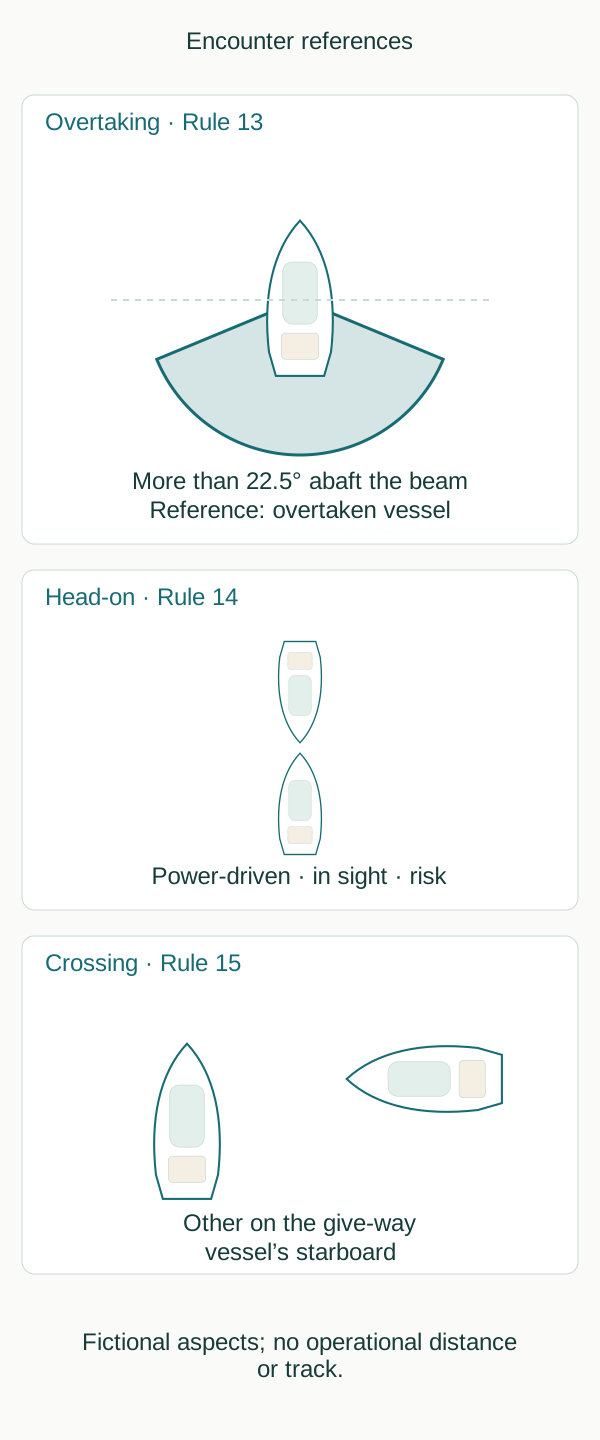
Original recognition schematic, not to scale; not navigation instruction.
insideSailOriginal insideSail artwork — all rights reservedEnlarge the diagram
Two bows on a sheet can suggest an encounter while leaving legal conditions unresolved. Rules 13–15 belong to Section II: vessels are in sight of one another.
Rule 13 concerns any vessel overtaking another; Rules 14 and 15 address two power-driven vessels with collision risk. Head-on or crossing must not automatically be extended to two sailing vessels or radar-only detection in fog.
The illustration identifies static relationships rather than a manoeuvring sequence. Its simplified hulls describe aspect and heading, not actual velocities, distances or navigable space.
Rule 13: the overtaker retains the duty
Rule 13(a) requires any overtaking vessel to keep out of the way, notwithstanding Part B Sections I and II. It prevents first choosing a more convenient rule based solely on propulsion type.
Overtaking comes from more than 22.5 degrees abaft the overtaken vessel’s beam, corresponding at night to seeing only its sternlight, not its sidelights. The angle references the overtaken vessel rather than our own bow or a fixed compass heading.
The sector illustration therefore places that vessel at the centre and identifies its beam and stern.
When in doubt about overtaking, Rule 13(c) requires assuming that it is the case. Subsequent bearing change does not turn the overtaker into a crossing vessel or remove the duty until finally past and clear under paragraph (d).
This continuity matters: the encounter is not restarted with every photograph. Special channel passing agreement under Rule 9(e) likewise does not remove the overtaker’s obligation.
Initial classification, development and conclusion must be read together rather than using a later aspect to escape an earlier duty.
Rule 14: two power-driven vessels
The head-on situation involves reciprocal or nearly reciprocal courses and collision risk. Rule 14(a) requires both vessels to alter course to starboard, passing port to port.
Paragraph (b) describes aspect: the other ahead or nearly ahead, masthead lights aligned or nearly aligned and/or both sidelights by night, with corresponding daytime aspect. Paragraph (c) addresses doubt.
It is not a universal rule for any object seen ahead; its specified vessels and conditions remain essential. One visible white light alone may not establish the complete classification.
Rule 15: the other on starboard in a crossing
When two power-driven vessels cross with collision risk, the one with the other on its starboard side must keep out of the way and, if circumstances admit, avoid crossing ahead. Rule 16 develops the give-way vessel’s action and Rule 17 the other vessel’s action.
This does not assign priority to whichever boat lies on the right of a drawing viewed from shore. Starboard belongs to the observing vessel.
Rotating a page does not change its side, although a changing actual situation may change the relevant facts.
These rules preserve lookout, safe speed and effectiveness checks, together with relevant channel, scheme and responsibility duties. A useful figure states references and assumed facts; a misleading one suggests that every approach fits three recipes.
When studying a case, retain the exact rule rather than only an arrow. Lights can help recognise aspects, but limited observation, absent equipment or special arrangements require care in inference.
Its diagrams classify educational examples rather than supply navigational instructions; the relevant conditions remain part of every rule.
The concept in a few words
Rule 13 overtaking
Coming up from more than 22.5° abaft the overtaken vessel’s beam within Section II visual scope; the overtaker keeps clear until finally past and clear.
Educational definition; consult the scope of the identified rule.
Sources and references
- RIEAM / COLREGs — Rule 9: Narrow channels ↗
Instituto Hidrográfico / International Maritime Organization · Rule 9, normative Portuguese printed p.11 (PDF p.17); International English cross-check in USCG handbook.
Rule 9; IH normative Portuguese printed p.11, PDF p.17; English International column cross-check. Individual provision commencement not established: valid_from remains null.
Checked on - RIEAM / COLREGs — Rule 11: Application of Section II ↗
Instituto Hidrográfico / International Maritime Organization · Rule 11, normative Portuguese printed p.17 (PDF p.23); International English cross-check in USCG handbook.
Rule 11; IH normative Portuguese printed p.17, PDF p.23; English International column cross-check. Individual provision commencement not established: valid_from remains null.
Checked on - RIEAM / COLREGs — Rule 16: Action by give-way vessel ↗
Instituto Hidrográfico / International Maritime Organization · Rule 16, normative Portuguese printed p.22 (PDF p.28); International English cross-check in USCG handbook. Rule 17, normative Portuguese printed p.22 (PDF p.28); International English cross-check in USCG handbook.
Rule 16; IH normative Portuguese printed p.22, PDF p.28; English International column cross-check. Individual provision commencement not established: valid_from remains null. Rule 17; IH normative Portuguese printed p.22, PDF p.28; English International column cross-check. Individual provision commencement not established: valid_from remains null.
Checked on - RIEAM / COLREGs — Rule 13: Overtaking ↗
Instituto Hidrográfico / International Maritime Organization · Rule 13, normative Portuguese printed p.19 (PDF p.25); International English cross-check in USCG handbook.
Rule 13; IH normative Portuguese printed p.19, PDF p.25; English International column cross-check. Individual provision commencement not established: valid_from remains null.
Checked on - RIEAM / COLREGs — Rule 14: Head-on situation ↗
Instituto Hidrográfico / International Maritime Organization · Rule 14, normative Portuguese printed p.20 (PDF p.26); International English cross-check in USCG handbook.
Rule 14; IH normative Portuguese printed p.20, PDF p.26; English International column cross-check. Individual provision commencement not established: valid_from remains null.
Checked on - RIEAM / COLREGs — Rule 15: Crossing situation ↗
Instituto Hidrográfico / International Maritime Organization · Rule 15, normative Portuguese printed p.21 (PDF p.27); International English cross-check in USCG handbook.
Rule 15; IH normative Portuguese printed p.21, PDF p.27; English International column cross-check. Individual provision commencement not established: valid_from remains null.
Checked on - RIEAM / COLREGs — Rule 8: Action to avoid collision ↗
Instituto Hidrográfico / International Maritime Organization · Rule 8, normative Portuguese printed p.9 (PDF p.15); International English cross-check in USCG handbook.
Rule 8; IH normative Portuguese printed p.9, PDF p.15; English International column cross-check. Individual provision commencement not established: valid_from remains null.
Checked on
Regulatory references
- Regra 14 / Rule 14 — Navios de roda a roda / Head-on situation ↗
COLREG 1972 as amended; IH 9th edition September 2025 / International cross-check August 2024 · International Maritime Organization · International convention; national/local implementation must be checked
Verified on - Regra 15 / Rule 15 — Navios em rumos cruzados / Crossing situation ↗
COLREG 1972 as amended; IH 9th edition September 2025 / International cross-check August 2024 · International Maritime Organization · International convention; national/local implementation must be checked
Verified on - Regra 8 / Rule 8 — Manobras para evitar abalroamentos / Action to avoid collision ↗
COLREG 1972 as amended; IH 9th edition September 2025 / International cross-check August 2024 · International Maritime Organization · International convention; national/local implementation must be checked
Verified on - Regra 13 / Rule 13 — Ultrapassagem / Overtaking ↗
COLREG 1972 as amended; IH 9th edition September 2025 / International cross-check August 2024 · International Maritime Organization · International convention; national/local implementation must be checked
Verified on - Regra 17 / Rule 17 — Manobra do navio que tem prioridade / Action by stand-on vessel ↗
COLREG 1972 as amended; IH 9th edition September 2025 / International cross-check August 2024 · International Maritime Organization · International convention; national/local implementation must be checked
Verified on - Regra 9 / Rule 9 — Canais estreitos / Narrow channels ↗
COLREG 1972 as amended; IH 9th edition September 2025 / International cross-check August 2024 · International Maritime Organization · International convention; national/local implementation must be checked
Verified on - Regra 11 / Rule 11 — Aplicação da Secção II / Application of Section II ↗
COLREG 1972 as amended; IH 9th edition September 2025 / International cross-check August 2024 · International Maritime Organization · International convention; national/local implementation must be checked
Verified on - Regra 16 / Rule 16 — Manobra do navio que deve afastar-se / Action by give-way vessel ↗
COLREG 1972 as amended; IH 9th edition September 2025 / International cross-check August 2024 · International Maritime Organization · International convention; national/local implementation must be checked
Verified on
Keep discovering
The next piece of the puzzle
Discuss this concept
Loading the conversation…