By insideSail
AI-assisted editorial review · version 3 ·
Responsibilities: keeping course also has limits
Rules 16–18 distinguish initial duty, permitted action and later required action.
In this guide
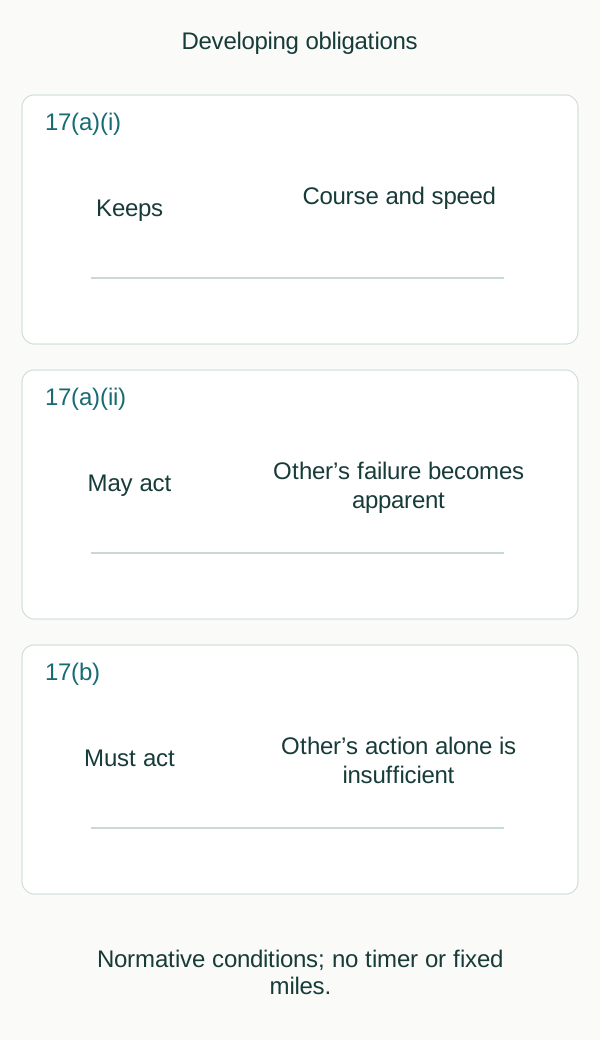
Original recognition schematic, not to scale; not navigation instruction.
insideSailOriginal insideSail artwork — all rights reservedEnlarge the diagram
Priority can sound as though one vessel is relieved of considering the encounter. Rule 17 is more precise.
It begins with one vessel required to keep out of the way and the other keeping course and speed, then describes when the latter may and must act. These stages have no universal fixed distances.
The drawing sequences legal conditions rather than a clock, mile scale or helm command. Observed development determines which conditions are present, so an initial role cannot be treated as a permanent right to proceed regardless of danger.
Rule 16: action by the give-way vessel
Rule 16 requires, so far as possible, early and substantial action to keep well clear. Rule 8 accompanies it: apparent action in time, without creating another close-quarters situation, and effectiveness checked until past and clear.
The role is not fulfilled merely by starting a minimal alteration. Nor does the duty depend on the other vessel calling, sounding doubt or showing inconvenience.
Continuing appraisal under Rules 5–7 supplies the context. The other vessel’s obligations coexist rather than reducing the give-way vessel’s own duty.
Rule 17: three conditions that should not be merged
Under Rule 17(a)(i), where one vessel must keep out of the way, the other keeps course and speed. Under (a)(ii), the latter may take action to avoid collision alone as soon as it becomes apparent that the obliged vessel is not acting appropriately.
Paragraph (b) differs: once so close that the give-way vessel’s action alone cannot avoid collision, the other must take action best aiding avoidance. May and shall refer to different conditions.
They must not be compressed into “never change course”, or into permission to abandon the initial duty whenever preferred.
Rule 17(c) also has limited scope: a power-driven vessel acting under (a)(ii) in a crossing with another power-driven vessel shall, if circumstances admit, not alter to port for a vessel on its own port side. This is not a port-turn prohibition for every situation, vessel type or stage.
Paragraph (d) preserves the give-way vessel’s obligation. Action by the other does not automatically transfer fault or provide exoneration established by this educational text.
Preserving subject, trigger and qualification is essential to explaining the paragraph accurately.
Rule 18: responsibilities and exceptions
Rule 18 begins with exceptions where Rules 9, 10 and 13 otherwise require. A category chart ignoring channels, schemes and overtaking loses that condition.
Paragraph (a) requires a power-driven vessel underway to keep out of the way of not-under-command, restricted-in-ability, fishing and sailing vessels. Paragraph (b) requires a sailing vessel underway to keep out of the way of the first three.
Fishing vessels underway under (c) keep clear, so far as possible, of the first two. These are Rule 3 statuses, not commercial appearances or a universal ranking of boat prestige.
Paragraph (d) concerns draught-constrained vessels exhibiting Rule 28 signals: others, except not-under-command or restricted-in-ability vessels, avoid impeding their safe passage when circumstances admit. The constrained vessel navigates with particular caution.
Being large or having more draught than our boat is insufficient. Seaplanes and WIG craft have specific paragraphs (e) and (f), including operating state.
Definitions and signals help identify conditions without eliminating the actual risk assessment or making every larger vessel automatically draught-constrained.
Concepts in this lesson
Give-way vessel
A vessel assigned the duty to keep out of the way by the applicable encounter rule; Rule 16 requires early substantial action so far as possible to keep well clear.
Educational definition; consult the scope of the identified rule.
Stand-on vessel
The vessel keeping course and speed under 17(a)(i), with permitted action under 17(a)(ii) and required action under 17(b) in their respective conditions; not absolute right of way.
Educational definition; consult the scope of the identified rule.
Sources and references
- RIEAM / COLREGs — Rule 9: Narrow channels ↗
Instituto Hidrográfico / International Maritime Organization · Rule 9, normative Portuguese printed p.11 (PDF p.17); International English cross-check in USCG handbook.
Rule 9; IH normative Portuguese printed p.11, PDF p.17; English International column cross-check. Individual provision commencement not established: valid_from remains null.
Checked on - RIEAM / COLREGs — Rule 28: Vessels constrained by their draught ↗
Instituto Hidrográfico / International Maritime Organization · Rule 28, normative Portuguese printed p.48 (PDF p.54); International English cross-check in USCG handbook.
Rule 28; IH normative Portuguese printed p.48, PDF p.54; English International column cross-check. Individual provision commencement not established: valid_from remains null.
Checked on - RIEAM / COLREGs — Rule 16: Action by give-way vessel ↗
Instituto Hidrográfico / International Maritime Organization · Rule 16, normative Portuguese printed p.22 (PDF p.28); International English cross-check in USCG handbook. Rule 17, normative Portuguese printed p.22 (PDF p.28); International English cross-check in USCG handbook.
Rule 16; IH normative Portuguese printed p.22, PDF p.28; English International column cross-check. Individual provision commencement not established: valid_from remains null. Rule 17; IH normative Portuguese printed p.22, PDF p.28; English International column cross-check. Individual provision commencement not established: valid_from remains null.
Checked on - RIEAM / COLREGs — Rule 13: Overtaking ↗
Instituto Hidrográfico / International Maritime Organization · Rule 13, normative Portuguese printed p.19 (PDF p.25); International English cross-check in USCG handbook.
Rule 13; IH normative Portuguese printed p.19, PDF p.25; English International column cross-check. Individual provision commencement not established: valid_from remains null.
Checked on - RIEAM / COLREGs — Rule 18: Responsibilities between vessels ↗
Instituto Hidrográfico / International Maritime Organization · Rule 18, normative Portuguese printed p.23 (PDF p.29); International English cross-check in USCG handbook.
Rule 18; IH normative Portuguese printed p.23, PDF p.29; English International column cross-check. Individual provision commencement not established: valid_from remains null.
Checked on - RIEAM / COLREGs — Rule 2: Responsibility ↗
Instituto Hidrográfico / International Maritime Organization · Rule 3, normative Portuguese printed p.3 (PDF p.9); International English cross-check in USCG handbook. Rule 2, normative Portuguese printed p.3 (PDF p.9); International English cross-check in USCG handbook.
Rule 3; IH normative Portuguese printed p.3, PDF p.9; English International column cross-check. Individual provision commencement not established: valid_from remains null. Rule 2; IH normative Portuguese printed p.3, PDF p.9; English International column cross-check. Individual provision commencement not established: valid_from remains null.
Checked on - RIEAM / COLREGs — Rule 10: Traffic separation schemes ↗
Instituto Hidrográfico / International Maritime Organization · Rule 10, normative Portuguese printed p.14 (PDF p.20); International English cross-check in USCG handbook.
Rule 10; IH normative Portuguese printed p.14, PDF p.20; English International column cross-check. Individual provision commencement not established: valid_from remains null.
Checked on - RIEAM / COLREGs — Rule 8: Action to avoid collision ↗
Instituto Hidrográfico / International Maritime Organization · Rule 8, normative Portuguese printed p.9 (PDF p.15); International English cross-check in USCG handbook.
Rule 8; IH normative Portuguese printed p.9, PDF p.15; English International column cross-check. Individual provision commencement not established: valid_from remains null.
Checked on
Regulatory references
- Regra 3 / Rule 3 — Definições gerais / General definitions ↗
COLREG 1972 as amended; IH 9th edition September 2025 / International cross-check August 2024 · International Maritime Organization · International convention; national/local implementation must be checked
Verified on - Regra 10 / Rule 10 — Dispositivos de separação de tráfego / Traffic separation schemes ↗
COLREG 1972 as amended; IH 9th edition September 2025 / International cross-check August 2024 · International Maritime Organization · International convention; national/local implementation must be checked
Verified on - Regra 13 / Rule 13 — Ultrapassagem / Overtaking ↗
COLREG 1972 as amended; IH 9th edition September 2025 / International cross-check August 2024 · International Maritime Organization · International convention; national/local implementation must be checked
Verified on - Regra 8 / Rule 8 — Manobras para evitar abalroamentos / Action to avoid collision ↗
COLREG 1972 as amended; IH 9th edition September 2025 / International cross-check August 2024 · International Maritime Organization · International convention; national/local implementation must be checked
Verified on - Regra 16 / Rule 16 — Manobra do navio que deve afastar-se / Action by give-way vessel ↗
COLREG 1972 as amended; IH 9th edition September 2025 / International cross-check August 2024 · International Maritime Organization · International convention; national/local implementation must be checked
Verified on - Regra 28 / Rule 28 — Navios condicionados pelo seu calado / Vessels constrained by their draught ↗
COLREG 1972 as amended; IH 9th edition September 2025 / International cross-check August 2024 · International Maritime Organization · International convention; national/local implementation must be checked
Verified on - Regra 2 / Rule 2 — Responsabilidade / Responsibility ↗
COLREG 1972 as amended; IH 9th edition September 2025 / International cross-check August 2024 · International Maritime Organization · International convention; national/local implementation must be checked
Verified on - Regra 9 / Rule 9 — Canais estreitos / Narrow channels ↗
COLREG 1972 as amended; IH 9th edition September 2025 / International cross-check August 2024 · International Maritime Organization · International convention; national/local implementation must be checked
Verified on - Regra 18 / Rule 18 — Responsabilidades recíprocas dos navios / Responsibilities between vessels ↗
COLREG 1972 as amended; IH 9th edition September 2025 / International cross-check August 2024 · International Maritime Organization · International convention; national/local implementation must be checked
Verified on - Regra 17 / Rule 17 — Manobra do navio que tem prioridade / Action by stand-on vessel ↗
COLREG 1972 as amended; IH 9th edition September 2025 / International cross-check August 2024 · International Maritime Organization · International convention; national/local implementation must be checked
Verified on
Keep discovering
The next piece of the puzzle
Discuss this concept
Loading the conversation…