By insideSail
AI-assisted editorial review · version 3 ·
Avoiding collision: the obligation includes checking the result
Rule 8 distinguishes action, providing sea room and checking effectiveness.
In this guide
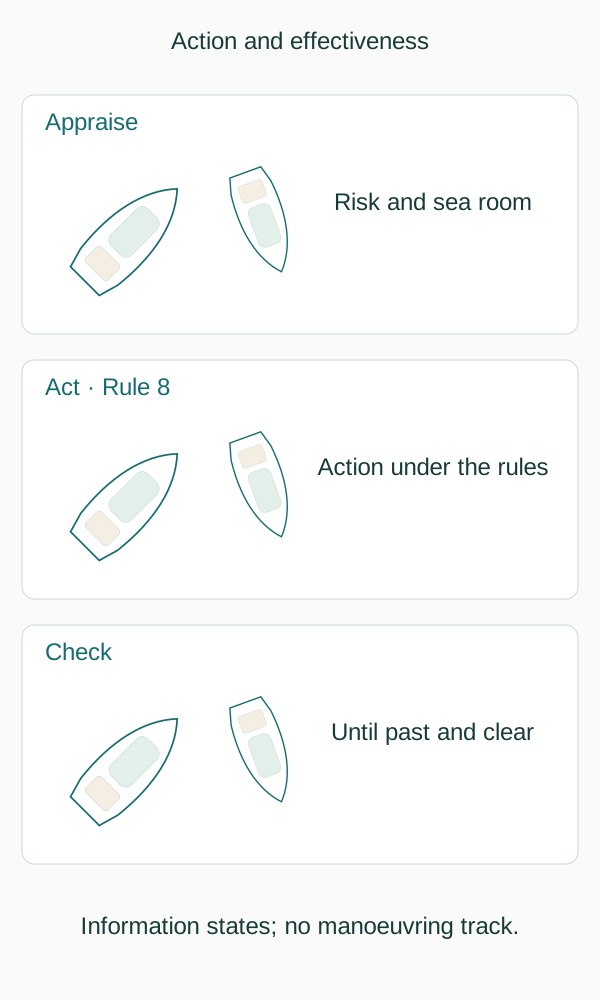
Original recognition schematic, not to scale; not navigation instruction.
insideSailOriginal insideSail artwork — all rights reservedEnlarge the diagram
Changing course or speed does not automatically end an encounter. Rule 8 connects action to Part B and to its result: passage at a safe distance, with effectiveness checked until the other vessel is finally past and clear.
The drawing presents information states rather than a track to copy. Intention, action and outcome are different things.
An apparent manoeuvre can still create another encounter, while a predicted passage needs subsequent observation. The rule therefore covers the quality and follow-through of action as well as its initial direction.
Time and clarity belong to the obligation
Rule 8(a), when circumstances admit, calls for positive action in ample time with regard to good seamanship. Paragraph (b) relates alterations to being readily apparent visually or by radar and says successive small alterations should be avoided.
This establishes no minimum angle valid for every boat. An alteration’s significance depends on circumstances and the encounter.
A degree checklist can look precise while teaching a rule that does not exist. Perceptibility matters because the other vessel also needs to appraise what is happening, not merely our private intention.
Paragraph (c) allows course alteration alone to be most effective where there is sufficient sea room, good time and a substantial alteration that does not create another close-quarters situation. Those conditions should not disappear into a caption saying simply “change course”.
Paragraph (e) includes reducing speed or taking all way off when necessary to avoid collision or gain assessment time. These are contextual obligations and possibilities; this lesson does not select a combination for an actual encounter.
The available space and other traffic remain part of the assessment.
Not impeding and keeping out of the way differ
Rule 8(f) explains the connection where another rule requires passage or safe passage not to be impeded. That duty may require early action to provide sufficient sea room before collision risk arises.
It does not disappear when risk develops; the vessel acting must also consider applicable encounter rules. The vessel whose passage must not be impeded remains fully subject to Part B obligations.
It receives neither an unlimited corridor nor permission to disregard an existing risk. The distinction is particularly important in narrow channels and adopted traffic separation schemes.
Rule 16 and continuing lookout
Where a vessel is required to keep out of the way, Rule 16 calls, so far as possible, for early and substantial action to keep well clear. Rule 8 shows how effectiveness forms part of that duty.
The other vessel may initially be required to keep course and speed by Rule 17(a)(i), yet later stages allow or require action. An encounter is not frozen by its first classification.
Rule 17 thresholds depend on observed development, and the responsibilities lesson separates them without assigning universal distances or assuming that one initial label settles every later obligation.
Safe distance has no single metre or nautical-mile value here. It depends on context and should not be equated with a device’s configured CPA figure.
An informal radio agreement should likewise not be treated as replacing Part B. Useful learning retains four elements: applicable rule, circumstances, action and checking until past and clear.
The version and source accompany each explanation; manoeuvring practice, exercises and competence assessment require their own training and review. This chapter interprets obligations rather than offering an electronic alarm threshold or pre-planned response.
- An alteration must respect the applicable rules as a whole.
- Not impeding can require attention before collision risk develops.
- Checking effectiveness until past and clear belongs to Rule 8.
The concept in a few words
Not impeding passage
A contextual duty to provide room for the passage specified elsewhere, developed in Rule 8(f); not a simple synonym for keeping out of the way or immunity for the other vessel.
Educational definition; consult the scope of the identified rule.
Sources and references
- RIEAM / COLREGs — Rule 16: Action by give-way vessel ↗
Instituto Hidrográfico / International Maritime Organization · Rule 16, normative Portuguese printed p.22 (PDF p.28); International English cross-check in USCG handbook. Rule 17, normative Portuguese printed p.22 (PDF p.28); International English cross-check in USCG handbook.
Rule 16; IH normative Portuguese printed p.22, PDF p.28; English International column cross-check. Individual provision commencement not established: valid_from remains null. Rule 17; IH normative Portuguese printed p.22, PDF p.28; English International column cross-check. Individual provision commencement not established: valid_from remains null.
Checked on - RIEAM / COLREGs — Rule 2: Responsibility ↗
Instituto Hidrográfico / International Maritime Organization · Rule 2, normative Portuguese printed p.3 (PDF p.9); International English cross-check in USCG handbook.
Rule 2; IH normative Portuguese printed p.3, PDF p.9; English International column cross-check. Individual provision commencement not established: valid_from remains null.
Checked on - RIEAM / COLREGs — Rule 8: Action to avoid collision ↗
Instituto Hidrográfico / International Maritime Organization · Rule 8, normative Portuguese printed p.9 (PDF p.15); International English cross-check in USCG handbook.
Rule 8; IH normative Portuguese printed p.9, PDF p.15; English International column cross-check. Individual provision commencement not established: valid_from remains null.
Checked on
Regulatory references
- Regra 2 / Rule 2 — Responsabilidade / Responsibility ↗
COLREG 1972 as amended; IH 9th edition September 2025 / International cross-check August 2024 · International Maritime Organization · International convention; national/local implementation must be checked
Verified on - Regra 16 / Rule 16 — Manobra do navio que deve afastar-se / Action by give-way vessel ↗
COLREG 1972 as amended; IH 9th edition September 2025 / International cross-check August 2024 · International Maritime Organization · International convention; national/local implementation must be checked
Verified on - Regra 17 / Rule 17 — Manobra do navio que tem prioridade / Action by stand-on vessel ↗
COLREG 1972 as amended; IH 9th edition September 2025 / International cross-check August 2024 · International Maritime Organization · International convention; national/local implementation must be checked
Verified on - Regra 8 / Rule 8 — Manobras para evitar abalroamentos / Action to avoid collision ↗
COLREG 1972 as amended; IH 9th edition September 2025 / International cross-check August 2024 · International Maritime Organization · International convention; national/local implementation must be checked
Verified on
Keep discovering
The next piece of the puzzle
Discuss this concept
Loading the conversation…