By insideSail
AI-assisted editorial review · version 3 ·
Lookout, speed and risk: three continuing questions
Rules 5–7 connect observation, response capability and sufficient information.
In this guide
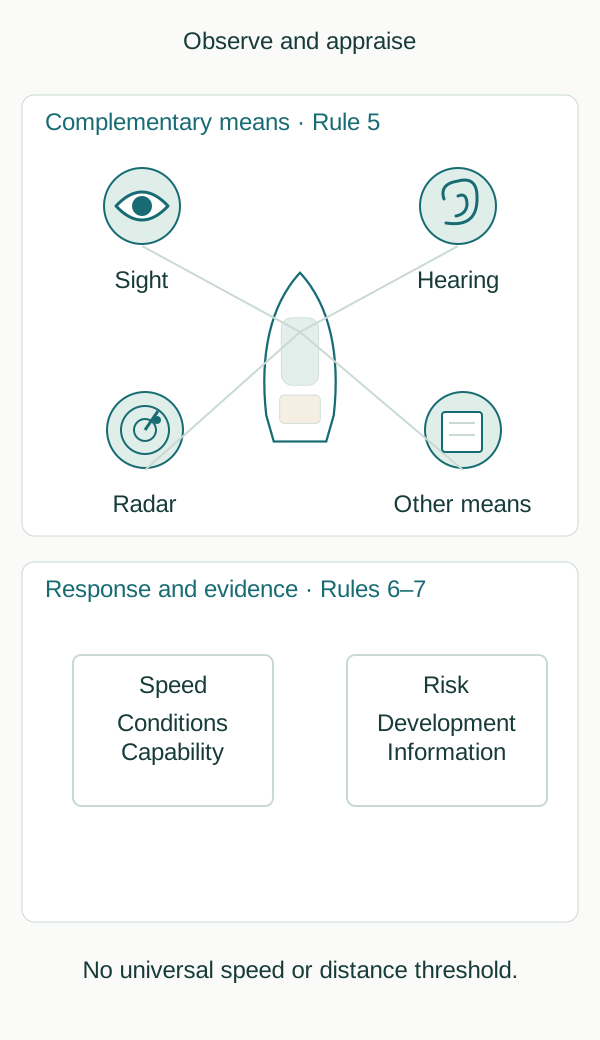
Original recognition schematic, not to scale; not navigation instruction.
insideSailOriginal insideSail artwork — all rights reservedEnlarge the diagram
Seeing another boat is only part of lookout. Rule 5 requires a proper lookout at all times by sight, hearing and all available means appropriate to prevailing circumstances.
Its purpose is full appraisal of the situation and collision risk. A screen can add information without turning what it misses into empty water.
Proper relates the obligation to the environment; it does not allow observation to be abandoned because it becomes inconvenient or an electronic system appears reassuring. The rule addresses appraisal, not simply possession of a device.
Safe speed is not one universal number
Rule 6 relates speed to effective avoiding action and stopping within an appropriate distance. Factors include visibility, traffic density, stopping distance, turning ability, background lights, wind, sea, current and draught relative to available depth.
Maximum engine speed and a posted harbour limit do not exhaust that assessment. Staying below a limit does not establish safe speed in prevailing conditions: the limit and Rule 6 can apply together.
The rule supplies relevant factors, rather than a universal speed for every recreational hull.
With operational radar, Rule 6(b) adds equipment limitations, the range scale in use, interference and the possibility of small targets not being detected at an adequate range. More information does not confer immunity to conditions.
A selected range is different from a reliable measurement; an absent target differs from a confirmed absence. These distinctions explain the legal factor, while practical radar operation and interpretation require their own training.
The illustration shows complementary sources rather than presenting a usable radar screen or setting prescription.
Risk: information needs continuity
Rule 7 requires appropriate available means to determine collision risk; doubt is treated as risk existing. Radar, if fitted and operational, has specified use, including systematic observation and early warning.
Assumptions based on scanty information, particularly scanty radar information, are prohibited. Two separated symbols on a map at one instant do not establish a future passage clear of danger.
The encounter’s development and observation quality matter more than an initial impression. Electronic estimates remain inputs to appraisal rather than legal conclusions supplied by a percentage.
An approaching vessel’s compass bearing failing to change appreciably is an indicator specified in Rule 7(d). It differs from always seeing another vessel beside a fitting on our own boat: that relative observation may change as our heading changes.
Risk can also exist despite appreciable bearing change, for example with a very large vessel, a tow or at close range. Consequently, “the bearing changed, therefore all is clear” deletes an express qualification.
Understanding the reference of the bearing is part of understanding the evidence.
How the three rules connect
Lookout supplies evidence; safe speed preserves response capability; risk appraisal gives meaning to approach. All three continue after a particular encounter rule is identified.
Knowing which vessel must keep out of the way never removes observation. These fictional examples prescribe neither personnel, equipment, radar scales nor CPA figures.
If training material supplies such numbers, recognise them as additional context rather than silently attributing them to Rule 6 or 7. This distinction lets useful instruction coexist with an accurate account of what the regulation itself states.
- Appropriate means complement sight and hearing.
- Safe speed depends on circumstances and response capability.
- Doubt, scanty information and target limitations belong in risk appraisal.
Concepts in this lesson
Risk of collision
Risk assessed through appropriate available means under Rule 7; doubt is treated as risk existing rather than relying on a universal CPA value.
Educational definition; consult the scope of the identified rule.
Safe speed
Speed permitting proper effective collision-avoiding action and stopping within a distance appropriate to circumstances under Rule 6; not one universal fixed value.
Educational definition; consult the scope of the identified rule.
Sources and references
- RIEAM / COLREGs — Rule 4: Application of Section I ↗
Instituto Hidrográfico / International Maritime Organization · Rule 5, normative Portuguese printed p.7 (PDF p.13); International English cross-check in USCG handbook.
Rule 5; IH normative Portuguese printed p.7, PDF p.13; English International column cross-check. Individual provision commencement not established: valid_from remains null.
Checked on - RIEAM / COLREGs — Rule 6: Safe speed ↗
Instituto Hidrográfico / International Maritime Organization · Rule 6, normative Portuguese printed p.8 (PDF p.14); International English cross-check in USCG handbook. Rule 7, normative Portuguese printed p.8 (PDF p.14); International English cross-check in USCG handbook.
Rule 6; IH normative Portuguese printed p.8, PDF p.14; English International column cross-check. Individual provision commencement not established: valid_from remains null. Rule 7; IH normative Portuguese printed p.8, PDF p.14; English International column cross-check. Individual provision commencement not established: valid_from remains null.
Checked on
Regulatory references
- Regra 6 / Rule 6 — Velocidade de segurança / Safe speed ↗
COLREG 1972 as amended; IH 9th edition September 2025 / International cross-check August 2024 · International Maritime Organization · International convention; national/local implementation must be checked
Verified on - Regra 7 / Rule 7 — Risco de abalroamento / Risk of collision ↗
COLREG 1972 as amended; IH 9th edition September 2025 / International cross-check August 2024 · International Maritime Organization · International convention; national/local implementation must be checked
Verified on - Regra 5 / Rule 5 — Vigilância / Look-out ↗
COLREG 1972 as amended; IH 9th edition September 2025 / International cross-check August 2024 · International Maritime Organization · International convention; national/local implementation must be checked
Verified on
Keep discovering
The next piece of the puzzle
Discuss this concept
Loading the conversation…