By insideSail
AI-assisted editorial review · version 2 ·
General rules: obligations begin before an encounter
Scope, responsibility and definitions give encounter rules their meaning.
In this guide
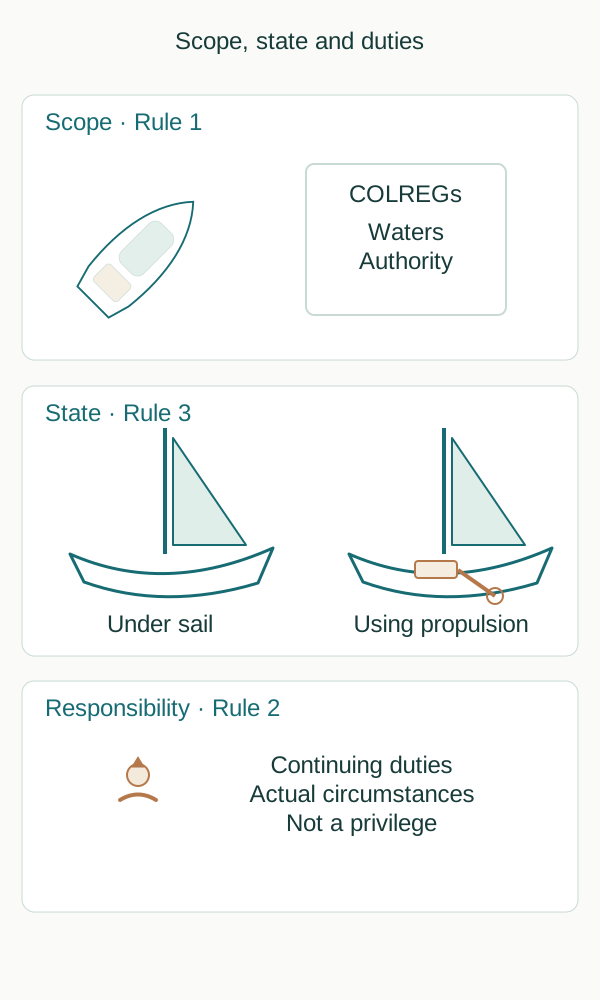
Original recognition schematic, not to scale; not navigation instruction.
insideSailOriginal insideSail artwork — all rights reservedEnlarge the diagram
The COLREGs organise obligations for preventing collisions. They are not a list of privileges assigned to boat types.
A first reading asks where they apply, which situation is described and which words have defined meanings. A small recreational sailboat participates in this system even near the coast or with limited equipment.
The drawing separates scope, observation and responsibility; none disappears because another vessel carries a particular obligation. Size is relevant to some provisions, but does not remove the general duty to comply.
Rule 1: international and local rules
Rule 1(a) establishes scope on the high seas and waters connected with them navigable by seagoing vessels. Paragraph (b) accommodates special rules made by the appropriate authority for harbours, rivers and other specified waters, conforming as closely as possible to the international rules.
It does not mean that any marina policy replaces the entire COLREGs. Identify the authority, location and subject of the local provision.
A harbour speed limit and responsibility during an encounter answer different questions and can both be relevant.
The remaining paragraphs of Rule 1 address special additional signals, traffic separation schemes adopted by the Organization and closest-possible compliance for special construction or purpose, determined by the government concerned. They do not let an owner invent lights or choose an alternative for convenience.
UK national implementation and scope are described in MSN 1781 Amendment 3; Portugal has its applicable instruments. A European platform should identify those jurisdictions rather than presenting a national interpretation as universal law or assuming that a UK notice has Portuguese legal force.
Rule 2: responsibility is not delegated away
Rule 2(a) preserves consequences arising from non-compliance and neglect of precautions required by ordinary seamanship or particular circumstances. Saying that one had priority is insufficient.
Paragraph (b) requires consideration of dangers, special circumstances and vessel limitations; these may make departure from the rules necessary to avoid immediate danger. That is a demanding condition, not a general exception for personal preferences.
Reading begins with compliance and prevention, rather than searching afterwards for a reason why an inconvenient provision could be ignored.
Rule 3: actual status matters
A sailing vessel under Rule 3(c) is under sail without use of propelling machinery; having a mast is insufficient. Underway means neither anchored, made fast to shore nor aground, and can include a vessel making no way through the water.
Engaged in fishing requires fishing apparatus that restricts manoeuvrability, rather than merely someone carrying a rod. Not under command and restricted in ability to manoeuvre have distinct defined causes.
These distinctions matter throughout responsibilities, lights and signals, so everyday labels should not silently replace them.
Rule 4: the foundation remains in every visibility
Part B Section I, Rules 4–10, applies in any condition of visibility. Lookout, safe speed and risk assessment are not replaced by later rules.
Carry this foundation into Rules 11–18 or Rule 19. When reading a statement, retain its rule number, application condition, subject and obligation.
Editorial explanation helps make these elements intelligible; it does not amend the normative text or certify navigational competence. A photograph or a simple boat-type category cannot establish all the facts that a legal classification requires.
- Rule 1 defines scope; local rules need authority and context.
- Rule 2 prevents treating priority as permission to collide.
- Rule 3 classifies states; Rule 4 preserves the foundation in any visibility.
Sources and references
- RIEAM / COLREGs — Rule 1: Application ↗
Instituto Hidrográfico / International Maritime Organization · Rule 1, normative Portuguese printed p.2 (PDF p.8); International English cross-check in USCG handbook.
Rule 1; IH normative Portuguese printed p.2, PDF p.8; English International column cross-check. Individual provision commencement not established: valid_from remains null.
Checked on - MSN 1781 (M+F) Amendment 3 ↗
Maritime and Coastguard Agency · Sections 2.1–2.3, 3.1–3.4 and 4.1; scope, national implementation and Watercraft Order 2023.
UK-specific implementation. Amendment 2 revoked; not used as current guidance.
Checked on - RIEAM / COLREGs — Rule 4: Application of Section I ↗
Instituto Hidrográfico / International Maritime Organization · Rule 4, normative Portuguese printed p.7 (PDF p.13); International English cross-check in USCG handbook.
Rule 4; IH normative Portuguese printed p.7, PDF p.13; English International column cross-check. Individual provision commencement not established: valid_from remains null.
Checked on - Convention on the International Regulations for Preventing Collisions at Sea, 1972 ↗
International Maritime Organization · COLREG 1972, as amended · Structure; adoption 20 October 1972; entry into force 15 July 1977; 2013 amendment, Part F effective 1 January 2016.
Overview used for structure/history only. Its Rule 33 bell summary is not treated as consolidated normative wording.
Checked on - RIEAM / COLREGs — Rule 2: Responsibility ↗
Instituto Hidrográfico / International Maritime Organization · Rule 2, normative Portuguese printed p.3 (PDF p.9); International English cross-check in USCG handbook. Rule 3, normative Portuguese printed p.3 (PDF p.9); International English cross-check in USCG handbook.
Rule 2; IH normative Portuguese printed p.3, PDF p.9; English International column cross-check. Individual provision commencement not established: valid_from remains null. Rule 3; IH normative Portuguese printed p.3, PDF p.9; English International column cross-check. Individual provision commencement not established: valid_from remains null.
Checked on
Regulatory references
- Regra 3 / Rule 3 — Definições gerais / General definitions ↗
COLREG 1972 as amended; IH 9th edition September 2025 / International cross-check August 2024 · International Maritime Organization · International convention; national/local implementation must be checked
Verified on - Regra 1 / Rule 1 — Aplicação / Application ↗
COLREG 1972 as amended; IH 9th edition September 2025 / International cross-check August 2024 · International Maritime Organization · International convention; national/local implementation must be checked
Verified on - Regra 2 / Rule 2 — Responsabilidade / Responsibility ↗
COLREG 1972 as amended; IH 9th edition September 2025 / International cross-check August 2024 · International Maritime Organization · International convention; national/local implementation must be checked
Verified on - Regra 4 / Rule 4 — Aplicação da Secção I / Application of Section I ↗
COLREG 1972 as amended; IH 9th edition September 2025 / International cross-check August 2024 · International Maritime Organization · International convention; national/local implementation must be checked
Verified on
Keep discovering
The next piece of the puzzle
Discuss this concept
Loading the conversation…