By insideSail
Automated technical check · version 2 ·
Nearly parallel lines: geometry amplifies uncertainty
An exact-looking intersection can react strongly to small changes in its lines.
In this guide
A line constrains a possible position without independently selecting one point. Two non-parallel lines have a mathematical intersection.
That does not mean the point is as well determined as the crisp drawing suggests: small changes in the lines can move the intersection substantially. We explore sensitivity on an abstract grid without coastal targets, instruments or procedures for fixing a position at sea.
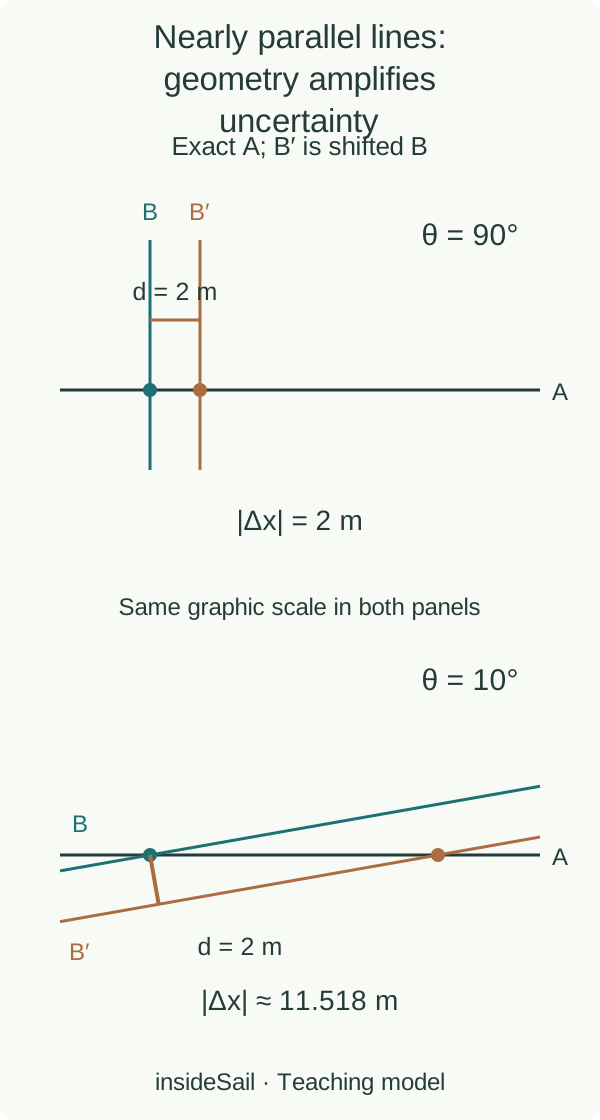
Original schematic; fictional examples and explicit assumptions. Does not represent actual navigation.
insideSailOriginal insideSail artwork — all rights reservedEnlarge the diagram
What changes and what stays fixed?
In the first model, line A is horizontal and exact: y=0. Line B initially passes through the origin and makes angle θ with A.
We shift B parallel to itself by distance d, measured perpendicular to B. We neither rotate the line nor move A.
These conditions matter: another combination of changes would be another problem. The new crossing remains on A but moves away from the origin.
The relationships form a right triangle. The side of length d is opposite angle θ, while the crossing’s displacement along A is the hypotenuse.
Thus sin(θ)=d/displacement. As θ approaches zero, its sine decreases and the same perpendicular shift corresponds to greater displacement.
The formula quantifies geometric amplification rather than compass accuracy or a confidence level.
The relationship in numbers
|Δx| = |d| / |sin(θ)|
Planar model: exact A, parallel shift of B; d and Δx in metres.
A mathematically thick line
If B’s shift can range between −2 and +2 m, the model admits a parallel strip rather than one line. Where the strip crosses A, it produces an interval.
At 30° this is −4 to +4 m; at 10°, approximately −11.518 to +11.518 m. These are results admitted by our invented bounds, not automatically a 95% interval: no probability distribution has been assigned to the shifts.
If A is uncertain too, two strips can intersect in a region whose shape depends on angles and widths. If both share a systematic displacement, the point or region can be displaced together.
Adding lines need not remove that common effect. Having more mathematical relationships and having independent relationships are different properties; information origin remains relevant.
An angular change differs from the parallel translation used in our calculation. Rotating a line around a point changes its separation elsewhere; separation can be larger farther from the rotation centre.
A degree-valued error cannot be inserted in place of d in metres. Another model relating angle, distance and reference would first be needed, with units retained.
Exactly parallel distinct lines do not intersect; coincident lines admit infinitely many points. This limit explains why the formula grows without supplying a position when sin(θ)=0.
A computer can draw an intersection with many decimal places without creating further information about its inputs. Understanding the geometry supports learning about bearings and position relationships; executing and validating real observations remains a separate applied competence.
- Geometry controls intersection sensitivity.
- Perpendicular distance, angular error and statistical uncertainty differ.
- A mathematical point does not validate an actual position.
Sources and references
- Boat Crew Handbook — Navigation and Piloting, BCH16114.3 ↗
United States Coast Guard · BCH 16114.3, December 2017; Chapter 3 E.9 printed p.3-94 / PDF p.139; D.13 pp.3-74–3-77.
Only the idea of a directional line as a geometric constraint is used. No observing/plotting procedure, target choice, fix validation or operational angle rule adopted.
Checked on - Measurement uncertainty glossary ↗
NIST · Uncertainty, standard uncertainty and expanded uncertainty entries.
Directly consulted. Brief terminology synthesis; no confidence level assigned to an unspecified receiver or chart.
Checked on - Essentials of expressing measurement uncertainty — Basic definitions ↗
NIST · Basic definitions: measurement equation and uncertainty components; enduring overview adapted from TN 1297.
Directly consulted. Selected distinction between result and input uncertainty only; original coordinate examples, no instrument accuracy guarantee.
Checked on
Keep discovering
The next piece of the puzzle
Discuss this concept
Loading the conversation…