By insideSail
Automated technical check · version 2 ·
Position digits, resolution and uncertainty
A longer number does not make a position more certain: separate representation, repeatability and reference.
In this guide
A position might appear as 60°00.000′ N or 60°00.0000′ N. The second notation distinguishes intervals ten times smaller, but does not demonstrate a measurement ten times better.
Digits tell us how a value was represented. To understand what it says, we also need its origin, time, datum and the uncertainty associated with the result.
This lesson develops that separation after the basic latitude and longitude formats.
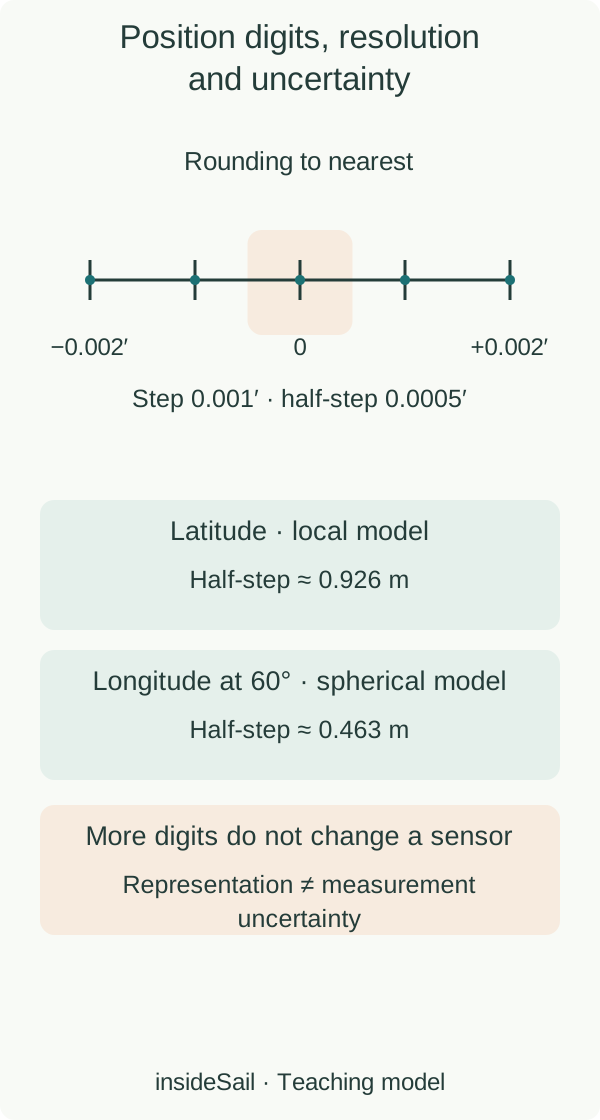
Original schematic; fictional examples and explicit assumptions. Does not represent actual navigation.
insideSailOriginal insideSail artwork — all rights reservedEnlarge the diagram
The number’s grid
Display resolution is the smallest step distinguished by the notation. With a 0.001-minute step and rounding to the nearest value, the difference between the value before rounding and the written value is at most half a step: 0.0005 minute.
This bounds representation error, not every position error. Truncating instead of rounding changes the interval; the conversion rule therefore matters.
For longitude, identical notation does not represent identical distance at every latitude. In a local spherical approximation, multiply equatorial distance by cos(latitude).
At 60°, cos(60°)=0.5: half a 0.001′ longitude step is approximately 0.463 m. Degrees therefore do not convert into metres through one universal constant.
Nor can the size of a latitude–longitude rectangle be directly equated with an uncertainty circle.
Scatter is not systematic displacement
Imagine ten readings close together. Their small scatter describes repeatability under the observed conditions.
Yet all ten might share an eastward displacement caused by the same reference or influence. Averaging does not eliminate a common effect.
Accuracy concerns closeness to a reference value; repeatability concerns agreement between repeated results. Informal claims that something is “very precise” can conceal which property is actually being discussed.
An uncertainty needs to identify its quantity and evaluation method. An interval with a stated confidence level, a standard uncertainty and a maximum rounding bound are not equivalent expressions.
Half a step does not acquire 95% coverage simply because it is drawn around a point. Even “horizontal” leaves a question: does it describe each axis or radial distance?
A meaningful comparison retains the definition alongside the unit.
A wrong datum, mismatched time or coordinate copied with an incorrect sign belongs to another category again: it can displace the result without appearing in a small scatter of readings. The diagram shows a rounding grid, not the performance of an actual receiver.
The aim is understanding a value and its description; judging fitness for a manoeuvre requires separate applied assessment.
- More digits distinguish smaller steps; they do not prove smaller uncertainty.
- State rounding convention, datum and time.
- Agreeing readings can share the same error.
Sources and references
- NIST TN1297 — Appendix D1, Terminology ↗
NIST · Second edition 1994; §§D.1.1.1, D.1.1.2 and D.1.2: accuracy, repeatability and precision. Web page updated 11 September 2025.
Official page directly read on the recorded consultation date. Qualitative terms distinguished, without assigning a numeric accuracy specification.
Checked on - Evaluating uncertainty components — Type B ↗
NIST · Uniform (rectangular) distribution; distinction between interval half-width and standard uncertainty.
Directly consulted. Only the distinction is used: the lesson states deterministic rounding bounds and does not claim a statistical distribution or coverage.
Checked on - Boat Crew Handbook — Navigation and Piloting, BCH16114.3 ↗
United States Coast Guard · December 2017, issued 13 December; Chapter 3 A.3–A.4 printed pp.3-4–3-5; E.6–E.8 pp.3-87–3-88.
Selected angular format, meridian/parallel and distance concepts read. No plotting procedure, fix frequency or US navigation policy adopted.
Checked on - Measurement uncertainty glossary ↗
NIST · Uncertainty, standard uncertainty and expanded uncertainty entries.
Directly consulted. Brief terminology synthesis; no confidence level assigned to an unspecified receiver or chart.
Checked on - Essentials of expressing measurement uncertainty — Basic definitions ↗
NIST · Basic definitions: measurement equation and uncertainty components; enduring overview adapted from TN 1297.
Directly consulted. Selected distinction between result and input uncertainty only; original coordinate examples, no instrument accuracy guarantee.
Checked on
Keep discovering
The next piece of the puzzle
Discuss this concept
Loading the conversation…