By insideSail
Published without technical review · version 2 ·
Passage planning: from assumptions to monitoring
A passage needs conditions, alternatives and monitoring.
In this guide
Planning means more than connecting departure harbour and destination. It relates the passage to the actual boat, crew, available information and expected conditions.
A line supplies the geographical component, while time adds another dimension. Conditions can differ by the time the boat reaches an area.
The structure presented helps organise information rather than providing an executable plan.
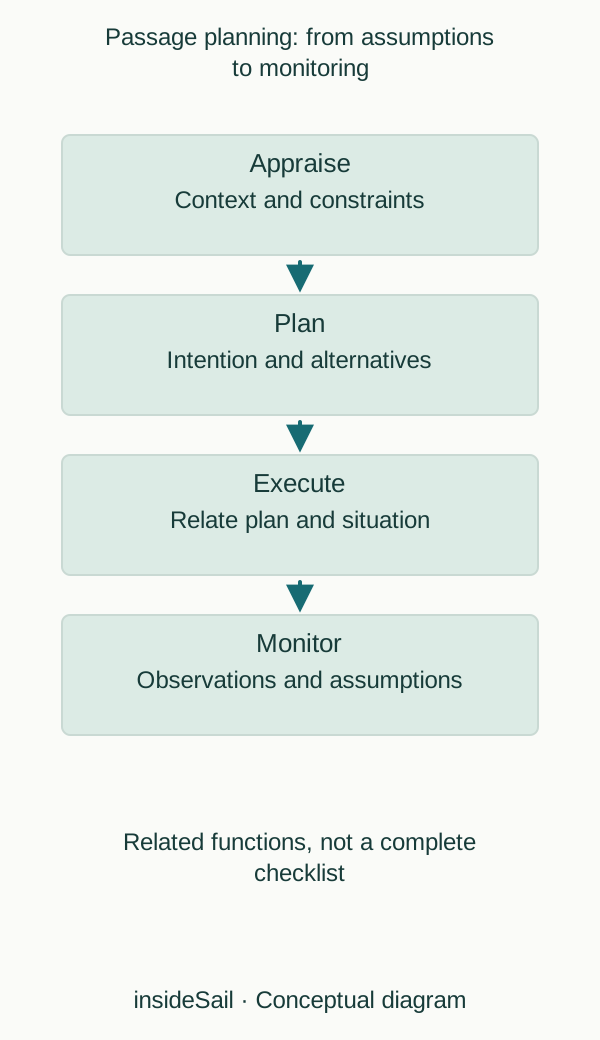
Teaching schematic not to scale; without local data or operational approval.
insideSailOriginal insideSail artwork — all rights reservedEnlarge the diagram
Four complementary relationships
Appraisal gathers context and constraints. Planning organises intentions and alternatives from that context.
Execution relates intention to what is happening. Monitoring compares observations with assumptions and keeps the plan under assessment.
These functions overlap through time; a saved plan does not remain correct forever. An updated forecast or local information can change its basis.
Context includes individual-vessel dimensions and condition, crew capability and limitations, fuel or energy, charts and publications, restrictions, weather, tides and arrival conditions. These themes relate to each other without replacing each other.
A short distance does not remove depth questions; favourable wind does not establish access; a photograph of another boat in a marina does not establish compatibility for this vessel.
An alternative needs appraisal in its own context rather than merely existing as another screen point. Monitoring also means recognising discrepancies without inventing a fixed checking interval or automatic decision to continue.
The cited MCA reference applies to the UK. It is neither a European legal summary nor professional approval for a voyage.
An assumption has attached conditions. “Four knots” may be average speed over ground, speed through water or simply a chosen example value.
It looks like a unit detail at first; in a plan it changes the time model. Current and ground speed can vary between legs.
A constant-speed schedule should identify that simplification rather than display a time more precise than its inputs support.
A plan contains different kinds of questions: geometry locates, depth constrains vertical space, weather describes expected conditions, and crew supplies human capability and limits. Adding them into one score does not yield a valid conclusion.
Some are constraints, others uncertainties and others choices. Organising relationships reveals what remains unassessed without turning this teaching list into a complete or legally sufficient checklist.
- Geography is one planning component.
- Speed assumptions change the time context.
- Monitoring relates intention and observation.
Sources and references
- MGN 599 (M) Amendment 1 — pleasure vessels guidance ↗
UK Maritime and Coastguard Agency · Updated 10 December 2024; §7.4 voyage-planning context.
UK jurisdiction stated; not a pan-European legal summary. Publication of applied lessons still requires qualified review.
Checked on - Boat Crew Handbook — Navigation and Piloting, BCH16114.3 ↗
United States Coast Guard · Chapter 3 A.1–A.5, printed pp.3-2–3-7; B.4–B.6 pp.3-13–3-24; E.8 pp.3-88–3-93.
Selected geometrical concepts only. US procedures, numerical equipment claims and protected artwork excluded.
Checked on
Keep discovering
The next piece of the puzzle
Discuss this concept
Loading the conversation…