By insideSail
AI-assisted editorial review · version 3 ·
Sail and power: status, wind and applicable rules
Rule 12 requires two sailing vessels in sight with collision risk.
In this guide
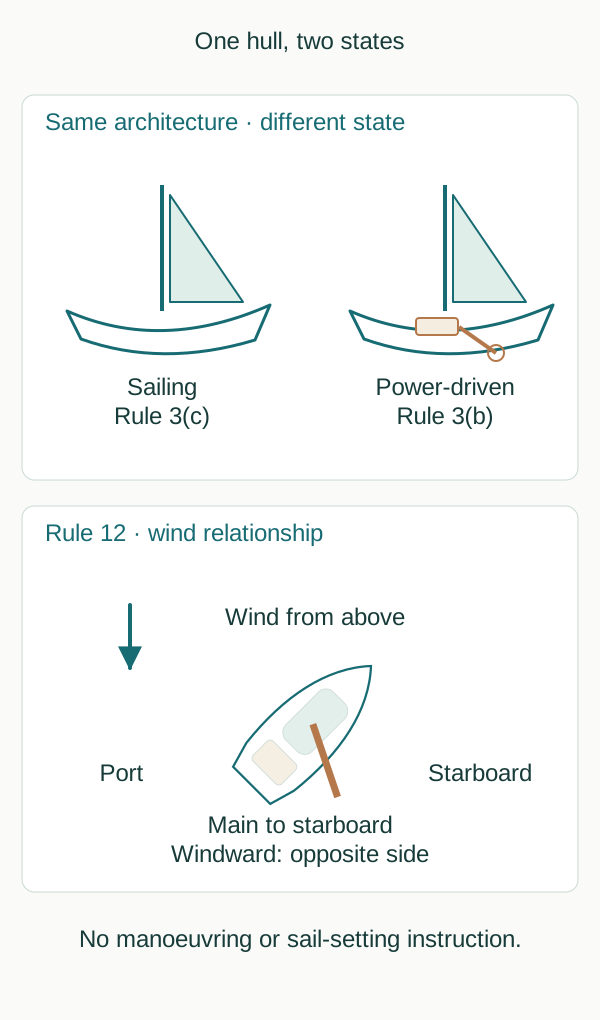
Original recognition schematic, not to scale; not navigation instruction.
insideSailOriginal insideSail artwork — all rights reservedEnlarge the diagram
A photograph of a mast does not determine whether a vessel is legally sailing. Rule 3(c) requires being under sail without using propelling machinery.
A sailboat using mechanical propulsion is power-driven in that state. The distinction affects encounters and signals, not merely its commercial model category.
The first panel separates states of the same fictional hull; the second explains the wind relationship used by Rule 12 without depicting a manoeuvre. A boat’s design does not fix the legal state in which it operates at every moment.
The conditions preceding Rule 12
Rule 12 lies in Section II, applicable to vessels in sight. Paragraph (a) concerns two sailing vessels approaching with collision risk.
Section I remains relevant, and Rule 13 overtaking may be decisive. “Both have sails” therefore does not finish the assessment.
Retain actual classification, visual condition, risk and overtaking relationship. Additional Rules 9 and 10 obligations in channels and traffic schemes also remain.
A diagram that omits those conditions can help explain wind geometry but cannot independently determine all responsibilities in a real encounter.
With wind on different sides, Rule 12(a)(i) assigns the duty to keep out of the way to the vessel with wind on her port side. With wind on the same side, paragraph (a)(ii) requires the windward vessel to keep out of the way of the leeward vessel.
These relationships do not depend on which boat is faster, more expensive or larger. Windward relates to where wind comes from and leeward to the other direction.
They are wind references between vessels rather than fixed north and south positions on a map.
The rule’s specific windward-side definition
For Rule 12, paragraph (b) defines windward as the side opposite that carrying the mainsail; for a square-rigged vessel it uses the largest fore-and-aft sail. This legal definition should not be replaced by looking only at a flag or the bow direction.
Mainsail position is particularly important in an aft-wind depiction. Our drawing identifies the main and wind origin so that the relationship is visible rather than depending on decorative colour.
It is a geometric teaching comparison and supplies no sail-handling or course-change instructions.
Rule 12(a)(iii) addresses uncertainty: a vessel with wind on the port side seeing a vessel to windward, whose wind side cannot be determined with certainty, must keep out of the way. It does not say that any uncertainty about any vessel always creates that role.
The subject and other vessel’s location are express conditions. It accompanies the general requirement to treat doubtful collision risk as existing, without being synonymous with it.
The questions concern risk and responsibility respectively, and should remain separate in an explanation.
Propulsion and signals need consistency
Rule 25(e) requires a forward cone, apex downwards, for a vessel proceeding under sail while also mechanically propelled. Its daytime display relates to Part C.
At night classification affects applicable lights rather than authorising random mixtures of arrangements. Merely having an engine fitted, or an electrical operation without propulsion, should not automatically be equated with using propelling machinery.
The encounter condition must correspond to actual operation and the exact provision, rather than the name “sailboat”. Signals communicate that state but do not remove the other duties.
The concept in a few words
Sailing vessel under COLREGs
A vessel under sail without using propelling machinery, if fitted, under Rule 3(c); distinct from the commercial sailboat type.
Educational definition; consult the scope of the identified rule.
Sources and references
- RIEAM / COLREGs — Rule 9: Narrow channels ↗
Instituto Hidrográfico / International Maritime Organization · Rule 9, normative Portuguese printed p.11 (PDF p.17); International English cross-check in USCG handbook.
Rule 9; IH normative Portuguese printed p.11, PDF p.17; English International column cross-check. Individual provision commencement not established: valid_from remains null.
Checked on - RIEAM / COLREGs — Rule 11: Application of Section II ↗
Instituto Hidrográfico / International Maritime Organization · Rule 11, normative Portuguese printed p.17 (PDF p.23); International English cross-check in USCG handbook. Rule 12, normative Portuguese printed p.17 (PDF p.23); International English cross-check in USCG handbook.
Rule 11; IH normative Portuguese printed p.17, PDF p.23; English International column cross-check. Individual provision commencement not established: valid_from remains null. Rule 12; IH normative Portuguese printed p.17, PDF p.23; English International column cross-check. Individual provision commencement not established: valid_from remains null.
Checked on - RIEAM / COLREGs — Rule 25: Sailing vessels underway and vessels under oars ↗
Instituto Hidrográfico / International Maritime Organization · Rule 25, normative Portuguese printed p.39 (PDF p.45); International English cross-check in USCG handbook.
Rule 25; IH normative Portuguese printed p.39, PDF p.45; English International column cross-check. Individual provision commencement not established: valid_from remains null.
Checked on - RIEAM / COLREGs — Rule 13: Overtaking ↗
Instituto Hidrográfico / International Maritime Organization · Rule 13, normative Portuguese printed p.19 (PDF p.25); International English cross-check in USCG handbook.
Rule 13; IH normative Portuguese printed p.19, PDF p.25; English International column cross-check. Individual provision commencement not established: valid_from remains null.
Checked on - RIEAM / COLREGs — Rule 18: Responsibilities between vessels ↗
Instituto Hidrográfico / International Maritime Organization · Rule 18, normative Portuguese printed p.23 (PDF p.29); International English cross-check in USCG handbook.
Rule 18; IH normative Portuguese printed p.23, PDF p.29; English International column cross-check. Individual provision commencement not established: valid_from remains null.
Checked on - RIEAM / COLREGs — Rule 2: Responsibility ↗
Instituto Hidrográfico / International Maritime Organization · Rule 3, normative Portuguese printed p.3 (PDF p.9); International English cross-check in USCG handbook.
Rule 3; IH normative Portuguese printed p.3, PDF p.9; English International column cross-check. Individual provision commencement not established: valid_from remains null.
Checked on - RIEAM / COLREGs — Rule 10: Traffic separation schemes ↗
Instituto Hidrográfico / International Maritime Organization · Rule 10, normative Portuguese printed p.14 (PDF p.20); International English cross-check in USCG handbook.
Rule 10; IH normative Portuguese printed p.14, PDF p.20; English International column cross-check. Individual provision commencement not established: valid_from remains null.
Checked on
Regulatory references
- Regra 25 / Rule 25 — Navios à vela a navegar e navios a remos / Sailing vessels underway and vessels under oars ↗
COLREG 1972 as amended; IH 9th edition September 2025 / International cross-check August 2024 · International Maritime Organization · International convention; national/local implementation must be checked
Verified on - Regra 18 / Rule 18 — Responsabilidades recíprocas dos navios / Responsibilities between vessels ↗
COLREG 1972 as amended; IH 9th edition September 2025 / International cross-check August 2024 · International Maritime Organization · International convention; national/local implementation must be checked
Verified on - Regra 10 / Rule 10 — Dispositivos de separação de tráfego / Traffic separation schemes ↗
COLREG 1972 as amended; IH 9th edition September 2025 / International cross-check August 2024 · International Maritime Organization · International convention; national/local implementation must be checked
Verified on - Regra 12 / Rule 12 — Navios à vela / Sailing vessels ↗
COLREG 1972 as amended; IH 9th edition September 2025 / International cross-check August 2024 · International Maritime Organization · International convention; national/local implementation must be checked
Verified on - Regra 9 / Rule 9 — Canais estreitos / Narrow channels ↗
COLREG 1972 as amended; IH 9th edition September 2025 / International cross-check August 2024 · International Maritime Organization · International convention; national/local implementation must be checked
Verified on - Regra 11 / Rule 11 — Aplicação da Secção II / Application of Section II ↗
COLREG 1972 as amended; IH 9th edition September 2025 / International cross-check August 2024 · International Maritime Organization · International convention; national/local implementation must be checked
Verified on - Regra 3 / Rule 3 — Definições gerais / General definitions ↗
COLREG 1972 as amended; IH 9th edition September 2025 / International cross-check August 2024 · International Maritime Organization · International convention; national/local implementation must be checked
Verified on - Regra 13 / Rule 13 — Ultrapassagem / Overtaking ↗
COLREG 1972 as amended; IH 9th edition September 2025 / International cross-check August 2024 · International Maritime Organization · International convention; national/local implementation must be checked
Verified on
Keep discovering
The next piece of the puzzle
Discuss this concept
Loading the conversation…