By insideSail
Published without technical review · version 2 ·
Transits: one line, many positions
Alignment explains geometry; it does not determine a point by itself.
In this guide
Two fixed features can appear aligned when the observer lies on the line through both. This relationship is a transit.
The nearer and farther features appear in the same visual direction. Alignment supplies a line of position rather than the observer’s distance from the objects.
Many different points can produce the same visual coincidence.
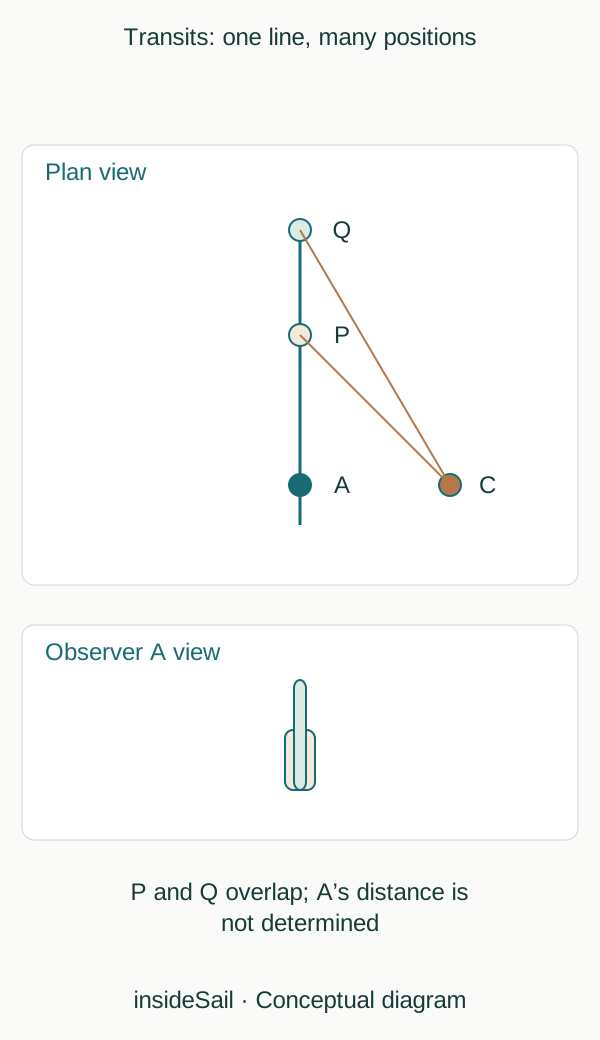
Teaching schematic not to scale; without local data or operational approval.
insideSailOriginal insideSail artwork — all rights reservedEnlarge the diagram
The observer is part of the geometry
Moving the observer sideways makes the features separate visually. The nearer feature changes its apparent direction more strongly than the distant one.
This is perspective rather than movement of the objects. Visual separation depends on distances and geometry.
A plan view shows the line, while a small frontal panel shows the overlap seen by the observer.
A transit between recognised features is not necessarily a line intended to be followed. Some alignments are deliberately established aids; others provide positional relationships or boundaries described in a publication.
Nautical meaning comes from official information and context, not merely the presence of two objects. Confusing geometry with permission to pass turns a valid observation into an unjustified conclusion.
Feature identification forms part of the observation. Two similar buildings or unsuitable charted positions can create a convincing but wrong line.
Observer height, visibility and obstruction also affect what is seen. This lesson explains the spatial relationship without choosing real marks or supplying a harbour entrance.
Pilotage use requires practical competence and current documents.
Alignment can be understood as visual projection: nearer and farther features occupy one viewing direction. The observer must be on a relevant extension of the line to see overlap; between the features, they can appear in opposite directions.
This shows why the complete geometrical line and observed visual relationship are not identical descriptions.
A bearing and a transit can produce lines through different relationships. The first uses an angular direction to one object; the second uses visual coincidence of two.
In both, feature identity and position form part of the evidence. A transit does not automatically contain a compass reading or remove identification error.
Different methods can share dependencies while having different observation mechanisms.
- A transit supplies a line of position.
- Alignment alone supplies no distance.
- An observable line is not automatically a navigable line.
Concepts in this lesson
Line of position
Linear set of positions consistent with an observation and its references.
Transit
Visual alignment of two features that can supply a line of position.
Sources and references
- Regulations for International (INT) Charts and Chart Specifications of the IHO — S-4 ↗
International Hydrographic Organization · Edition 4.10.0, March 2026; B-200 mathematical framework; B-300 topography; B-400 hydrography, including soundings and depth contours.
Conceptual facts and standards locator only. No IHO text, chart symbology plate or diagram is reproduced.
Checked on - Boat Crew Handbook — Navigation and Piloting, BCH16114.3 ↗
United States Coast Guard · Chapter 2 A.29 p.2-16; Chapter 3 E.1 pp.3-78–3-80; E.9 p.3-94; G.9–G.10 pp.3-138–3-140.
Selected line-of-position, range/transit and DR/EP concepts. No US fix frequency, plotting recipe or course instruction adopted.
Checked on
Keep discovering
The next piece of the puzzle
Discuss this concept
Loading the conversation…