By insideSail
Published without technical review · version 2 ·
Fixing position without erasing uncertainty
Intersections, observation identity and quality of geometry.
In this guide
A line of position contains locations consistent with an observation. A bearing to an identified object can produce a line; a distance from an object can produce a circle.
A position fix combines sufficient information to constrain the observer’s location. The small resulting plot point does not remove errors in the observations that produced it.
Origin, time and quality of every component remain important.
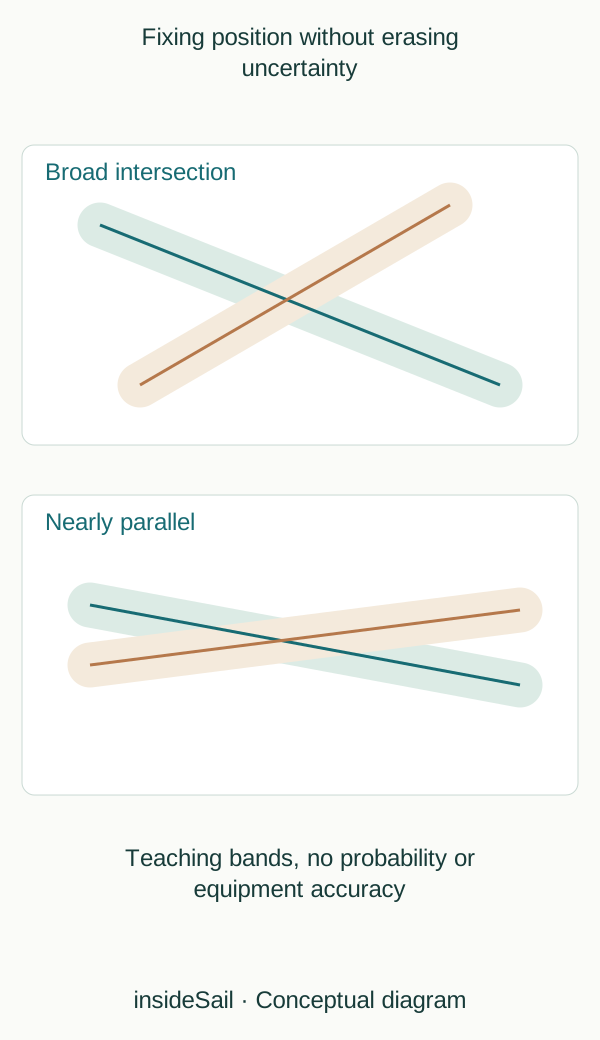
Teaching schematic not to scale; without local data or operational approval.
insideSailOriginal insideSail artwork — all rights reservedEnlarge the diagram
Geometry can amplify error
Two lines crossing at a broad angle constrain a different region from two nearly parallel lines. For the same small angular uncertainty, the latter can produce large uncertainty along the intersection.
The figure uses bands around ideal lines: they represent conceptual uncertainty, not a calculated statistical interval. Their overlap explains why precision depends on more than the number of observations.
Three measured lines may form a small triangle instead of intersecting at one point. Without an error model, one cannot assert that the true position always lies inside that triangle.
Systematic errors, misidentification or a wrong shared reference can affect several observations in the same direction. A clean display may hide such shared error.
Visual consistency is useful information, not an absolute guarantee.
The boat may move between observations. Combining times without relating them can treat different locations as simultaneous.
An electronic position also has time, origin and possible errors. This applied lesson teaches recognition of those components without prescribing fixing intervals or an operational method for choosing marks.
Using these methods in pilotage requires practical learning in the actual context.
Distance from a point fixes radius, not direction. Every point on the ideal circle is equally far from its centre.
A second datum can constrain that curve, but geometry may leave multiple intersections. Two circles, for example, can cross at two points.
Additional context is needed to distinguish mathematical solutions. Adding an observation does not automatically give one physically correct result.
Precision and accuracy describe different aspects. Closely grouped observations can be precise relative to each other while displaced from true position by systematic error.
Scattered observations have another uncertainty pattern. Shifting every conceptual line by one shared error illustrates the first case: the intersection remains small and coherent.
Statistical probability requires knowledge of errors and method. A position symbol is a representation, not certification.
- An observation can supply a line or curve.
- Geometry and shared errors affect the result.
- A small screen point does not prove precision.
Sources and references
- Boat Crew Handbook — Navigation and Piloting, BCH16114.3 ↗
United States Coast Guard · Chapter 2 A.29 p.2-16; Chapter 3 E.1 pp.3-78–3-80; E.9 p.3-94; G.9–G.10 pp.3-138–3-140.
Selected line-of-position, range/transit and DR/EP concepts. No US fix frequency, plotting recipe or course instruction adopted.
Checked on - GPS accuracy — archived official explainer ↗
GPS.gov · User accuracy; signal-in-space accuracy; obstruction, geometry and receiver effects.
Archive identifies itself as no longer updated since February 2025. Used for enduring error categories, never a current accuracy guarantee.
Checked on
Keep discovering
The next piece of the puzzle
Discuss this concept
Loading the conversation…