By insideSail
AI-assisted editorial review · version 3 ·
Underway, making way and vessel status: three questions
A GPS position, an engine and an activity do not answer the same definition.
In this guide
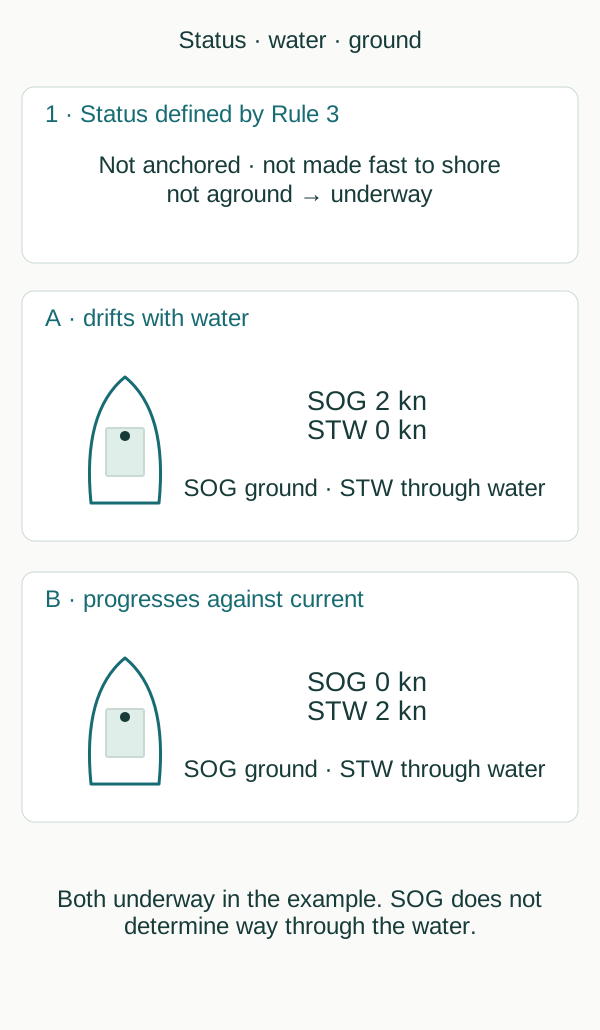
Original interpretation schematic with declared functions and references. No scale, approved installation or operational track.
insideSailOriginal insideSail artwork — all rights reservedEnlarge the diagram
A vessel can move relative to the shore while making no way through the water. She can also be momentarily stationary while remaining underway under COLREGs.
These distinctions enter lights, sound signals and responsibilities. Separate defined status, motion relative to the water and motion over the ground.
Rule 3 defines underway; later rules use additional expressions. The single word stopped cannot resolve all these classifications.
The definition of underway
Under Rule 3(i), a vessel is underway when not at anchor, made fast to the shore or aground. The definition requires neither filled sails, an operating engine nor a minimum speed.
A drifting boat without connection to the bottom or shore remains underway. An anchored boat does not change status because she moves slightly about her cable; a boat made fast to a quay does not change because current passes her hull.
Describe the physical relationship in the definition before motion.
Propulsion and work are separate questions
Rule 3(b) defines a power-driven vessel through propulsion by machinery. Paragraph (c) requires a sailing vessel to be under sail without using fitted propelling machinery.
A diesel running to charge batteries is not automatically the same fact as a propeller providing propulsion. Conversely, sails set do not preserve sailing status when machinery also propels.
The stated operation, rather than boat brand or speed, supports classification.
Not under command in paragraph (f) results from an exceptional circumstance preventing manoeuvre as required and keeping clear. Restricted ability to manoeuvre in paragraph (g) results from the nature of the work.
Neither means inexperience, a crowded cockpit or ordinary difficulty turning. Fishing in paragraph (d) requires apparatus restricting manoeuvrability; non-restricting trolling gear is excluded.
A commercial fishing-vessel photograph does not prove fishing status at that moment.
Connect the definition to the relevant rule
Rule 35(a)/(b) distinguishes power-driven vessels making and not making way through the water. Rule 27(a) adds sidelights and sternlight when a not-under-command vessel makes way.
Special status cannot be selected simply to obtain a favourable Rule 18 relationship. Establish the definition and facts, then the applicable lights and signals and channel, scheme or overtaking qualifications.
The diagram separates those questions without designing a manoeuvre: SOG is speed over ground and STW speed through the water.
A useful record might state: underway; sailing without machinery propulsion; ground movement known; way through the water not yet determined. That retains missing information instead of filling it by assumption.
Practical training covers observation and operation; this lesson explains why different data support different conclusions. Navigation lights, day shapes and whistles communicate aspects of these states, but no partial observation replaces the full description.
Sources and references
- RIEAM / COLREGs — Rule 25: Sailing vessels underway and vessels under oars ↗
Instituto Hidrográfico / International Maritime Organization · Rule 25, normative Portuguese printed p.39 (PDF p.45); International English cross-check in USCG handbook.
Rule 25; IH normative Portuguese printed p.39, PDF p.45; English International column cross-check. Individual provision commencement not established: valid_from remains null.
Checked on - USCG amalgamated rules — International current web cross-check ↗
United States Coast Guard Navigation Center · International/shared Rules 3,20–30,32–35; International Annexes I–III. International-only wording identified by angle-bracket legend; all Inland insertions excluded. Rule35(j)/(k) compared with IH normative Portuguese printed55/PDF61 and English appendix89–90/PDF95–96.
Directly read 11 October2026 alongside freshly fetched corrected-August2024 official handbook. Current page confirms under12 paragraph(j) and pilot(k); Portuguese IH agrees; its English appendix differs. Access is not qualified legal approval. No unsupported exact consolidation date assigned.
Checked on - RIEAM / COLREGs — Rule 23: Power-driven vessels underway ↗
Instituto Hidrográfico / International Maritime Organization · Rule 23, normative Portuguese printed p.31 (PDF p.37); International English cross-check in USCG handbook.
Rule 23; IH normative Portuguese printed p.31, PDF p.37; English International column cross-check. Individual provision commencement not established: valid_from remains null.
Checked on - RIEAM / COLREGs — Rule 18: Responsibilities between vessels ↗
Instituto Hidrográfico / International Maritime Organization · Rule 18, normative Portuguese printed p.23 (PDF p.29); International English cross-check in USCG handbook.
Rule 18; IH normative Portuguese printed p.23, PDF p.29; English International column cross-check. Individual provision commencement not established: valid_from remains null.
Checked on - RIEAM / COLREGs — Rule 35: Sound signals in restricted visibility ↗
Instituto Hidrográfico / International Maritime Organization · Rule 35, normative Portuguese printed p.55 (PDF p.61); International English cross-check in USCG handbook.
Rule 35; IH normative Portuguese printed p.55, PDF p.61; English International column cross-check. Individual provision commencement not established: valid_from remains null. Review discrepancy: IH English appendix printed pp.89–90 omits current paragraph (j), the under-12m alternative, and labels pilot clause (j). USCG International Rule35(j)/(k) supplies the current distinction; Editorial source concordance checked 2026-10-11: IH Portuguese normative Rule35(j)/(k), PDF61, and USCG INTERNATIONAL Rule35(j)/(k), PDF113, agree. The IH English appendix omission/misnumbering remains recorded; no professional approval is claimed.
Checked on - RIEAM / COLREGs — Rule 2: Responsibility ↗
Instituto Hidrográfico / International Maritime Organization · Rule 3, normative Portuguese printed p.3 (PDF p.9); International English cross-check in USCG handbook.
Rule 3; IH normative Portuguese printed p.3, PDF p.9; English International column cross-check. Individual provision commencement not established: valid_from remains null.
Checked on - RIEAM / COLREGs — Rule 27: Vessels not under command or restricted in their ability to manoeuvre ↗
Instituto Hidrográfico / International Maritime Organization · Rule 27, normative Portuguese printed p.43 (PDF p.49); International English cross-check in USCG handbook.
Rule 27; IH normative Portuguese printed p.43, PDF p.49; English International column cross-check. Individual provision commencement not established: valid_from remains null.
Checked on
Regulatory references
- Regra 25 / Rule 25 — Navios à vela a navegar e navios a remos / Sailing vessels underway and vessels under oars ↗
COLREG 1972 as amended; IH 9th edition September 2025 / International cross-check August 2024 · International Maritime Organization · International convention; national/local implementation must be checked
Verified on - Regra 18 / Rule 18 — Responsabilidades recíprocas dos navios / Responsibilities between vessels ↗
COLREG 1972 as amended; IH 9th edition September 2025 / International cross-check August 2024 · International Maritime Organization · International convention; national/local implementation must be checked
Verified on - Regra 27 / Rule 27 — Navios desgovernados ou com capacidade de manobra reduzida / Vessels not under command or restricted in their ability to manoeuvre ↗
COLREG 1972 as amended; IH 9th edition September 2025 / International cross-check August 2024 · International Maritime Organization · International convention; national/local implementation must be checked
Verified on - Regra 35 / Rule 35 — Sinais sonoros em condições de visibilidade reduzida / Sound signals in restricted visibility ↗
COLREG Rule35 — IH2025 Portuguese / USCG International; source review2026-10-11 · International Maritime Organization · International convention; national/local implementation must be checked
Verified on - Regra 23 / Rule 23 — Navios de propulsão mecânica a navegar / Power-driven vessels underway ↗
COLREG 1972 as amended; IH 9th edition September 2025 / International cross-check August 2024 · International Maritime Organization · International convention; national/local implementation must be checked
Verified on - Regra 3 / Rule 3 — Definições gerais / General definitions ↗
COLREG 1972 as amended; IH 9th edition September 2025 / International cross-check August 2024 · International Maritime Organization · International convention; national/local implementation must be checked
Verified on
Keep discovering
The next piece of the puzzle
Discuss this concept
Loading the conversation…