By insideSail
Automated technical check · version 2 ·
Wind waves, swell and generating histories
Present wind alone does not explain arriving waves.
In this guide
Wind transfers energy to the water surface and can generate waves. Response depends on intensity, duration and generating distance in a direction, called fetch.
These factors act together: recent and prolonged winds of the same strength need not produce the same sea state. Water can also receive waves formed far from the observer.
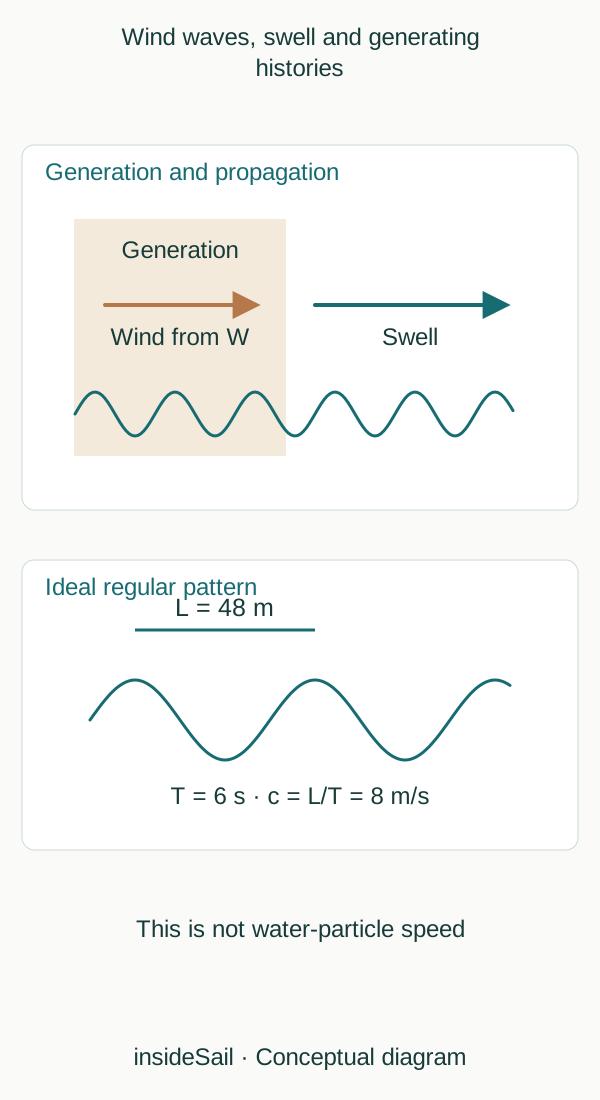
Conceptual schematic not to scale; no local forecast or operational decision.
insideSailOriginal insideSail artwork — all rights reservedEnlarge the diagram
Local generation and propagation
Wind waves are associated with generating wind in the region considered. Swell describes waves that have propagated beyond their generating area.
The distinction concerns generation rather than a universal height boundary. Swell can coexist with wind waves from another direction.
Total sea combines these components; its statistical representation is not obtained simply by stacking and adding every height number.
Height, period and wavelength are different dimensions. Period describes time between equivalent phases in the stated frame; wavelength is distance between them.
For an ideal regular wave, phase speed equals wavelength divided by period. It is not automatically water-particle speed or boat speed.
An irregular sea contains components with different periods and directions, so one drawn sine curve is only a conceptual tool.
Approaching shallower water, waves can change speed, length, direction and form. Transformation depends on bathymetry and components, not just local wind.
The existing lesson explains significant height and period; this one adds generating and propagating history. Interpreting a breaking area or passage is applied material, without an operating rule in this diagram.
Wave components can cross. One crest direction combined with another produces a surface more complex than a single profile.
Observed wave height depends on that combination and is not constant from wave to wave. A sea statistic summarises part of the set.
Mean period, peak period and the ideal example wave’s period are different quantities too.
An advancing crest does not imply that one water parcel travelled with it throughout. Local water motion and pattern propagation are distinct relationships, with mean transport and current potentially superimposed.
The diagram does not show exact circular particle paths valid at every depth. Separating wave and current allows sea interpretation without turning every propagation arrow into water velocity.
- Strength, duration and fetch influence generation.
- Wind waves and swell distinguish relationships to origin.
- Phase speed is not water or boat speed.
Concepts in this lesson
Fetch
Distance over water in the relevant direction along which wind acts in wave generation.
Swell
Waves that have propagated outside their generating region.
Wind wave
Wave associated with generating wind in the region considered.
Sources and references
- Estado do mar nas praias ↗
IPMA · Wave parameters and model-grid point explanation.
No current numerical forecast or model-resolution recommendation imported.
Checked on - Previsão costeira — legenda ↗
IPMA · Legenda: mar total and ondulação; separate period and peak-period columns.
Only vocabulary/product distinctions used; no live forecast values or beach image.
Checked on - Waves — Currents Tutorial ↗
NOAA National Ocean Service · Wind speed, duration and fetch; wave approach to coast.
Physical generation factors only; no surf-zone operating rule.
Checked on
Keep discovering
The next piece of the puzzle
Discuss this concept
Loading the conversation…