By insideSail
AI-assisted editorial review · version 3 ·
Yacht lights: sailing, machinery and anchoring
The same hull can require different sets; a tricolour lantern is not a masthead light.
In this guide
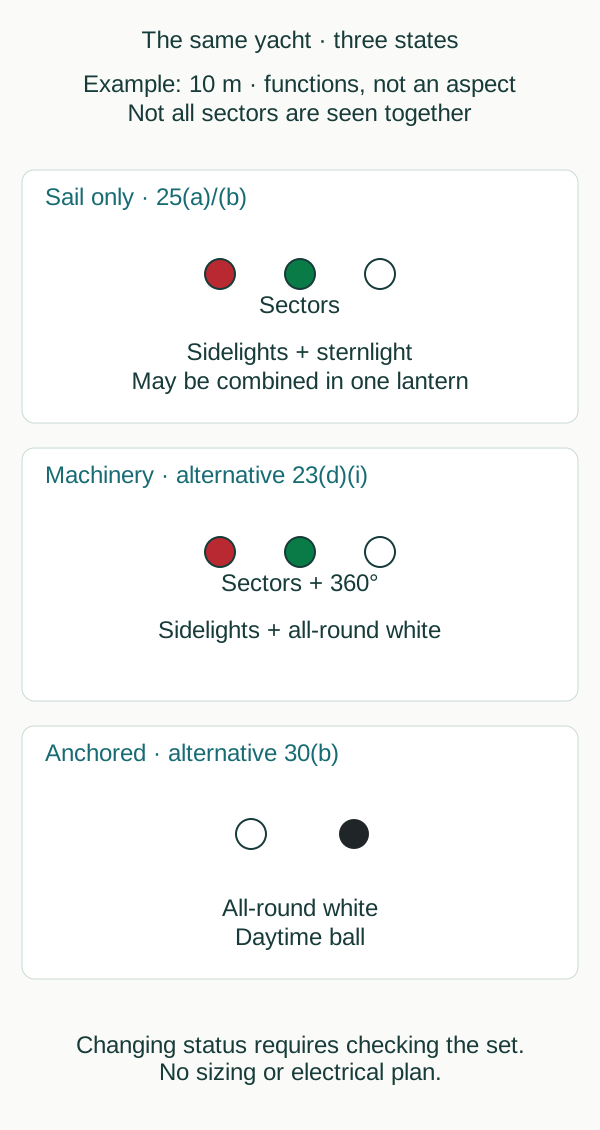
Original interpretation schematic with declared functions and references. No scale, approved installation or operational track.
insideSailOriginal insideSail artwork — all rights reservedEnlarge the diagram
Consider a fictional ten-metre yacht. Sailing without machinery, using machinery for propulsion and anchoring change the relevant status.
Lights must correspond to that status. Switching on every lantern to be more visible can confuse the message, and some combinations are expressly incompatible.
Start with Rules 3, 20 and 21, then identify the provision in 23, 25 or 30. The drawing represents sets of functions, not wiring or an approved installation.
Under sail alone: sidelights and sternlight
Rule 25(a) prescribes sidelights, red to port and green to starboard, and a white sternlight. For a sailing vessel under twenty metres, 25(b) permits their combination in a lantern at or near the mast top where best seen.
It is commonly called a tricolour, but its three colours remain in sectors: they are not three all-round lights. One physical lantern can provide three defined functions.
The additional arrangement in 25(c) is red over green, both all-round, at or near the mast top, alongside the set in 25(a). It must not be used with the combined lantern in 25(b).
Red over green does not replace sidelights and sternlight on its own. Below seven metres, 25(d)(i) requires prescribed lights if practicable; otherwise a white electric torch or lighted lantern must be ready at hand and exhibited in sufficient time to prevent collision.
That alternative cannot be transferred to a ten-metre yacht.
Under machinery: a function change is not all lights on
Under Rule 23(a), a power-driven vessel underway shows masthead, sidelights and sternlight; the second masthead abaft and higher becomes compulsory from fifty metres and optional below. Masthead here means a white 225-degree light, not its location at the physical mast top.
A sailing tricolour does not provide that function. Rule 23(d)(i) allows an all-round white light and sidelights instead of 23(a) below twelve metres.
That is not the ordinary alternative at exactly twelve metres.
Anchoring and the figure’s limits
Rule 30(a) prescribes all-round white forward and another lower aft, but 30(b) permits one all-round white light below fifty metres where best seen. The ball is the day shape.
The under-seven-metre exception in 30(e) depends on location as well as length. Being aground differs and can add signals.
Minimum ranges come from 22; positioning, separation, sectors and approval come from Annex I.
The schematic’s colours and functions are exact for the stated cases; dot size is not intensity, range or lantern size. Not all sectors are visible from the same viewpoint.
This reading prepares checking an individual vessel’s light plan against technical documentation and the competent authority. It neither certifies an installation from a photograph nor derives encounter responsibility from one observed white light.
Sources and references
- RIEAM / COLREGs — Rule 25: Sailing vessels underway and vessels under oars ↗
Instituto Hidrográfico / International Maritime Organization · Rule 25, normative Portuguese printed p.39 (PDF p.45); International English cross-check in USCG handbook.
Rule 25; IH normative Portuguese printed p.39, PDF p.45; English International column cross-check. Individual provision commencement not established: valid_from remains null.
Checked on - RIEAM / COLREGs — Rule 20: Application of lights and shapes ↗
Instituto Hidrográfico / International Maritime Organization · Rule 20, normative Portuguese printed p.29 (PDF p.35); International English cross-check in USCG handbook. Rule 21, normative Portuguese printed p.29 (PDF p.35); International English cross-check in USCG handbook.
Rule 20; IH normative Portuguese printed p.29, PDF p.35; English International column cross-check. Individual provision commencement not established: valid_from remains null. Rule 21; IH normative Portuguese printed p.29, PDF p.35; English International column cross-check. Individual provision commencement not established: valid_from remains null.
Checked on - USCG amalgamated rules — International current web cross-check ↗
United States Coast Guard Navigation Center · International/shared Rules 3,20–30,32–35; International Annexes I–III. International-only wording identified by angle-bracket legend; all Inland insertions excluded. Rule35(j)/(k) compared with IH normative Portuguese printed55/PDF61 and English appendix89–90/PDF95–96.
Directly read 11 October2026 alongside freshly fetched corrected-August2024 official handbook. Current page confirms under12 paragraph(j) and pilot(k); Portuguese IH agrees; its English appendix differs. Access is not qualified legal approval. No unsupported exact consolidation date assigned.
Checked on - RIEAM / COLREGs — Rule 23: Power-driven vessels underway ↗
Instituto Hidrográfico / International Maritime Organization · Rule 23, normative Portuguese printed p.31 (PDF p.37); International English cross-check in USCG handbook.
Rule 23; IH normative Portuguese printed p.31, PDF p.37; English International column cross-check. Individual provision commencement not established: valid_from remains null.
Checked on - RIEAM / COLREGs — Rule 2: Responsibility ↗
Instituto Hidrográfico / International Maritime Organization · Rule 3, normative Portuguese printed p.3 (PDF p.9); International English cross-check in USCG handbook.
Rule 3; IH normative Portuguese printed p.3, PDF p.9; English International column cross-check. Individual provision commencement not established: valid_from remains null.
Checked on - RIEAM / COLREGs — Rule 22: Visibility of lights ↗
Instituto Hidrográfico / International Maritime Organization · Rule 22, normative Portuguese printed p.30 (PDF p.36); International English cross-check in USCG handbook.
Rule 22; IH normative Portuguese printed p.30, PDF p.36; English International column cross-check. Individual provision commencement not established: valid_from remains null.
Checked on - COLREGs Annex I — Positioning and technical details of lights and shapes ↗
Instituto Hidrográfico / International Maritime Organization · Annex I; printed p.65, PDF p.71; International cross-check USCG.
Annex I, IH printed p.65 (PDF p.71); cross-check International annex in USCG handbook. Installation/approval is not taught. International/Inland distinction checked in the USCG PDF: International §3(a) half-length/100m agrees with IH; the quarter-length/50m value belongs to U.S. Inland and is not imported. No dimensional installation prescription is reproduced.
Checked on - RIEAM / COLREGs — Rule 29: Pilot vessels ↗
Instituto Hidrográfico / International Maritime Organization · Rule 30, normative Portuguese printed p.49 (PDF p.55); International English cross-check in USCG handbook.
Rule 30; IH normative Portuguese printed p.49, PDF p.55; English International column cross-check. Individual provision commencement not established: valid_from remains null.
Checked on
Regulatory references
- Regra 21 / Rule 21 — Definições de luzes / Definitions of lights ↗
COLREG 1972 as amended; IH 9th edition September 2025 / International cross-check August 2024 · International Maritime Organization · International convention; national/local implementation must be checked
Verified on - Annex I — Positioning and technical details of lights and shapes ↗
COLREG 1972 as amended; consolidated documents consulted 11 October 2026 · International Maritime Organization · International; flag authority approval
Verified on - Regra 22 / Rule 22 — Alcance das luzes / Visibility of lights ↗
COLREG 1972 as amended; IH 9th edition September 2025 / International cross-check August 2024 · International Maritime Organization · International convention; national/local implementation must be checked
Verified on - Regra 30 / Rule 30 — Navios fundeados e navios encalhados / Anchored vessels and vessels aground ↗
COLREG 1972 as amended; IH 9th edition September 2025 / International cross-check August 2024 · International Maritime Organization · International convention; national/local implementation must be checked
Verified on - Regra 20 / Rule 20 — Aplicação de luzes e balões / Application of lights and shapes ↗
COLREG 1972 as amended; IH 9th edition September 2025 / International cross-check August 2024 · International Maritime Organization · International convention; national/local implementation must be checked
Verified on - Regra 23 / Rule 23 — Navios de propulsão mecânica a navegar / Power-driven vessels underway ↗
COLREG 1972 as amended; IH 9th edition September 2025 / International cross-check August 2024 · International Maritime Organization · International convention; national/local implementation must be checked
Verified on - Regra 3 / Rule 3 — Definições gerais / General definitions ↗
COLREG 1972 as amended; IH 9th edition September 2025 / International cross-check August 2024 · International Maritime Organization · International convention; national/local implementation must be checked
Verified on - Regra 25 / Rule 25 — Navios à vela a navegar e navios a remos / Sailing vessels underway and vessels under oars ↗
COLREG 1972 as amended; IH 9th edition September 2025 / International cross-check August 2024 · International Maritime Organization · International convention; national/local implementation must be checked
Verified on
Keep discovering
The next piece of the puzzle
Discuss this concept
Loading the conversation…