By insideSail
Published without technical review · version 2 ·
Abandonment: decision, preparation and transfer
Preparing survival equipment is not the same as deciding to enter it.
In this guide
Abandonment means ceasing to use the vessel as the main protection. Consequences include loss of shelter, volume, resources and many communication and locating capabilities.
Remaining aboard can nevertheless become untenable. This lesson offers no clock or rule resolving every fire or flooding case.
It separates evolving danger, preparation of an alternative and actual transfer of people. Those tasks can overlap without becoming the same decision.
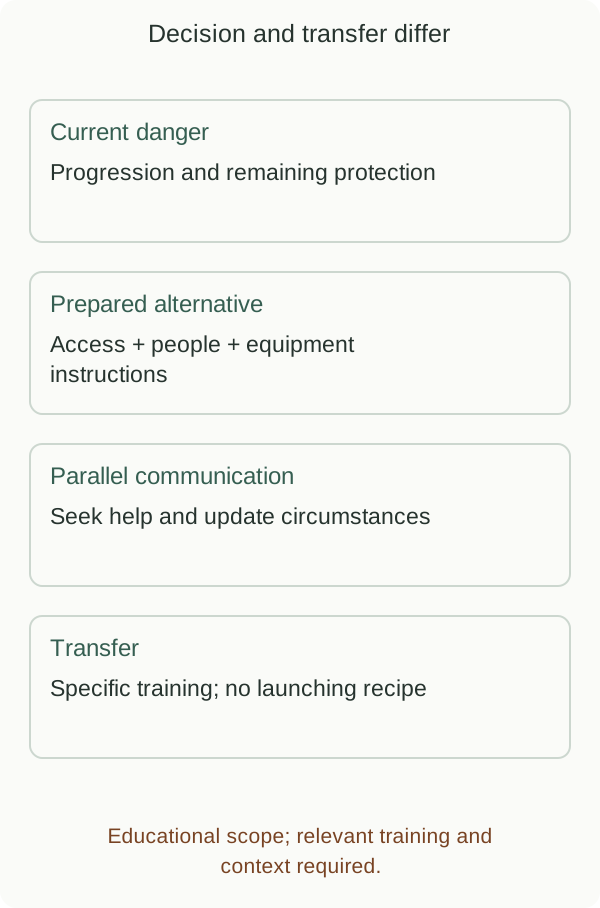
Educational scope; relevant training and context required.
insideSailOriginal insideSail artwork — all rights reservedEnlarge the diagram
The actual threat and actual alternative
A vessel still offering protection should not be left reflexively merely because a raft is available. Waiting until survival equipment becomes inaccessible can remove options too.
Decisions depend on actual progression, controllability, external conditions, people and assistance. A tender is not automatically equivalent to a survival liferaft.
Specification, capacity, stowage and servicing need understanding before departure rather than discovery during crisis.
Preparation includes location and access route, not just equipment presence. A blocked hatch, heavy container or limited mobility can affect transfer.
Identifying who assists each person and who maintains communication reduces gaps without certifying a procedure. The specific raft and installation require their instructions.
Activation, release and connection must not be inferred from a generic diagram or another raft used in training.
People, information and survival resources
People counts need clear confirmation. Communication planning distinguishes seeking help, updating circumstances and retaining means after transfer.
Identity, position, problem and people count assist response; an earlier position may need updating. A grab bag needs accessibility and must correspond to the capabilities actually inside.
Its existence guarantees neither charged phone, functioning light nor personally assessed medication.
Water and cold exposure, boarding and separation create distinct risks. Direct transfer to survival equipment differs from entering the water.
Jumping or swimming is not a universal recommendation. Competent assistance, equipment instructions and survival training shape preparation.
Locating and communication remain important after transfer; an alert is no guarantee of reception or arrival within a stated time.
Train without manufacturing an emergency
Compare known information, accessible resources and hazard progression at two times. The exercise issues no abandonment order after a checklist score.
Where survival preparation can proceed without added exposure, discuss that function separately from transfer. Count people and identify assistance needs.
A bag previously accessible can become unavailable; that change matters more than the initial photograph. Communication should keep current circumstances understandable to rescue coordination.
An instructor assesses scenario, layout and training equipment without deploying an in-service raft or ordering water entry for realism. The useful conclusion identifies a changed option and unresolved question, rather than pretend a classroom diagram decides when every real crew should leave its vessel.
Survival demonstrations use training equipment and controlled conditions. Deploying an in-service raft out of curiosity can remove a safety resource and require specialist servicing.
Training records should distinguish recognition, explanation and supervised execution. This lesson replaces neither specific instructions nor supervised real-world transfer assessment.
Sources and references
- Basic Rescue Boat Operator Manual — June 2023 ↗
International Maritime Rescue Federation · Printed pp.97–100: alert, observation, separation of approach/recovery, examples of recovery equipment; p.72 maintenance.
Official PDF obtained in the previous source review, read again locally on 11 October 2026. The RNLI 2019 link returned 404 and is not counted as newly verified. SAR boat approach distances and towing methods are not adopted.
Checked on - Liferaft ↗
Royal Yachting Association · Purpose, specification and carriage context.
Live guidance consulted; no reproduction of ISO 9650 text or claim of European carriage law.
Checked on - Sailing grab bags: what do you keep in yours? ↗
Royal Yachting Association · Opening purpose; liferaft contents vary; accessibility; rescue/survival categories.
Selected functions only. Published packing list and buoyancy specification not reproduced; no medication recommendations.
Checked on
Keep discovering
The next piece of the puzzle
Discuss this concept
Loading the conversation…