By insideSail
Published without technical review · version 2 ·
Emergencies: parallel roles and confirmed information
Coordination prevents gaps and helps identify changes early.
In this guide
Initial emergency descriptions are often incomplete. Someone sees water, another notices a smell and a third does not understand the instruction.
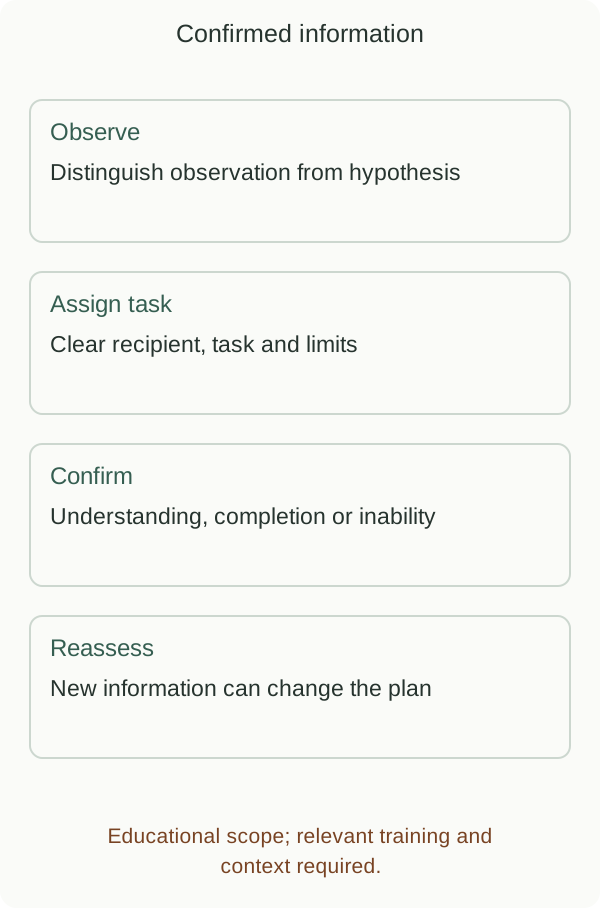
Useful organisation separates observation, decision, action and confirmation. It neither removes uncertainty nor creates a checklist solving every incident.
It identifies responsibilities, ongoing vessel control and information that could change the plan. Personal safety limits every task even under time pressure.
Educational scope; relevant training and context required.
insideSailOriginal insideSail artwork — all rights reservedEnlarge the diagram
Parallel roles with actual capacity
Helming and lookout, communication, care and incident control can compete for the same people. A two-person yacht cannot reasonably copy a ten-person vessel’s allocation.
Planning must expose priorities, feasible simultaneous tasks and gaps. If someone becomes unavailable, allocation changes.
A person should not enter danger merely because a card assigned “damage control”. A role grants neither competence nor protection.
An instruction should identify task, recipient and expected confirmation. “Someone check the radio” leaves responsibility diffuse.
During training, the recipient confirms understanding and reports inability instead of guessing. Coordination distinguishes confirmed completion from an instruction merely issued.
This cycle reduces misunderstanding without demanding lengthy exchanges that delay assistance. Communication remains brief and suited to hearing, language and motion constraints.
Observation and hypothesis differ
“Water above the previous level” is an observation; “the engine hose caused it” may be a hypothesis. Both help when labelled.
Treating a hypothesis as certain can send people to the wrong area and hide other causes. Records include time, location and development when possible without diverting critical attention.
Photography and apps do not outrank assistance or vessel control. Missing data should be acknowledged rather than filled automatically to complete a narrative.
Seeking assistance and controlling a problem can proceed in parallel. Waiting for a perfect technical diagnosis can lose time, while a confused message reduces usefulness.
Available knowledge should support identity, position, people and danger, followed by updates. Priority and communication means belong to radio training and circumstances.
The platform handles no distress calls and replaces no coordination centre. Community comments are outside the response chain.
Reassess and learn without exposing people
A role board can separate observation, assigned task and confirmation. The instructor introduces a change without exposure: misunderstood message, unavailable resource or incapable helper.
Participants identify the gap and adapt to actual capacity without inventing a diagnosis before communicating again. A task lacking a recipient should be revealed by confirmation, not marked completed by assumption.
The board is a training tool rather than mandatory paperwork during every crisis. Where records exist, keep facts and hypotheses separate and personal information private.
This discipline permits learning without manufacturing a perfect retrospective story. It also makes differing recollections visible instead of treating the most confident recollection as an unquestionable technical fact.
New information must be able to change the plan. Persistence is no virtue when danger has changed.
Subsequent learning distinguishes equipment, access, training and coordination problems. Health records and identities need not be public; community discussion can use anonymised cases.
Sources and references
- Basic Rescue Boat Operator Manual — June 2023 ↗
International Maritime Rescue Federation · Printed pp.97–100: alert, observation, separation of approach/recovery, examples of recovery equipment; p.72 maintenance.
Official PDF obtained in the previous source review, read again locally on 11 October 2026. The RNLI 2019 link returned 404 and is not counted as newly verified. SAR boat approach distances and towing methods are not adopted.
Checked on - Yacht sailing and motorboating ↗
RNLI · Safety checklist: briefing, training, weather, shore contact and means of help.
Preparedness guidance only. No statistics or comparative risk scores imported.
Checked on - Recommendation ITU-R M.541-11 — DSC operational procedures ↗
International Telecommunication Union · November 2023; Annex 1 §§2–5 and Annex 3 §§1–3; routine Annex 2; inadvertent alerts A 3-1.7.
Official PDF and recommendation status directly checked. No copied full distress script. Distress acknowledgements/relays and MF/HF procedures are outside the beginner exercise.
Checked on
Keep discovering
The next piece of the puzzle
Discuss this concept
Loading the conversation…