By insideSail
Published without technical review · version 2 ·
Distress, urgency or safety: what is the message?
Priority describes the need, not the drama in someone’s voice.
In this guide
MAYDAY, PAN PAN and SECURITÉ indicate different maritime radio functions. Recognising the words is insufficient: understand the situation being communicated and the assistance required.
Distress concerns grave and imminent danger and the need for immediate assistance. Urgency communicates an urgent matter involving a vessel’s or person’s safety without that same distress declaration.
Safety precedes important navigational or meteorological safety information. Classification affects priority and the people listening.
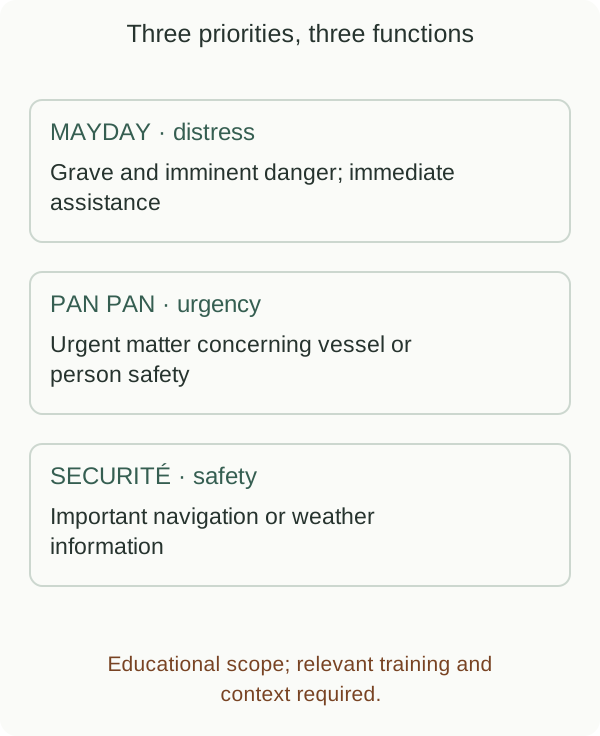
Educational scope; relevant training and context required.
insideSailOriginal insideSail artwork — all rights reservedEnlarge the diagram
Describe the actual situation first
Engine failure has no universal priority word. In sheltered water with control and alternatives, circumstances can differ from drifting towards a dangerous shore.
The category must reflect current danger, available time and vessel and crew capabilities. A low priority should not be selected out of embarrassment when immediate assistance is needed.
Nor should an emergency be invented to obtain faster attention. Assessment needs current information and competent guidance.
| Category | What must be clear |
|---|---|
| Distress | Grave and imminent danger; immediate assistance needed. |
| Urgency | An urgent safety matter and the assistance or information sought. |
| Safety | Relevant navigational or meteorological safety information. |
Messages need intelligible identity, position and problem description. Information volume should not conceal essentials.
A position needs its format and currency; an earlier marked point does not prove a casualty’s current location. People aboard and immediate constraints may matter to the response.
These are preparation elements, not a complete transcription of calling, repetition, acknowledgement and subsequent traffic procedures.
Priority can change
A controlled situation can deteriorate. Fire, increasing water ingress or loss of a safe alternative may require the communication to reflect that change.
An earlier report does not require maintaining its original category. People coordinating assistance need to know what changed.
Updating circumstances does not mean experimenting with categories on a live radio; training uses a simulator, while operation follows applicable procedures and operator competence.
Listening is also a responsibility
Distress traffic is not a public conversation inviting commentary. Interference can obstruct critical information.
Acknowledgement, relaying and cancellation have rules distinguishing ship and coast stations. Someone lacking competence should not improvise a relay after recognising a word.
Preparation includes attentive listening, recording information and acting within competence. Hearing a request establishes neither that help has arrived nor that applicable responsibilities have ended.
To classify a card, state current danger, required assistance and unknowns. Two groups can receive the same failure under different exposure and explain changed needs; the instructor resolves priority with complete context.
Avoid exercises where the answer seems embedded in a word such as “engine” or “injured”: severity, progression and alternatives matter. New information retains its chronology and the change requiring an update.
A prior report does not remove current observation. Learning makes classification explainable and procedurally sound instead of building a failure-name lookup table.
The exercise should also reveal when insufficient information prevents a confident conclusion rather than reward guessing a radio priority quickly.
Navigational safety information also relates to official warnings and the affected area; a social feed is not a maritime safety broadcast. Examples are original, not complete radio scripts.
Sources and references
- GMDSS VHF DSC procedures for small boat users ↗
Maritime and Coastguard Agency · Updated 24 July 2024: distress, urgency and safety functions; listening and communication discipline.
Official page directly consulted for functional distinctions only. No complete script, delay, button sequence or unrestricted relay instruction copied. National implementation and qualified operator training remain necessary.
Checked on - The Global Maritime Distress and Safety System ↗
Maritime and Coastguard Agency · System functions; pleasure-craft DSC guidance.
UK explanatory guidance directly read. Its small-craft voluntary statement is not exported as a European carriage rule.
Checked on - Recommendation ITU-R M.541-11 — DSC operational procedures ↗
International Telecommunication Union · November 2023; Annex 1 §§2–5 and Annex 3 §§1–3; routine Annex 2; inadvertent alerts A 3-1.7.
Official PDF and recommendation status directly checked. No copied full distress script. Distress acknowledgements/relays and MF/HF procedures are outside the beginner exercise.
Checked on
Regulatory references
- ITU-R M.541-11 ↗
November 2023 · ITU · International maritime radio service
Verified on
Keep discovering
The next piece of the puzzle
Discuss this concept
Loading the conversation…