By insideSail
Published without technical review · version 2 ·
Marine VHF: prepare understandable communications
Channel, identity, position and listening before transmission.
In this guide
Marine radio connects voice to others and may integrate digital alerts. Those functions are not interchangeable: DSC can announce a situation while voice adds information.
Identify and configure equipment according to instructions and national rules. Station licensing, identity and operator qualification are different layers; buying a radio does not resolve them.
This lesson supports accompanied training without real practice transmissions.
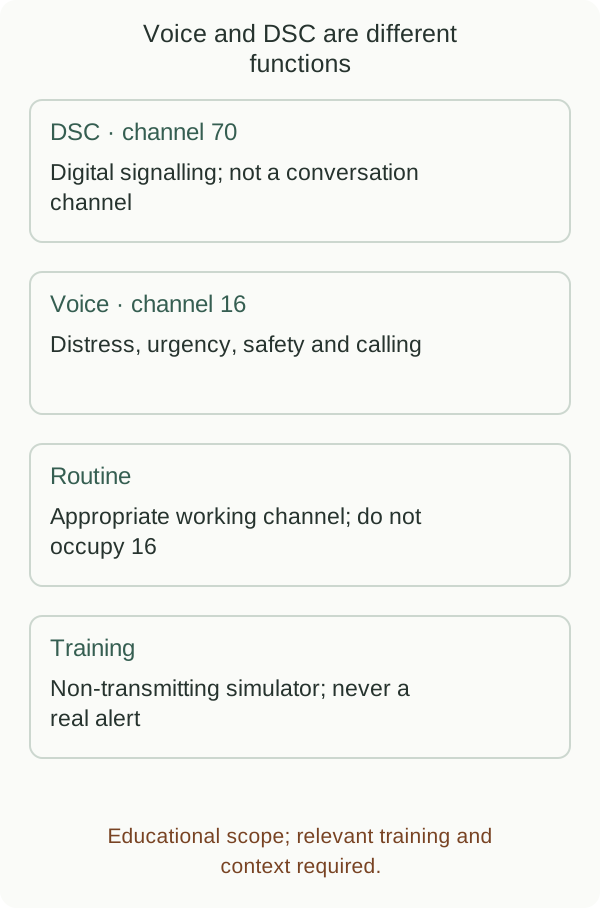
Educational scope; relevant training and context required.
insideSailOriginal insideSail artwork — all rights reservedEnlarge the diagram
Prepare identity and position
Boat name, call sign and MMSI should match documents and equipment where applicable. Displayed coordinates need a known source and currency.
An older position should not be transmitted as current. The briefing shows where information is found and how a missing connection is recognised.
A fictional identity is never programmed into operational equipment merely to demonstrate a display.
Voice and DSC use different functions
Marine VHF channel 70 is reserved for DSC rather than voice conversation. Channel 16 serves distress, urgency, safety and calling under applicable procedures.
Routine communication can move to an appropriate working channel. Long conversations do not remain on the calling channel, and a channel is not chosen merely because it sounds quiet.
Understand local availability and authority instructions before departure.
A routine exercise without transmitting
- Define the intended station and purpose in a simulator.
- Locate identity, position and appropriate channel.
- Listen before speaking and prepare a brief message.
- Confirm that a response is addressed to your boat.
- Record instructions and repeat critical information to resolve ambiguity.
Clarity matters more than decorative formality. Separate identity, position and request; avoid mixing coordinate formats without a declared convention.
Numbers and names need shared understanding, and uncertain instructions need clarification. This lesson supplies neither a copied complete script nor a substitute for operator training.
Exercises use fictional cards or a non-transmitting simulator to learn without occupying channels or raising alerts.
Accidental alert: do not disappear from communications
An accidental alert requires the appropriate cancellation procedure, including communication with potential recipients. Turning off the radio does not automatically inform authorities of an error.
ITU procedures distinguish cancellation, reception and relaying; those tasks should not be confused. Teach the specific sequence through operator training and equipment instructions.
Distress relays and acknowledgements have their own rules and are not unrestricted beginner exercises.
An information card separates identity, position, time and need. Participants identify each field and origin first: exercise coordinates are fictional rather than broadcast information.
Blank fields remain unknown. Clarity also depends on listening to the intended recipient and distinguishing instructions from another station’s commentary.
In a simulator, the instructor can present incomplete information to practise clarification without live traffic. The test teaches neither identity programming nor acknowledgement of another vessel’s distress.
Its outcome is preparation discipline and function recognition, while qualified operation and national requirements remain for appropriate training. Keeping a written card aboard can help organise information, but only when it is current and understood rather than copied from another boat.
International references guide procedures but do not identify every European boat’s licensing authority. Sources retain version, jurisdiction and consultation date.
Sources and references
- Decreto-Lei 93/2018 — Regime jurídico da náutica de recreio ↗
Diário da República / DGRM · 13 November 2018 official publication; recreational-craft and skipper legal framework.
Historical enactment PDF directly consulted; this is not an assertion that all provisions remain unamended. Consolidation and current implementing equipment rules require Portuguese legal review.
Checked on - Recommendation ITU-R M.541-11 — DSC operational procedures ↗
International Telecommunication Union · November 2023; Annex 1 §§2–5 and Annex 3 §§1–3; routine Annex 2; inadvertent alerts A 3-1.7.
Official PDF and recommendation status directly checked. No copied full distress script. Distress acknowledgements/relays and MF/HF procedures are outside the beginner exercise.
Checked on
Regulatory references
- ITU-R M.541-11 ↗
November 2023 · ITU · International maritime radio service
Verified on - Regime jurídico da náutica de recreio ↗
DL 93/2018 original publication, not consolidated · República Portuguesa / DGRM · Portugal
Verified on
Keep discovering
The next piece of the puzzle
Discuss this concept
Loading the conversation…