By insideSail
Published without technical review · version 2 ·
GMDSS: alert, communicate and receive information
A system of functions and services, not just a radio with a button.
In this guide
GMDSS stands for Global Maritime Distress and Safety System. It combines maritime communication functions including sending and receiving alerts, emergency communication and safety information.
It names neither a single appliance nor a certificate that a yacht is ready for every voyage. For a beginner, distinguish the need, the chosen means and the service actually able to receive that communication in the intended area.
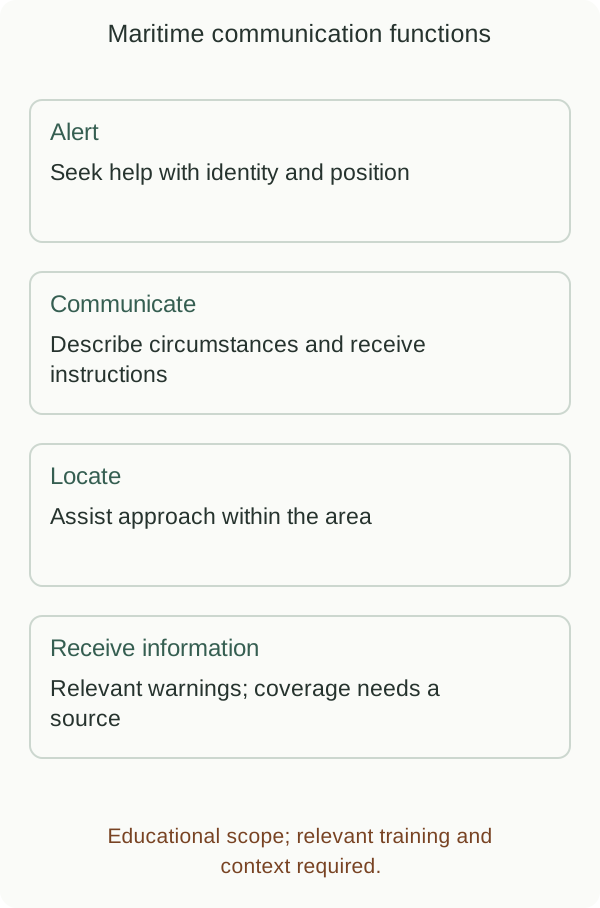
Educational scope; relevant training and context required.
insideSailOriginal insideSail artwork — all rights reservedEnlarge the diagram
Four different questions
| Question | Example function |
|---|---|
| How do we seek help? | An identifiable alert and position information. |
| How do we explain events? | Intelligible follow-up communication. |
| How do we help approaching rescuers? | Local locating and status information. |
| How do we receive warnings? | Relevant maritime safety information. |
DSC, EPIRB, information reception and voice communication are not synonyms. A digital alert can carry identity and position without explaining every detail available through voice.
A locating device can assist approach without providing conversation. Selection depends on coverage, installation, power, identity and operation.
Several boxes do not demonstrate independence: shared electrical circuits or antennas can create a common failure.
A DSC VHF requires correctly configured identity and current position. Stale coordinates may accompany an alert and suggest the wrong location.
Menus differ between models; entering identities or experimenting with alerts without instructions can have consequences. This lesson uses a relationship diagram and simulator to examine information flow.
It supplies no programming steps, button sequence or radiated test instructions.
Coverage and obligation are different
GMDSS sea-area classifications relate to services and coverage defined internationally. They should not become a universal distance from shore.
An approximate VHF distance does not establish guaranteed coverage: terrain, antenna height, installation and reception matter. Preparation needs relevant official area information and suitable equipment.
A mobile phone can be useful where it works, but observed service at one point does not guarantee communication throughout a voyage.
Carriage requirements depend on flag, use, size and voyage type among other factors. British small-pleasure-craft guidance creates no European exemption.
An offshore race requirement is not automatically law for every vessel. Keep regulatory references separate from radio specifications and owner opinions.
“I have GMDSS” needs unpacking into verifiable capabilities and documents rather than acceptance as a guarantee.
Build a function-to-equipment matrix, leaving undocumented cells empty. Separate alerting, follow-up communication, local locating and information reception.
Add power, antenna, configuration and competent operator. The matrix asks whether one shared failure removes several functions without claiming an answer unsupported by the installation.
One appliance can supply multiple functions while depending on external elements. Training requires neither actual power interruption nor transmitted calls.
It prepares the missing documents and competent assessment while retaining operation area and relevant services. A blank cell is a question to resolve, not a reason to invent a capability or assume another crew member knows how to operate the equipment.
The platform guarantees no coverage and dispatches no assistance. Equipment and communication references retain their versions.
Understanding functions prepares questions for training and installation assessment without replacing either.
Sources and references
- MGN 599 (M) Amendment 1 — pleasure vessels guidance ↗
UK Maritime and Coastguard Agency · Pleasure-vessel scope; equipment/legal distinctions; §7.4 voyage planning.
UK guidance, not European law. Statutory applicability must be checked against the actual flag, use and vessel; no Class XII checklist transferred to a 10 m yacht.
Checked on - The Global Maritime Distress and Safety System ↗
Maritime and Coastguard Agency · System functions; pleasure-craft DSC guidance.
UK explanatory guidance directly read. Its small-craft voluntary statement is not exported as a European carriage rule.
Checked on - Recommendation ITU-R M.541-11 — DSC operational procedures ↗
International Telecommunication Union · November 2023; Annex 1 §§2–5 and Annex 3 §§1–3; routine Annex 2; inadvertent alerts A 3-1.7.
Official PDF and recommendation status directly checked. No copied full distress script. Distress acknowledgements/relays and MF/HF procedures are outside the beginner exercise.
Checked on
Regulatory references
- ITU-R M.541-11 ↗
November 2023 · ITU · International maritime radio service
Verified on
Keep discovering
The next piece of the puzzle
Discuss this concept
Loading the conversation…