By insideSail
Published without technical review · version 2 ·
EPIRB, PLB and AIS MOB: functions and identity
Distinguish satellite alerting, local locating and correct registration.
In this guide
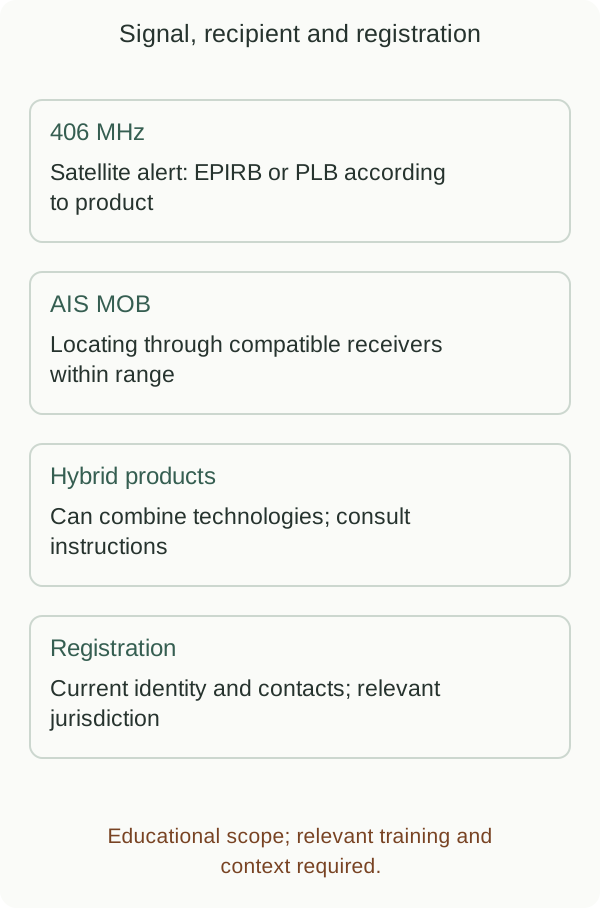
A beacon helps when its function matches the need and it can actually be used. EPIRB is associated with a vessel, PLB is personal, and AIS MOB describes locating a person overboard through compatible AIS reception.
Those names do not describe every product’s capabilities. Some devices combine technologies.
Before comparing, separate alert recipient, locating method, activation and physical connection to wearer or vessel.
Educational scope; relevant training and context required.
insideSailOriginal insideSail artwork — all rights reservedEnlarge the diagram
Who can receive the signal?
406 MHz beacons transmit alerts through the search-and-rescue satellite system. AIS depends on compatible reception within relevant range; a target on the yacht’s own display differs from an alert routed to a rescue coordination centre.
AIS MOB products do not necessarily share identical functions, and a hybrid is not simply AIS. Product documentation must identify included technologies, integration and limitations.
This lesson certifies no interoperability.
Registration connects transmitted identity with information that helps clarify an incident. Contacts, associated vessel and ownership changes need currency.
A second-hand device can retain an earlier owner’s details; changing a hull label does not resolve that. Registry, coding and documentation depend on device and country.
The platform can privately record the owner’s declared registration work without publishing identification numbers or emergency contacts.
A concrete legal example without an invented European rule
UK MGN 665 Amendment 1, published 24 March 2026, explains EPIRB and 406 MHz PLB registration on UK-flagged ships and other covered categories. It expressly distinguishes registration when carried from acquisition or carriage requirements established elsewhere.
This prevents two errors: “purchase is not required, therefore registration is unnecessary” and “registration is compulsory, therefore everyone must buy one”. Portuguese applicability needs its own reference.
Carriage, attachment and activation are also specific. A PLB should not be assumed buoyant, nor a device on a lifejacket accessible after inflation.
Some activations are manual; others incorporate particular automatic mechanisms. Instructions and appropriate demonstration must show the actual configuration.
Testing must follow permitted procedures without sending a false alert. Advertised endurance and test conditions are not identical guarantees for all products or aged batteries.
A study record distinguishes model, private identity, declared technologies and instructions. Compare two specifications without ranking safety by acronym count.
Ask whether the expected recipient can receive the stated technology, how it is carried and what instructions require. A loaned device’s wearer and recorded contact can differ; current information needs the appropriate process.
Training, permitted self-test and distress activation are different acts. The diagram teaches no button presses: it shows relationships making assessment clearer before demonstration and national-applicability checks.
Do not publish identity codes to make the comparison look more complete; technical vocabulary can be explained while keeping personal registration and emergency-contact information private.
Codes, registration data and decontextualised activation sequences are not published. Local locating, remote alerting and recovery still need combined preparation.
A beacon neither makes a fall safe nor guarantees rescue arrival time.
Sources and references
- MGN 665(M+F) Amendment 1 — EPIRB and PLB registration ↗
Maritime and Coastguard Agency · Published 24 March 2026; §§2.5–2.6 carriage versus registration, §3.4 accuracy, §§6–7 updates and transfers.
Current official guidance directly consulted. It does not itself require acquisition of a beacon; UK applicability is explicit. Device-specific operating durations are not universalised.
Checked on - Lifejackets and buoyancy aids ↗
RNLI · Choosing/fitting a lifejacket; safety lanyards; sprayhood, light, whistle and locator; manufacturer inspection.
Public guidance directly consulted. Irish legal examples do not establish Portuguese or UK requirements.
Checked on - 406 MHz beacons ↗
Maritime and Coastguard Agency · EPIRB/PLB distinction, satellites and registration.
UK guidance directly read; registration authority depends on flag and device ownership.
Checked on
Regulatory references
- MGN 665(M+F) Amendment 1 ↗
24 March 2026 official guidance · MCA · United Kingdom flagged ships, hovercraft and relevant watercraft
Verified on
Keep discovering
The next piece of the puzzle
Discuss this concept
Loading the conversation…