By insideSail
Published without technical review · version 2 ·
Lifejacket, harness and boat connection: understand the system
Preventing a fall, remaining attached and floating are separate functions.
In this guide
A lifejacket supports flotation; harness and boat connection address restraint. One product can combine those functions without making them identical.
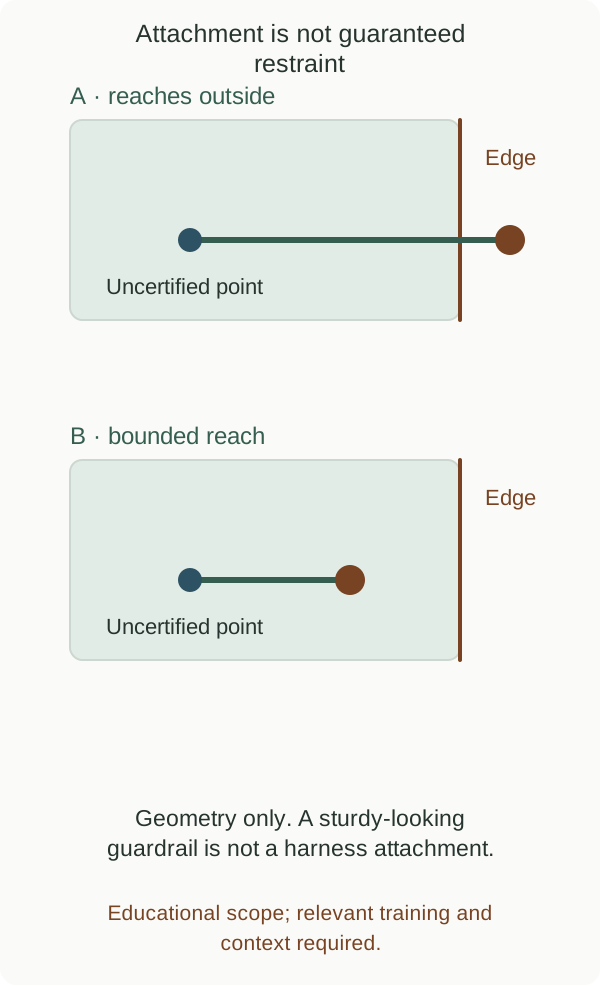
Geometry matters too: connection length, path and attachment location influence whether a person can fall outside. “Attached” means neither “unable to fall” nor “protected from dragging”.
Understanding the distinction is essential before trying an in-service connection.
Educational scope; relevant training and context required.
insideSailOriginal insideSail artwork — all rights reservedEnlarge the diagram
Restraint requires an identified assembly
Harness, tether, hook, fixed attachment and any jackstay belong to an assembly. Each component’s documentation and the installation must be consistent.
A guardrail should not be assumed suitable for harness attachment merely because it is nearby or looks strong. RYA guidance distinguishes appropriate attachment points from guardrails; the editorial drawing illustrates that distinction without installation dimensions or strength ratings.
Missing information must remain unknown.
Clothing, wearing and adjustment also affect function. An integrated harness may have different instructions from a separate one.
Hooks being present establishes neither correct closure nor load alignment. Practical assessment must identify product, attachment point and complete path.
Repositioning a component for mobility requires assessing restraint consequences rather than only noticing greater comfort.
A geometry comparison, not an installation specification
An attached fall remains an emergency
An attached person falling into the water can be dragged, held dangerously or unable to return. The RYA highlights drowning risk even while attached and the danger of being dragged into the propeller.
Response requires coordinated boat control and recovery appropriate to the individual vessel. Lifejacket or hook alone should not be expected to solve it.
The plan should be understood before anyone enters an exposed position.
Learn through controlled practice that does not expose a person to an actual fall. Discuss changing attachment points, preventing misuse and recognising a damaged component.
Execution and checking follow documentation and training rather than imitation of a photograph. Practice should allow interruption whenever uncertainty arises, without deliberately loading an assembly that has not yet been assessed.
Separate marketing promise from demonstrated function
On a tabletop plan, mark deck boundary and the path required by a task. Identify documented components and missing information.
If completing the task requires reaching beyond the boundary, attachment alone has not resolved exposure. The drawing selects neither tether length nor mounting point; it reveals a system-assessment question.
Treat mobility, restraint and recovery separately. Easy movement is an ergonomics observation rather than hook-strength evidence.
A proposed change needs reassessment of the assembly and what happens to a person after a fall, not adoption solely for comfort. Record which assumptions were examined so that another wearer or different task does not silently inherit an earlier conclusion.
“Ocean”, “pro” or “racing” in a product name does not approve an installed assembly. Declared marking has a scope; accessories and geometry have another.
An owner’s record should distinguish purchased equipment, installed configuration and documented assessment. No platform editorial score should replace that assessment.
Sources and references
- Safety lines: clipping on ↗
Royal Yachting Association · What is a safety line?; attachment points; mobility and risk; MAIB bulletin link.
Product/system recognition and risks directly read. ISO texts were not obtained; no compliance claim, numerical tether prescription or deck-anchor design.
Checked on - Lifejackets and buoyancy aids ↗
RNLI · Choosing/fitting a lifejacket; safety lanyards; sprayhood, light, whistle and locator; manufacturer inspection.
Public guidance directly consulted. Irish legal examples do not establish Portuguese or UK requirements.
Checked on
Keep discovering
The next piece of the puzzle
Discuss this concept
Loading the conversation…