By insideSail
Published without technical review · version 2 ·
Person in the water: maintain contact and coordinate recovery
Alerting, observation, approach and lifting are complementary tasks.
In this guide
A fall into the water can quickly turn a voyage into an emergency. The person may separate, disappear from view or become unable to cooperate.
A plan connects prevention, warning, visual contact, boat control, assistance and recovery. Tasks can proceed in parallel; waiting for a manoeuvre to end before communicating can delay help.
Boat approach ability also does not guarantee that the casualty can be brought aboard.
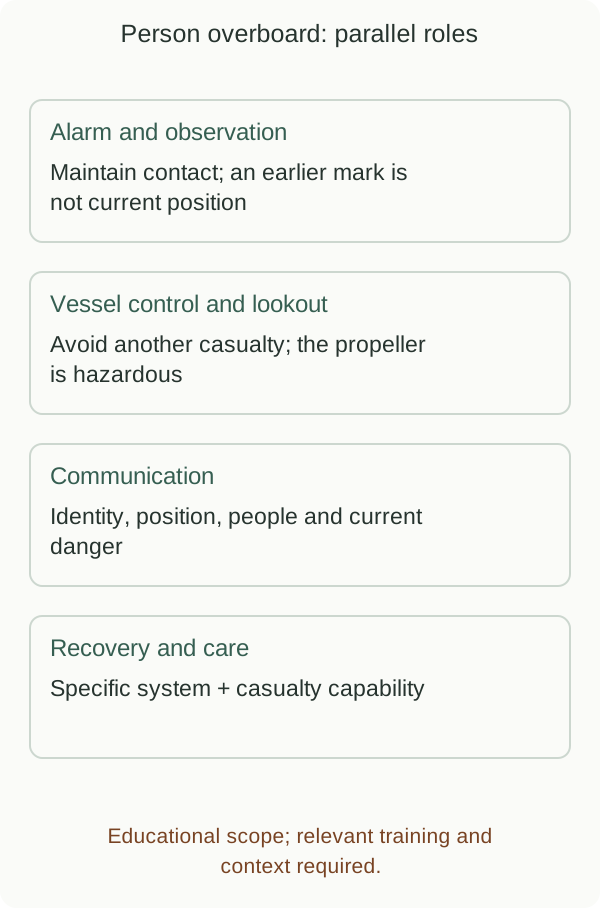
Educational scope; relevant training and context required.
insideSailOriginal insideSail artwork — all rights reservedEnlarge the diagram
Recognise and allocate functions
The warning should be unambiguous and understood by the crew. One person maintains observation and points out the casualty while others take previously understood roles.
A recorded device position is useful but is not the casualty’s current position after movement. Additional flotation can help when provided without exposing another crew member.
Communications include observations, position and situation changes rather than an invented clinical assessment.
Approach appropriate to boat and conditions
No track can be copied across all sailboats. Sail, engine, inertia, wind, current, access and crew preparation shape response.
A trained manoeuvre preserves contact and avoids striking the casualty with hull, equipment or propeller. Protection from propulsion near the person requires coordination and instructions appropriate to the system.
A teaching curve establishes no universal distance, speed or control-change moment.
Recover without adding casualties
An exhausted person may be unable to use their usual swimming ladder. An unconscious casualty cannot follow the same requests.
Prepare recovery for those scenarios using suitable equipment and load points. Any available halyard or fitting should not be improvised for lifting because it survived another job.
Rescuers’ positions and crushing or falling risks belong to the plan. An untrained rescuer should not enter the water impulsively.
After returning aboard
Leaving the water does not end assessment. Breathing, responsiveness, cold and possible injuries need attention and appropriate medical guidance.
Drowning involves respiratory impairment through immersion or submersion rather than only a fatal outcome. Someone able to speak may still need care.
Crew report observations and follow rescue-service guidance rather than assuming “back aboard” means no continuing risk.
A card or dummy exercise identifies who maintains observation and reports changes without interrupting control and lookout. A marked point describes one instant while casualty, water and vessel continue moving.
Ask participants to explain that distinction before discussing approach. A source’s rescue craft may differ from the yacht and authorises no copied track.
An instructor selects conditions and procedures appropriate to the actual vessel. Record unclear communication and unassigned tasks.
That information can improve the next briefing without exposing a real person or granting general rescue capability. A successful exercise is evidence about the bounded task and conditions, not proof that every later casualty can be approached and recovered the same way.
Exercises use suitable training targets and methods, permit interruption and never put people overboard merely for realism. Records distinguish practised tasks, installed resources and conditions.
Completing an educational exercise certifies neither crew nor individual vessel.
Sources and references
- Basic Rescue Boat Operator Manual — June 2023 ↗
International Maritime Rescue Federation · Printed pp.97–100: alert, observation, separation of approach/recovery, examples of recovery equipment; p.72 maintenance.
Official PDF obtained in the previous source review, read again locally on 11 October 2026. The RNLI 2019 link returned 404 and is not counted as newly verified. SAR boat approach distances and towing methods are not adopted.
Checked on - European Resuscitation Council Guidelines 2025 — First Aid ↗
European Resuscitation Council · Resuscitation 215 (2025) 110752: printed pp.2–5 expectations/assessment; drowning and hypothermia sections.
Published official PDF directly read. Not the consultation draft. No oxygen, drug doses, tourniquet application or paediatric treatment taught.
Checked on - Float to Live ↗
RNLI · Regain breathing control, flotation and calling for help.
Initial self-survival principles, not a swimming-rescue course or a guarantee in all sea states.
Checked on - European Resuscitation Council Guidelines 2025 — Special Circumstances ↗
European Resuscitation Council · Resuscitation 215 (2025) 110753: Drowning, trained rescue, ventilation and resuscitation.
Official published PDF consulted. Professional rescue scope is distinguished from untrained bystander care.
Checked on
Keep discovering
The next piece of the puzzle
Discuss this concept
Loading the conversation…