By insideSail
Published without technical review · version 2 ·
First aid afloat: recognise, call and act
Adult training foundations using ERC 2025, with explicit scope limits.
In this guide
First aid begins by recognising a need for help and whether approaching is safe. Movement, space, noise and distance from medical care complicate that task aboard.
Preparation includes training, communication, identified supplies and relevant information shared privately. It does not make crew healthcare professionals.
This lesson concerns adults and teaches no child or infant intervention by adaptation.
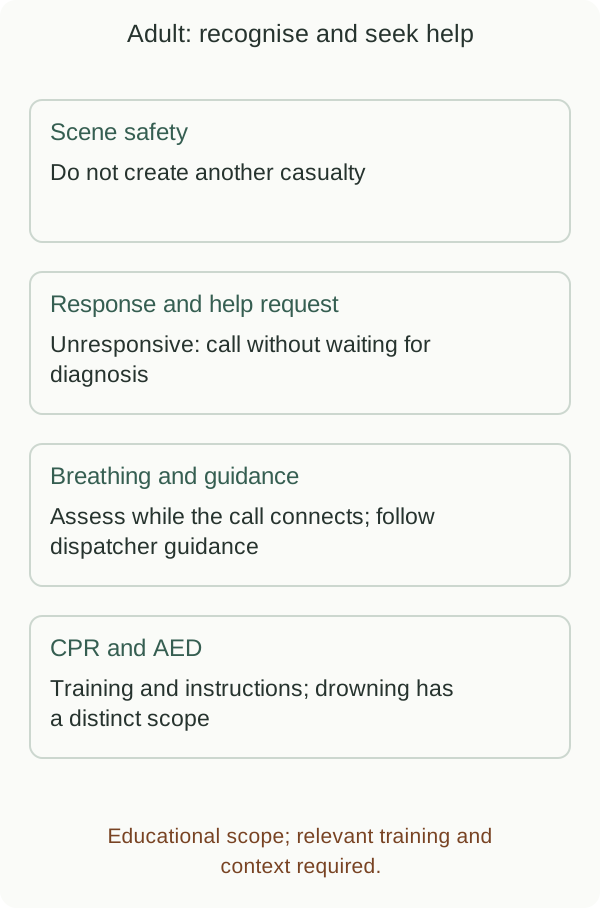
Educational scope; relevant training and context required.
insideSailOriginal insideSail artwork — all rights reservedEnlarge the diagram
Recognition and help request
The 2025 guidance calls for immediate emergency contact when an adult is unresponsive, without waiting to confirm abnormal breathing. Assess breathing while the call connects and follow dispatcher guidance.
With unresponsiveness and abnormal breathing, presume cardiac arrest; agonal breathing is not normal breathing. In the EU, 112 is an emergency number; suitable maritime communications and rescue coordination remain relevant offshore.
Describe location and observations without delaying for a diagnosis.
Adult basic life support: declared scope
Adult 2025 basic life support recommends 100–120 compressions per minute, 5–6 cm depth and complete chest recoil. Trained, able and willing rescuers can use 30 compressions to 2 breaths; those unable to ventilate provide compressions and follow received guidance.
Use an available AED according to its prompts, with nobody touching the person during analysis or shock. Quality is learned and assessed practically rather than established by reading.
Drowning is not a generic arrest example
Ventilation has a specific importance in drowning. ERC 2025 guidance distinguishes lay rescuers from trained rescuers; in-water care belongs to appropriately trained people under safe conditions.
This lesson does not turn that scope into an instruction for an untrained person to enter the sea. Training should include the appropriate drowning module and medical coordination, preserving the distinction rather than merging algorithms.
Care and information while waiting
Other situations require recognising changes and communicating consciousness, breathing, bleeding, pain and exposure. Protection against heat loss includes shelter and insulation appropriate to the situation rather than invented specialist treatment.
Food, drink or medication is not given to someone unable to take it safely. Oxygen, medicines and intervention equipment need training and appropriate indications; they are not additions merely to make a list look complete.
Reassessment matters because condition can change.
Clinical practice uses a manikin and competent instructor. The scenario identifies an adult, mechanism and resources rather than assuming every breathing difficulty is cardiac arrest.
Participants describe observations and requested help while the instructor assesses recognition and technique on suitable equipment. Access, surface and motion affect delivery afloat; those limitations must not be tested on a healthy volunteer acting as casualty.
Record training scope and questions requiring further clinical guidance. Clinical advice must match the person, circumstances and applicable training rather than a remembered numerical fragment.
No completion record from this educational platform is a resuscitation qualification or evidence of fitness to manage every injury at sea.
The kit should suit users, risks and duration, with documented identity, access and maintenance. Personal medical information remains private.
An educational text is not an automatic response to an emergency.
Sources and references
- ERC Guidelines 2025 — official release ↗
European Resuscitation Council · Guideline development and current 2025 download centre.
Confirms edition, not a professional review of this lesson.
Checked on - European Resuscitation Council Guidelines 2025 — First Aid ↗
European Resuscitation Council · Resuscitation 215 (2025) 110752: printed pp.2–5 expectations/assessment; drowning and hypothermia sections.
Published official PDF directly read. Not the consultation draft. No oxygen, drug doses, tourniquet application or paediatric treatment taught.
Checked on - Adult basic life support — Guidelines 2025 ↗
Resuscitation Council UK · Recognition, emergency call, CPR, ventilation and AED; ERC 2025 adult BLS DOI 10.1016/j.resuscitation.2025.110771.
Official national resuscitation council adaptation directly consulted. Emergency-number example 999 is UK-specific; no paediatric extrapolation.
Checked on - European Resuscitation Council Guidelines 2025 — Special Circumstances ↗
European Resuscitation Council · Resuscitation 215 (2025) 110753: Drowning, trained rescue, ventilation and resuscitation.
Official published PDF consulted. Professional rescue scope is distinguished from untrained bystander care.
Checked on
Keep discovering
The next piece of the puzzle
Discuss this concept
Loading the conversation…