By insideSail
Published without technical review · version 2 ·
Liferaft and recovery: prepare the water-to-boat transition
Finding, reaching, recovering and surviving need different resources.
In this guide
Reaching someone in the water does not complete recovery. Freeboard may be high, the casualty exhausted or unconscious, and crew unable to lift them.
A liferaft serves another function rather than automatically returning someone aboard. Separate recovery to the boat, survival outside it and transfer to rescue.
Each needs identified equipment, prepared people and a plan appropriate to the actual vessel.
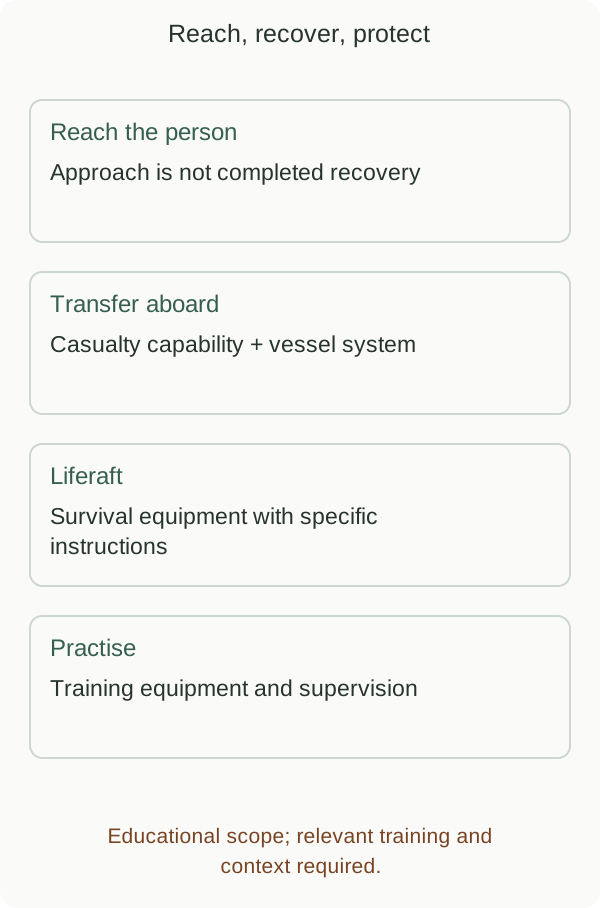
Educational scope; relevant training and context required.
insideSailOriginal insideSail artwork — all rights reservedEnlarge the diagram
Demonstrated access and recovery
A ladder suitable for someone able to climb does not necessarily solve an uncooperative casualty’s recovery. Lifting and recovery systems have limits and instructions.
A load point should not be chosen by resemblance to a drawing. Accompanied practice can use an appropriate training mannequin or load without risking a person or overloading fittings.
Record conditions and limitations rather than only “recovery practised”.
Liferaft: identity, stowage and operation
Model, stated capacity, equipment pack, packaging and servicing distinguish liferafts. A deck-container photograph establishes no service condition.
Crew access in the expected situation matters too. Launching follows the product and installation: retention, connection and sequence should not be improvised from a generic image.
Training uses authorised demonstration methods without improperly opening or activating an operational raft.
Complementing rather than blindly duplicating
An emergency bag should consider the raft’s actual contents and resources for alerting and survival. RYA guidance separates those two purposes.
Another boat’s list may omit personal needs or duplicate items. Identify documents, water and communication resources for the context without copying medical doses or treatments by analogy.
Bag access belongs to the plan, together with its ability to accompany a transfer.
Prevent a second casualty
Recovery creates risks for rescuers: falling, strain, crushing and moving equipment. An unprepared person entering the water can add another emergency.
The plan maintains observation and coordination while the chosen system is used, seeking early assistance when risk exists. Expected help is neither a reason to abandon the casualty nor proof that manoeuvring ability equals lifting capability.
These are complementary tasks.
Compare three casualty cards ashore: cooperative, severely weakened and unconscious. Cards select no lifting technique; they show that one ladder does not automatically answer all three cases.
Identify needed capability, intended recovery point and who retains vessel control and communication. Work requiring every crew member can leave an essential function unattended.
Make that gap explicit before waterborne practice. After specialist demonstration, record conditions, training equipment and assessment scope.
Recovering a dummy in calm conditions certifies no arbitrary real recovery, although it can reveal difficulties absent from a layout drawing. Learning concerns these identified limitations rather than an assumed guarantee from the presence of a ladder or lifebuoy.
The final record identifies the boat and tested configuration. Equipment certificates and reports are sources; owners’ accounts are experiences.
Neither a photograph nor an educational chapter establishes approval of an individual boat’s recovery system.
Sources and references
- Basic Rescue Boat Operator Manual — June 2023 ↗
International Maritime Rescue Federation · Printed pp.97–100: alert, observation, separation of approach/recovery, examples of recovery equipment; p.72 maintenance.
Official PDF obtained in the previous source review, read again locally on 11 October 2026. The RNLI 2019 link returned 404 and is not counted as newly verified. SAR boat approach distances and towing methods are not adopted.
Checked on - Liferaft ↗
Royal Yachting Association · Purpose, specification and carriage context.
Live guidance consulted; no reproduction of ISO 9650 text or claim of European carriage law.
Checked on - Sailing grab bags: what do you keep in yours? ↗
Royal Yachting Association · Opening purpose; liferaft contents vary; accessibility; rescue/survival categories.
Selected functions only. Published packing list and buoyancy specification not reproduced; no medication recommendations.
Checked on
Keep discovering
The next piece of the puzzle
Discuss this concept
Loading the conversation…