By insideSail
Published without technical review · version 2 ·
Briefing and drills: make preparation usable
Recognise, locate and explain before supervised execution.
In this guide
A useful briefing helps every person understand vessel and role. It is neither a nautical vocabulary lecture nor an authority demonstration.
A visitor may never have seen an inflatable lifejacket, used VHF or identified an alternative exit. The purpose is to reveal gaps while there is time to address them.
Locating equipment differs from demonstrating it, which differs again from checking another person can use it in expected conditions.
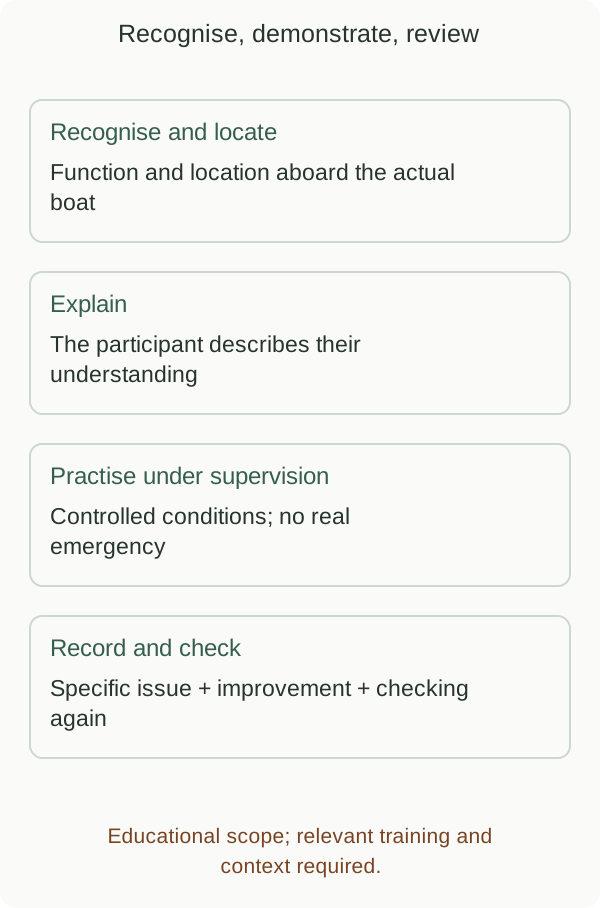
Educational scope; relevant training and context required.
insideSailOriginal insideSail artwork — all rights reservedEnlarge the diagram
Walk through the actual boat
Briefing begins with the actual vessel: spaces, access, movement hazards and communication. Catalogue layouts may omit later installations or exits blocked by storage.
Mobility, hearing and language differences need adapted explanation. Do not demand memorisation of a whole list before permitting questions.
People should locate items and identify uncertainty. Asking “all clear?”
often reveals less than requesting a demonstration of where they would seek help.
Priority functions include personal protection, vessel control and lookout, seeking assistance and foreseeable incidents. Allocation depends on crew numbers and competence.
Explaining who maintains visual contact in a person-overboard simulation and who handles communication does not qualify a visitor as a radio operator. Planning should consider a normally capable person becoming unavailable.
That situation tests dependencies rather than courage.
Controlled practice, never a manufactured emergency
Exercises can use cards, locating tasks and demonstrations without power or load. Rescue, survival, fire and first-aid practice need suitable conditions, equipment and instruction.
Do not put a person in the water for realism, transmit real alerts or deploy in-service equipment outside competent procedures. Manoeuvre practice defines space, conditions and stopping point beforehand.
Unexpected hazards do not require continuing merely to complete a worksheet.
| Demonstrated level | Honest record |
|---|---|
| Recognises | Identifies function and equipment. |
| Locates | Finds it aboard without inappropriate prompting. |
| Explains | Describes limits and task in their own words. |
| Executes under supervision | Performs the bounded training task; not general certification. |
Exercise counts do not describe quality. Record scenario, conditions, result and a concrete improvement.
“We practised emergencies” reveals less than “grab-bag access was delayed by a blocked locker; storage and route need revision”. Not every problem is solved through purchase: organisation, servicing or training may be involved.
A proposed remedy needs checking rather than immediate completion status.
A debrief can begin with the difference between plan and observation. Each person describes the understood task and barriers without blame-seeking.
Choose a specific improvement and how to check it. Changed locker storage may be assessed by safe access testing; moving a radio replaces no missing operator training.
Match improvement to identified cause. Retain exercise limits too: calm conditions, daylight and present participants represent no universal scenario.
Exercise count matters less than demonstrated learning and remaining preparation. Different explanations can be recorded as such rather than reconciled into a certainty nobody observed.
The review should make questions clearer for the next competent instructor, not merely improve a public profile’s appearance.
Community sharing can describe improvements without revealing identities or clinical data. Experiences must remain distinct from professional advice and regulatory standards.
Sources and references
- Safety lines: clipping on ↗
Royal Yachting Association · What is a safety line?; attachment points; mobility and risk; MAIB bulletin link.
Product/system recognition and risks directly read. ISO texts were not obtained; no compliance claim, numerical tether prescription or deck-anchor design.
Checked on - Basic Rescue Boat Operator Manual — June 2023 ↗
International Maritime Rescue Federation · Printed pp.97–100: alert, observation, separation of approach/recovery, examples of recovery equipment; p.72 maintenance.
Official PDF obtained in the previous source review, read again locally on 11 October 2026. The RNLI 2019 link returned 404 and is not counted as newly verified. SAR boat approach distances and towing methods are not adopted.
Checked on - Yacht sailing and motorboating ↗
RNLI · Safety checklist: briefing, training, weather, shore contact and means of help.
Preparedness guidance only. No statistics or comparative risk scores imported.
Checked on
Keep discovering
The next piece of the puzzle
Discuss this concept
Loading the conversation…