By insideSail
Published without technical review · version 2 ·
Adverse conditions: reduce exposure before a crisis
Conditions, human limits and alternatives require combined assessment.
In this guide
Adverse conditions do not begin at one universal wind number. Tired family members, a difficult entrance or steering problems can make conditions demanding while other boats continue sailing.
Sea state, visibility, current, temperature, daylight and duration add to wind. Decisions must connect forecast, observation and available margin.
Design certification, a ratio or a passage report does not establish the safe capability of this boat and crew today.
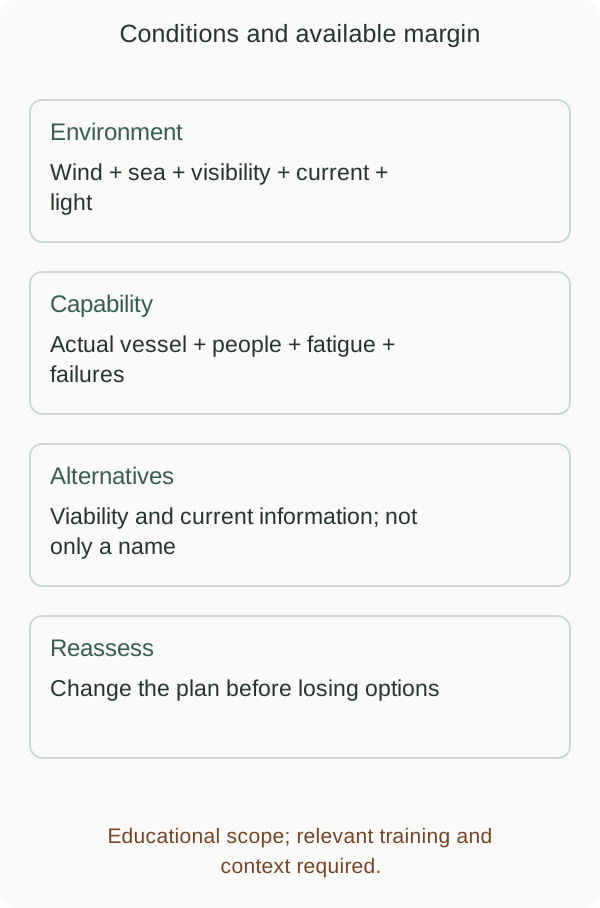
Educational scope; relevant training and context required.
insideSailOriginal insideSail artwork — all rights reservedEnlarge the diagram
Before departure: limits that change decisions
A preparation limit needs a consequence: postpone, change passage or choose another alternative. “Check weather” without stating concern and review timing leaves the decision vague.
Forecasts have area, issue time and validity and need relevant official warnings and updates. A favourable departure window does not establish a favourable arrival window.
Planning also considers who can steer, keep watch, rest and seek help if someone else becomes unavailable.
Windward exposure, shallow water and current can change difficulty in the same wind. A refuge on paper is not automatically accessible: entrance, shelter, depth, tide and services need current information.
This chapter supplies no pilotage instructions or port approval. Exercises identify missing information and reconsideration points.
Shelter selection requires appropriate nautical sources, local rules and competence rather than marina reviews or a tranquil photograph.
Prepare vessel and people
Reducing exposure includes anticipating tasks that become difficult with motion, fatigue and darkness. Stowage, equipment access, clothing, food and communication belong in the plan.
Sail reduction depends on rig, system and conditions; no furling sequence fits every model. A preventable deck task can create another emergency.
Preparation should identify necessary tasks, safe methods and work exceeding available competence.
Fatigue is more than sleepiness. Understanding instructions, observing hazards and completing tasks can deteriorate.
Seasickness may remove a crew member from duties or eating and change watch arrangements. The skipper needs that information; silence to avoid bothering others withholds it.
Briefings should make early admission of limitations possible. Response is not a universal medication recommendation: doses, contraindications and care require clinical assessment and are not supplied here.
Assess a fictional plan at departure, maximum exposure and arrival. For each, record forecast conditions, human capability and alternative.
A departure decision does not approve later circumstances. A card changing arrival time can change daylight, water level and available assistance without changing wind.
Participants identify consequences and where postponement remains possible rather than derive a route from an picture without data. This shows margin as a relationship between timing and capability, not a permanent yacht adjective.
If one participant becomes unavailable, repeat the assessment instead of treating the original plan as binding. Its useful result is identifying what changed and which assumption needs resolution before a real voyage.
Storm tactics, heaving-to, drogues and severe-sea handling need competent instruction and vessel assessment rather than an illustration shortcut. This lesson focuses on anticipation, reassessment and communication.
Review must check its links to weather and passage planning, local warnings and scenario suitability. No editorial “safe in bad weather” label follows from this text.
Sources and references
- MGN 610(M+F) Amendment 1 — SOLAS Chapter V ↗
Maritime and Coastguard Agency · §1.1 implementation in UK law; voyage planning and vessel/crew/passage context.
Guidance directly consulted. International convention and UK implementation are separate legal layers.
Checked on - Yacht sailing and motorboating ↗
RNLI · Safety checklist: briefing, training, weather, shore contact and means of help.
Preparedness guidance only. No statistics or comparative risk scores imported.
Checked on - MGN 599 (M) Amendment 1 — pleasure vessels guidance ↗
UK Maritime and Coastguard Agency · Pleasure-vessel scope; equipment/legal distinctions; §7.4 voyage planning.
UK guidance, not European law. Statutory applicability must be checked against the actual flag, use and vessel; no Class XII checklist transferred to a 10 m yacht.
Checked on
Keep discovering
The next piece of the puzzle
Discuss this concept
Loading the conversation…