By insideSail
Published without technical review · version 3 ·
Buoy, position and fault: three distinct records
An observation, a published assignment and a display representation are not the same record.
In this guide
A buoy, its published position and its symbol on a display belong to three different layers. The object exists at sea; a record describes an aid with an identity and date; equipment presents received or stored information.
These layers often concern the same aid, but they are not three independent confirmations. Separating them improves chart interpretation and the quality of a report.
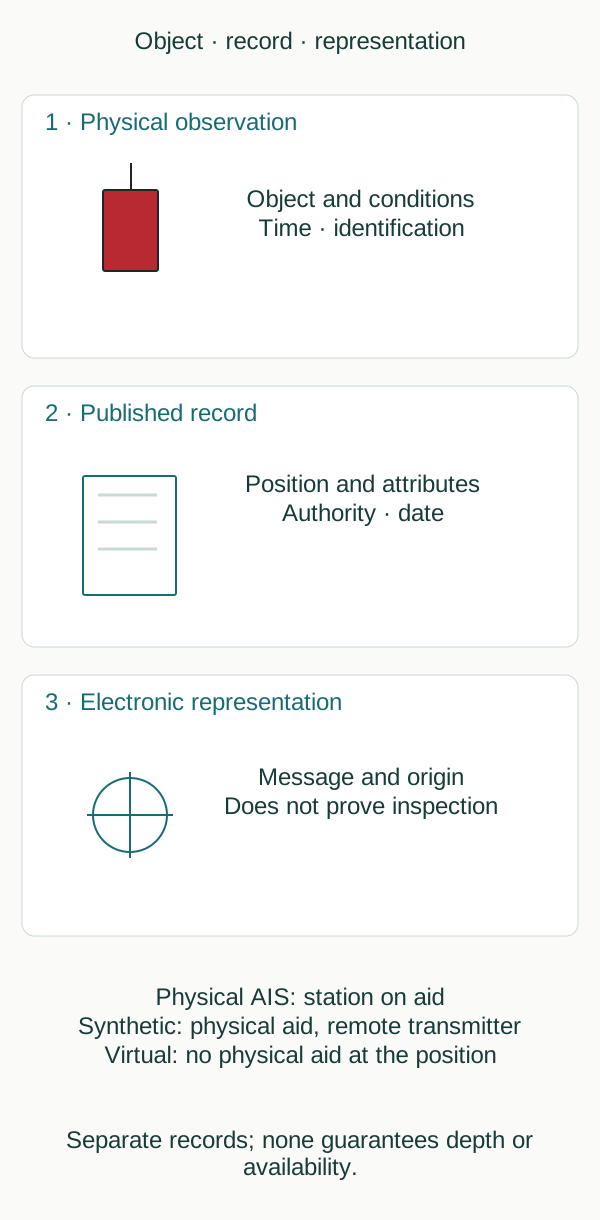
Original conceptual schematic, not to scale; fictional cases, not a manoeuvre procedure.
insideSailOriginal insideSail artwork — all rights reservedEnlarge the diagram
What each layer says
| Layer | Example information | Useful question |
|---|---|---|
| Observed object | Body, topmark, observed light | When and under what conditions was it observed? |
| Official record | Identity and assigned position | Which authority, edition and applicable update? |
| Electronic presentation | Symbol and displayed attributes | Where did the information originate and what date is shown? |
A floating buoy can move within the movement allowed by its mooring. A difference from a published record can also involve positional error, mistaken identity, outdated information or displacement of the aid.
The discrepancy is evidence to interpret, not an already known cause. Without geometry, uncertainty and appropriate confirmation, apparent separation between two symbols cannot measure the extent of possible displacement.
Physical, synthetic and virtual AIS
AIS AtoN is AIS information concerning an aid to navigation. In physical implementation the transmitting station is installed on the physically existing aid.
In synthetic implementation the physical aid also exists, but equipment elsewhere transmits the information. In virtual implementation the marked position has no corresponding physical aid.
The main distinction is the relationship between the represented object and message origin.
| Implementation | Physical aid at that position? | Transmitter |
|---|---|---|
| Physical | Yes | On the aid itself |
| Synthetic | Yes | Elsewhere |
| Virtual | No | Elsewhere |
“Synthetic” does not mean an imaginary buoy. “Virtual” does not mean a physical buoy the observer failed to see.
A display may present these messages using its own conventions and attributes; equipment does not all show identical information. A symbol alone establishes neither recent reception, inspection of the aid nor light operation.
The actual system’s data origin and displayed attributes need to be understood.
Worked case: light not observed
- Separate observed facts: red body, unresolved topmark, no observed light during the interval.
- Add consulted documents and display information with their respective dates and identities.
- Record the discrepancy without selecting an unconfirmed cause.
- If authority confirmation becomes available later, add it to the history rather than rewriting the earlier observation as retrospective certainty.
Reporting an issue
A clear report identifies location, time, conditions and the observed issue. Trinity House provides a dedicated page for reporting hazards and aid observations within its remit, requesting location and issue details.
This is a British institutional reporting example; elsewhere the competent authority should be consulted. This content submits no reports, and community information remains distinct from an official notice.
Key points
- A failed light does not remove the danger marked.
- A chart symbol, message and observation may share source information.
- Assigned and observed positions need date, identity and context.
- Physical/synthetic/virtual distinguishes object and transmitter; it does not assign an automatic reliability rating.
The figure maps relationships between records rather than providing a chart with usable coordinates. To understand a discrepancy, first ask what each layer actually states.
Incomplete recognition helps describe attributes; charted marks explains published notation. Together they allow discussion of the same aid without confusing observation, documentation and interpretation.
Sources and references
- RBMN — artigo 14: Boias de assinalamento de emergência ↗
Diário da República · RBMN annex Article 20; printed p.1981, PDF p.4.
Annex RBMN Article 20, published text 24 June 2016. Commencement follows Portaria Article5; later national interpretation/updates and local directions require qualified checking. Not treated as automatic adoption of IALA2023.
Checked on - IALA R1001 — Light rhythm identities and abbreviations ↗
IALA · Sections 2.2.2, 2.2.4, 2.4.2.2, 2.6.2.1, 4 (definitions) and 5 (abbreviations); PDF p.13 onwards and p.29; edition 2.0 June 2023.
IALA recommendation, edition 2.0 June 2023, 2.2.2, 2.2.4, 2.4.2.2, 2.6.2.1 and 4. Consulted edition does not establish individual national effective dates. Publication and jurisdiction require qualified review.
Checked on - RBMN — artigo 3: Método de caracterização das marcas ↗
Diário da República · RBMN annex Article 3; printed p.1979, PDF p.2.
Annex RBMN Article 3, published text 24 June 2016. Commencement follows Portaria Article5; later national interpretation/updates and local directions require qualified checking. Not treated as automatic adoption of IALA2023.
Checked on - Regulations for International (INT) Charts and Chart Specifications of the IHO — S-4 ↗
International Hydrographic Organization · B-460–B-466 buoy characteristics; B-471 light descriptions; B-475.1–B-475.6 sectors and leading lights; PDF pp.306–331 and 336–339.
Official 452-page PDF directly consulted; edition verified against current IHO catalogue. Original educational fragments rather than reproduced INT1 symbol plates. Paper chart conventions are not universal electronic display behaviour.
Checked on - IALA R1001 — Physical, synthetic and virtual AIS AtoN; local context and synchronisation ↗
IALA · Sections 3.2.1–3.2.4; PDF p.27 onwards; edition 2.0 June 2023.
IALA recommendation, edition 2.0 June 2023, 3.2.1–3.2.4. Consulted edition does not establish individual national effective dates. Publication and jurisdiction require qualified review.
Checked on - Report an aid to navigation issue ↗
Trinity House · Heading and reporting form: hazards/observations, location and issue; Planning Centre.
Directly consulted 11 October 2026. Reporting channel within Trinity House context; not a universal European recipient. No report submitted.
Checked on
Regulatory references
- RBMN artigo 3 — Método de caracterização das marcas ↗
Portaria 177/2016, original published annex · Defesa Nacional e Mar; technical direction Direção de Faróis / DGAM · Portugal
Verified on - Light rhythm identities and abbreviations ↗
IALA R1001 edition 2.0 June 2023 · IALA · International recommendation; competent-authority implementation
Verified on - RBMN artigo 20 — Balizas e farolins ↗
Portaria 177/2016, original published annex · Defesa Nacional e Mar; technical direction Direção de Faróis / DGAM · Portugal
Verified on - Physical, synthetic and virtual AIS AtoN; local context and synchronisation ↗
IALA R1001 edition 2.0 June 2023 · IALA · International recommendation; competent-authority implementation
Verified on
Keep discovering
The next piece of the puzzle
Discuss this concept
Loading the conversation…