By insideSail
Published without technical review · version 3 ·
Complementary aids: physical, electronic and local are different
Lighthouses, beacons, AIS AtoN and local signals need identity and scope.
In this guide
Buoyage includes more than coloured buoys. Lighthouses, fixed beacons, major floating aids and electronic information can work together.
The useful question has two parts: which aid exists at the place, and where does our information originate? An electronic symbol can refer to a real buoy, but can also identify a point without any buoy.
Separating object, transmitter and representation avoids mistaking screen information for something that will be visible.
Three forms of AIS AtoN
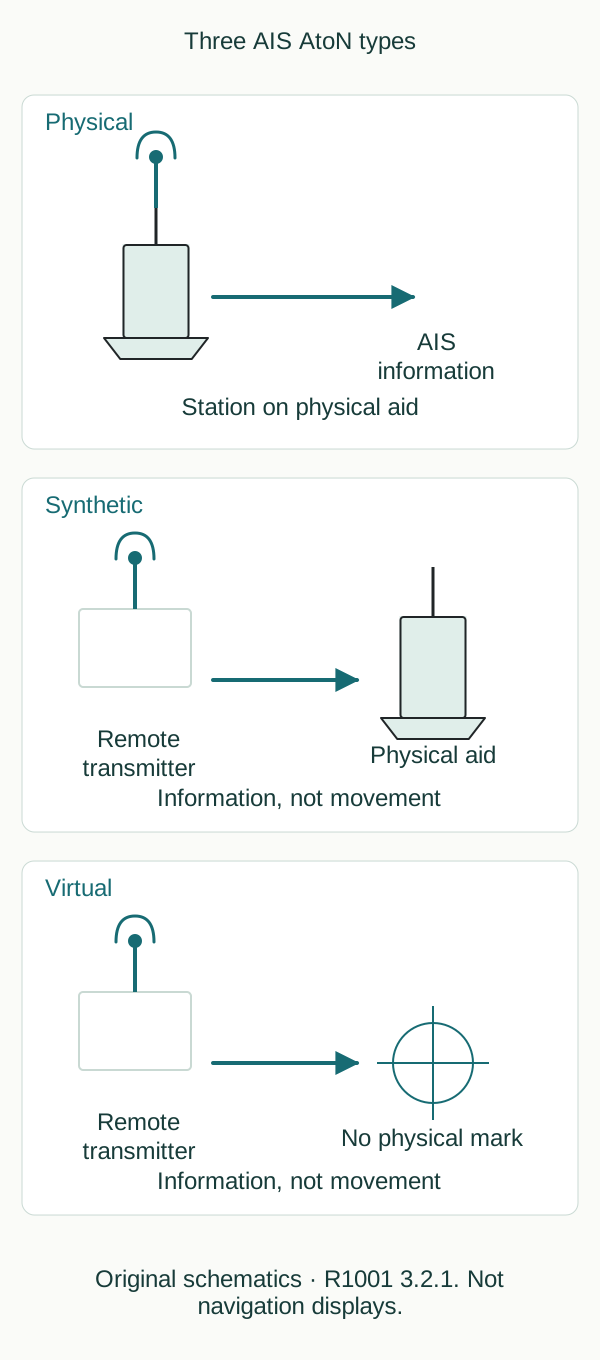
Original schematic without spatial scale; not a chart, route or navigation instruction.
insideSailOriginal insideSail artwork — all rights reservedEnlarge the diagram
| Type | Physical aid at the referenced point? | Transmission origin |
|---|---|---|
| Physical | Yes | AIS station on the aid itself |
| Synthetic | Yes | Remote station or transponder |
| Virtual | No corresponding physical aid exists | Remote station or transponder |
In physical AIS, the station is on the existing aid. Synthetic AIS refers to a physical aid but transmits from elsewhere: referenced object and transmitter no longer coincide.
Virtual AIS represents an aid that does not physically exist at that point. The absence of a visible buoy is not automatically a fault; absence of the corresponding physical aid belongs to the definition.
R1001 describes the three forms in 3.2.1.
Fixed aid, floating aid and light
A lighthouse is a tower or substantial structure at a designated geographical location, providing a daymark and identifying light. It can incorporate sectors and support additional aids.
A beacon is fixed; a buoy floats. RBMN terminology distinguishes balizas in the water and farolins ashore, lit or unlit according to arrangement.
Lightvessels, light floats and large navigational buoys are major floating aids. Size and prominence alone do not select a passing side.
Radar and local information
A racon and radar reflector are not synonyms. A reflector improves an object’s passive radar response; a racon replies with an identifiable radar signal under the system’s conditions.
Morse D can supplement new-danger marking in the consulted provisions; it does not classify every radar echo as a new danger. AIS, racon, daymark and light are complementary recognition channels with their own equipment and condition dependencies.
Auxiliary marks and signals for harbours, bridges, quays, rivers or locks can have local scope. They should be published in appropriate documentation and not conflict with the system.
R1001 recommends consistency with MBS wherever possible, but creates no universal harbour-entry permission table. Synchronised or sequential lights also need their published system context.
A photograph of three lights without an official description is an incomplete observation, rather than a rule.
Physical/synthetic/virtual is not a quality ranking. It describes the relationship between an aid and transmission.
A record can have identity, referenced position, message origin and status known in different ways. Virtual AIS should not be confused with a prediction of where a moving buoy will be in the future: under the definition presented, no corresponding physical aid exists at the point.
Clarity begins by naming the information’s origin before discussing its use.
- Virtual does not mean an invisible buoy: it means absence of the corresponding physical aid.
- Synthetic retains a physical aid although its transmitter is elsewhere.
- Aid-to-navigation AIS differs from a vessel carrying AIS.
- Authority, purpose, date and display system help interpret local information.
References: IALA R1001, edition 2.0, June 2023, 2.7.1–2.7.6 and 3.2.1–3.2.4; Portugal: RBMN, Articles 16–22. The lesson distinguishes origins and functions; it gives no AIS or radar configuration.
Concepts in this lesson
Physical AIS AtoN
AIS aid-to-navigation transmission from a station on the physical aid itself under R1001 3.2.1.
Educational recognition; provides no route or depth.
Synthetic AIS AtoN
AIS information about an existing physical aid transmitted from another location under R1001 3.2.1.
Educational recognition; provides no route or depth.
Virtual AIS AtoN
AIS information for an aid point without the corresponding physical mark under R1001 3.2.1; its symbol does not prove a buoy’s presence.
Educational recognition; provides no route or depth.
Sources and references
- RBMN — artigo 14: Boias de assinalamento de emergência ↗
Diário da República · RBMN annex Article 16; printed p.1981, PDF p.4. RBMN annex Article 17; printed p.1981, PDF p.4. RBMN annex Article 18; printed p.1981, PDF p.4. RBMN annex Article 19; printed p.1981, PDF p.4. RBMN annex Article 20; printed p.1981, PDF p.4. RBMN annex Article 21; printed p.1981, PDF p.4. RBMN annex Article 22; printed p.1981, PDF p.4.
Annex RBMN Article 16, published text 24 June 2016. Commencement follows Portaria Article5; later national interpretation/updates and local directions require qualified checking. Not treated as automatic adoption of IALA2023. Annex RBMN Article 17, published text 24 June 2016. Commencement follows Portaria Article5; later national interpretation/updates and local directions require qualified checking. Not treated as automatic adoption of IALA2023. Annex RBMN Article 18, published text 24 June 2016. Commencement follows Portaria Article5; later national interpretation/updates and local directions require qualified checking. Not treated as automatic adoption of IALA2023. Annex RBMN Article 19, published text 24 June 2016. Commencement follows Portaria Article5; later national interpretation/updates and local directions require qualified checking. Not treated as automatic adoption of IALA2023. Annex RBMN Article 20, published text 24 June 2016. Commencement follows Portaria Article5; later national interpretation/updates and local directions require qualified checking. Not treated as automatic adoption of IALA2023. Annex RBMN Article 21, published text 24 June 2016. Commencement follows Portaria Article5; later national interpretation/updates and local directions require qualified checking. Not treated as automatic adoption of IALA2023. Annex RBMN Article 22, published text 24 June 2016. Commencement follows Portaria Article5; later national interpretation/updates and local directions require qualified checking. Not treated as automatic adoption of IALA2023.
Checked on - IALA R1001 — Special marks and Mobile AtoN, exact edition context ↗
IALA · Sections 2.5.1–2.5.2.6; PDF p.18 onwards; edition 2.0 June 2023.
IALA recommendation, edition 2.0 June 2023, 2.5.1–2.5.2.6. Consulted edition does not establish individual national effective dates. Publication and jurisdiction require qualified review.
Checked on - IALA R1001 — Physical, synthetic and virtual AIS AtoN; local context and synchronisation ↗
IALA · Sections 3.2.1–3.2.4; PDF p.27 onwards; edition 2.0 June 2023.
IALA recommendation, edition 2.0 June 2023, 3.2.1–3.2.4. Consulted edition does not establish individual national effective dates. Publication and jurisdiction require qualified review.
Checked on - IALA R1001 — Lighthouses, leading lines, sector lights and other aids ↗
IALA · Sections 2.7.1–2.7.6; PDF p.21 onwards; edition 2.0 June 2023.
IALA recommendation, edition 2.0 June 2023, 2.7.1–2.7.6. Consulted edition does not establish individual national effective dates. Publication and jurisdiction require qualified review.
Checked on
Regulatory references
- Special marks and Mobile AtoN, exact edition context ↗
IALA R1001 edition 2.0 June 2023 · IALA · International recommendation; competent-authority implementation
Verified on - Physical, synthetic and virtual AIS AtoN; local context and synchronisation ↗
IALA R1001 edition 2.0 June 2023 · IALA · International recommendation; competent-authority implementation
Verified on - RBMN artigo 20 — Balizas e farolins ↗
Portaria 177/2016, original published annex · Defesa Nacional e Mar; technical direction Direção de Faróis / DGAM · Portugal
Verified on - RBMN artigo 19 — Farol ↗
Portaria 177/2016, original published annex · Defesa Nacional e Mar; technical direction Direção de Faróis / DGAM · Portugal
Verified on - RBMN artigo 17 — Enfiamento e alinhamento ↗
Portaria 177/2016, original published annex · Defesa Nacional e Mar; technical direction Direção de Faróis / DGAM · Portugal
Verified on - RBMN artigo 22 — Marcas auxiliares ↗
Portaria 177/2016, original published annex · Defesa Nacional e Mar; technical direction Direção de Faróis / DGAM · Portugal
Verified on - RBMN artigo 18 — Farolim de sectores ↗
Portaria 177/2016, original published annex · Defesa Nacional e Mar; technical direction Direção de Faróis / DGAM · Portugal
Verified on - Lighthouses, leading lines, sector lights and other aids ↗
IALA R1001 edition 2.0 June 2023 · IALA · International recommendation; competent-authority implementation
Verified on - RBMN artigo 21 — Marcas flutuantes de grandes dimensões ↗
Portaria 177/2016, original published annex · Defesa Nacional e Mar; technical direction Direção de Faróis / DGAM · Portugal
Verified on - RBMN artigo 16 — Marcação adicional ↗
Portaria 177/2016, original published annex · Defesa Nacional e Mar; technical direction Direção de Faróis / DGAM · Portugal
Verified on
Keep discovering
The next piece of the puzzle
Discuss this concept
Loading the conversation…