By insideSail
Published without technical review · version 3 ·
New dangers: blue/yellow is a specific temporary identity
The cross is upright and the light alternates colours; other marks can also indicate new dangers.
In this guide
A new danger is a recently discovered hazard that may not yet appear in nautical charts and publications. It can be natural or man-made: a newly identified bank, obstruction or wreck, for example.
Newness describes the available information. It does not imply that the object itself is recent, or that all marking is removed after one fixed period.
The blue and yellow buoy
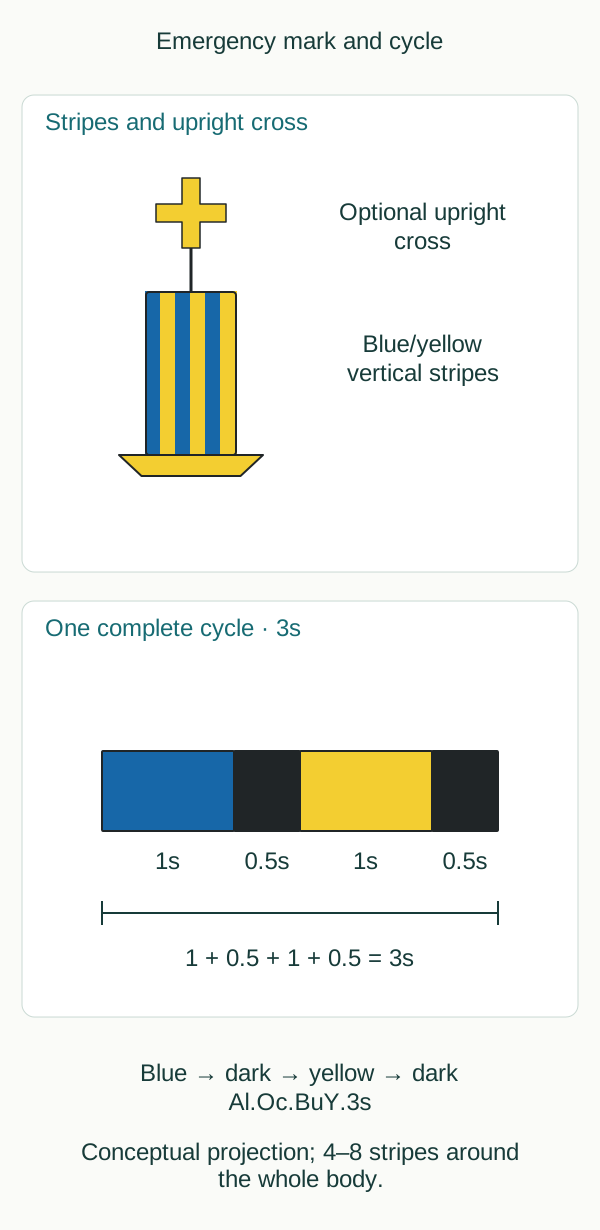
Original schematic without spatial scale; not a chart, route or navigation instruction.
insideSailOriginal insideSail artwork — all rights reservedEnlarge the diagram
The emergency wreck mark has blue and yellow vertical stripes in equal number and dimensions. R1001 specifies four to eight stripes around the body; a flat view does not show every side.
The body is pillar or spar. The topmark, if present, is an upright/perpendicular yellow cross, preferably three-dimensional.
Its arms are vertical and horizontal, unlike the diagonal yellow X of a special mark.
A three-second light cycle
| Phase | Duration | Cumulative time |
|---|---|---|
| Blue | 1s | 1s |
| Dark | 0.5s | 1.5s |
| Yellow | 1s | 2.5s |
| Dark | 0.5s | 3s; returns to blue |
The colours alternate, with darkness between phases. They do not overlap to create a mixed-colour light.
The calculation is 1 + 0.5 + 1 + 0.5 = 3 seconds. IHO notation can appear as Al.Oc.BuY.3s: alternating, blue/yellow and period.
Phase durations come from the technical description rather than guesses from the abbreviation. The figure’s timeline helps recognise this characteristic without simulating an operational light.
Not every new danger uses this buoy
Depending on context, suitable lateral, cardinal or isolated danger marks, or an emergency wreck buoy, can be used. A lit lateral used for this purpose has Q or VQ in the consulted provisions.
If the authority considers navigation risk especially high, at least one mark should be duplicated; the duplicate should be identical to its partner. This concerns management of marking, rather than instructions for owners to deploy aids.
A racon coded Morse D and AIS AtoN can supplement the information.
Temporary information and common confusions
The hazard can remain while its marking changes. The recommendation relates new-danger status to removal of the hazard or sufficient dissemination of its information, as determined by the competent authority.
A virtual electronic aid can exist without a corresponding physical buoy. A photograph lacking a buoy therefore does not prove absence of a danger, and a display symbol does not prove that a floating body will be visible at that point.
Official notices form part of current information alongside chart edition.
Compare two dates in a record: discovery of the danger and installation of its aid. They can differ.
A third date can concern dissemination in a notice or chart. This timeline explains why “temporary” does not mean “the danger disappears”: information and marking arrangements evolve while the obstruction can remain.
The lesson records source edition and consultation date without presenting either as current confirmation of a particular buoy. Documentary history and physical history are related but separate.
- Emergency describes the marking purpose, rather than a distress call from a vessel.
- Upright cross, vertical stripes and blue/yellow alternation are separate clues that should agree.
- New danger does not necessarily mean wreck or blue/yellow buoy.
- No universal validity period follows from the light cycle.
References: IALA R1001, edition 2.0, June 2023, 2.6.1–2.6.2 and 3.2.2; Portugal: RBMN, Articles 14–16; light notation: IHO S-4, B-466.2(f) and B-471.3.
Concepts in this lesson
Emergency wreck mark
A new-danger identity with blue/yellow vertical stripes, fitted upright yellow cross and cycle blue1s/dark0.5s/yellow1s/dark0.5s.
Educational recognition; provides no route or depth.
New danger
A recently discovered natural or human-created obstruction not yet in nautical documents; it can use different provided marking identities.
Educational recognition; provides no route or depth.
Sources and references
- RBMN — artigo 14: Boias de assinalamento de emergência ↗
Diário da República · RBMN annex Article 14; printed p.1981, PDF p.4. RBMN annex Article 15; printed p.1981, PDF p.4. RBMN annex Article 16; printed p.1981, PDF p.4.
Annex RBMN Article 14, published text 24 June 2016. Commencement follows Portaria Article5; later national interpretation/updates and local directions require qualified checking. Not treated as automatic adoption of IALA2023. Annex RBMN Article 15, published text 24 June 2016. Commencement follows Portaria Article5; later national interpretation/updates and local directions require qualified checking. Not treated as automatic adoption of IALA2023. Annex RBMN Article 16, published text 24 June 2016. Commencement follows Portaria Article5; later national interpretation/updates and local directions require qualified checking. Not treated as automatic adoption of IALA2023.
Checked on - Regulations for International (INT) Charts and Chart Specifications of the IHO — S-4 ↗
International Hydrographic Organization · B-460–B-466 buoy characteristics; B-471 light descriptions; B-475.1–B-475.6 sectors and leading lights; PDF pp.306–331 and 336–339.
Official 452-page PDF directly consulted; edition verified against current IHO catalogue. Original educational fragments rather than reproduced INT1 symbol plates. Paper chart conventions are not universal electronic display behaviour.
Checked on - IALA R1001 — Physical, synthetic and virtual AIS AtoN; local context and synchronisation ↗
IALA · Sections 3.2.1–3.2.4; PDF p.27 onwards; edition 2.0 June 2023.
IALA recommendation, edition 2.0 June 2023, 3.2.1–3.2.4. Consulted edition does not establish individual national effective dates. Publication and jurisdiction require qualified review.
Checked on - IALA R1001 — Emergency wreck identity and other new-danger marking ↗
IALA · Sections 2.6.1–2.6.2 and 3.2.2; PDF p.20 onwards; edition 2.0 June 2023.
IALA recommendation, edition 2.0 June 2023, 2.6.1–2.6.2 and 3.2.2. Consulted edition does not establish individual national effective dates. Publication and jurisdiction require qualified review.
Checked on
Regulatory references
- S-4 B-460–466 / B-470–475 — buoy and light charting specifications ↗
IHO S-4 edition 4.10.0 March 2026 · International Hydrographic Organization · International chart-production specification; not a local pilotage rule
Verified on - RBMN artigo 15 — Sinalização de novos perigos ↗
Portaria 177/2016, original published annex · Defesa Nacional e Mar; technical direction Direção de Faróis / DGAM · Portugal
Verified on - RBMN artigo 16 — Marcação adicional ↗
Portaria 177/2016, original published annex · Defesa Nacional e Mar; technical direction Direção de Faróis / DGAM · Portugal
Verified on - Emergency wreck identity and other new-danger marking ↗
IALA R1001 edition 2.0 June 2023 · IALA · International recommendation; competent-authority implementation
Verified on - RBMN artigo 14 — Boias de assinalamento de emergência ↗
Portaria 177/2016, original published annex · Defesa Nacional e Mar; technical direction Direção de Faróis / DGAM · Portugal
Verified on - Physical, synthetic and virtual AIS AtoN; local context and synchronisation ↗
IALA R1001 edition 2.0 June 2023 · IALA · International recommendation; competent-authority implementation
Verified on
Keep discovering
The next piece of the puzzle
Discuss this concept
Loading the conversation…