By insideSail
Published without technical review · version 3 ·
Special marks: yellow calls for the published purpose
The X is diagonal and identity does not independently choose a passing side.
In this guide
A special mark identifies an area or feature whose nature can be found in the chart or another nautical publication. Yellow identifies the family; it does not alone distinguish a recreation area, submarine cable, aquaculture or another purpose.
It is like recognising an information sign before reading its content: the category points to published information rather than conveying one identical rule everywhere.
Colour, topmark and light
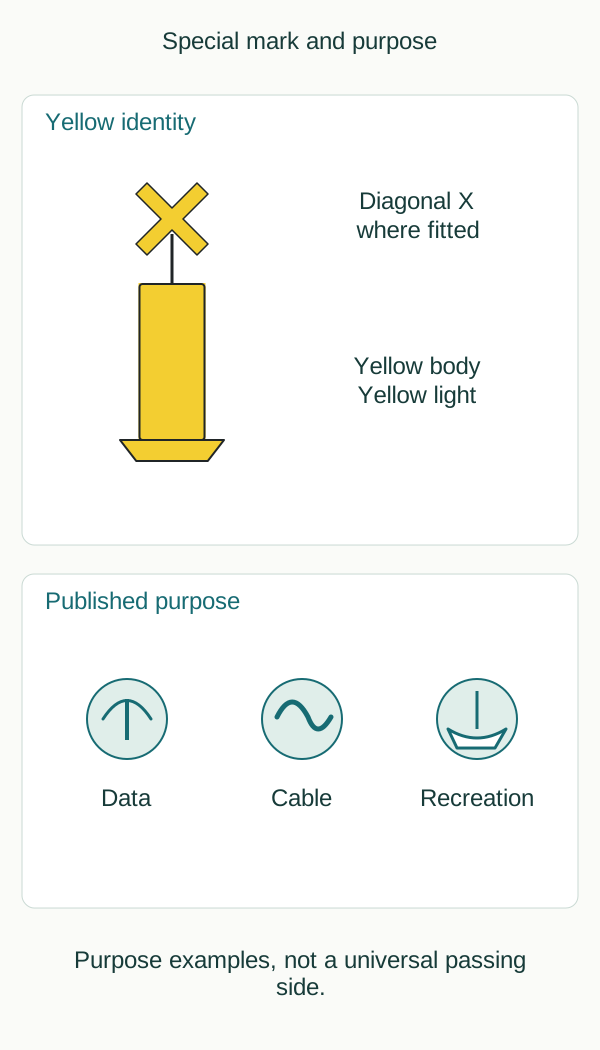
Original schematic without spatial scale; not a chart, route or navigation instruction.
insideSailOriginal insideSail artwork — all rights reservedEnlarge the diagram
| Element | Characteristics | Useful distinction |
|---|---|---|
| Body | Yellow | Colour alone does not identify purpose |
| Topmark if any | One yellow X | Diagonal cross, distinct from the upright emergency cross |
| Shape | Variable, not conflicting with laterals | Shape can retain a lateral relationship in local context |
| Light when fitted | Yellow; rhythm not reserved to the families specified by R1001 | Published description completes recognition |
The X topmark is preferably three-dimensional so it can be recognised from different directions. Body shape should not conflict with laterals: R1001 gives the example of a special mark on a channel’s port side, which may be cylindrical but not conical.
This does not turn every yellow can into a universal port-hand indication. The relationship depends on the particular use and channel reference.
Why are there different purposes?
The family can mark oceanographic data systems, military exercise zones, spoil grounds, cables or pipelines, recreation areas, anchorage boundaries, structures and aquaculture. These uses do not share one access regime.
Yellow alone creates neither an entry prohibition, anchoring permission nor permission to attach a boat. Numbers, lettering or pictograms can help identify purpose, but meaning belongs to the authority and relevant documents.
Generally, a special mark does not replace laterals or cardinals where those families suit channel limits or obstructions. Particular applications exist: a dredged channel for deep-draught vessels can use special marks within an area adequately deep for general navigation.
Laterals or cardinals continue to define general navigation limits. These are two information layers rather than competing recommendations about one passing side.
The mobile variant and Portuguese context
An ordinary special mark does not use rhythms reserved for cardinals, isolated danger, safe water or MAtoN under R1001 2023. This separation reduces confusion between yellow and white under difficult observation.
It does not mean “any rhythm”: the individual characteristic still needs a description. The MAtoN reservation retains its 2023 recommendation scope here, without being inserted into the original Portuguese 2016 text.
The 2023 R1001 edition includes MAtoN: a special mark attached to a floating object that may create a collision hazard. Its defined characteristic combines three flickering phases with two regular flashes; it is not simply Fl(5).
This variant needs its own description and should not be assigned to every yellow special mark. Portuguese RBMN 2016 sets out special uses and characteristics in Article 13; a category detailed in a later recommendation is not presumed automatically added to the national act.
An editorial record can separate “type: special”, “characteristics: yellow and X topmark” and “purpose: aquaculture area”. The last field needs a reference for the place.
Knowing only the first two still allows the family to be explained while purpose remains unknown. This structure allows two cases to be compared without giving an oceanographic mark the regime of an exercise area.
Purpose is therefore an explicit field, rather than a hidden assumption attached to the colour.
- Yellow identifies family; purpose still needs a reference.
- A diagonal X and an upright cross are different topmarks.
- A mooring buoy and an aid to navigation are not synonyms; large moorings can carry special marking for conspicuity.
- Do not extend a local meaning to the whole European coast.
References: IALA R1001, edition 2.0, June 2023, 2.5.1–2.5.2.6; Portugal: RBMN, Article 13. MAtoN is described within the consulted international recommendation, not as an automatic national-law amendment.
The concept in a few words
Special mark
A yellow mark with documented special purpose, fitted diagonal yellow X and fitted yellow light; it supplies no universal passing side.
Educational recognition; provides no route or depth.
Sources and references
- RBMN — artigo 14: Boias de assinalamento de emergência ↗
Diário da República · RBMN annex Article 22; printed p.1981, PDF p.4.
Annex RBMN Article 22, published text 24 June 2016. Commencement follows Portaria Article5; later national interpretation/updates and local directions require qualified checking. Not treated as automatic adoption of IALA2023.
Checked on - IALA R1001 — Special marks and Mobile AtoN, exact edition context ↗
IALA · Sections 2.5.1–2.5.2.6; PDF p.18 onwards; edition 2.0 June 2023.
IALA recommendation, edition 2.0 June 2023, 2.5.1–2.5.2.6. Consulted edition does not establish individual national effective dates. Publication and jurisdiction require qualified review.
Checked on - IALA R1001 — Physical, synthetic and virtual AIS AtoN; local context and synchronisation ↗
IALA · Sections 3.2.1–3.2.4; PDF p.27 onwards; edition 2.0 June 2023.
IALA recommendation, edition 2.0 June 2023, 3.2.1–3.2.4. Consulted edition does not establish individual national effective dates. Publication and jurisdiction require qualified review.
Checked on - RBMN — artigo 8: Quadrantes das marcas cardeais ↗
Diário da República · RBMN annex Article 13; printed pp.1980–1981, PDF pp.3–4.
Annex RBMN Article 13, published text 24 June 2016. Commencement follows Portaria Article5; later national interpretation/updates and local directions require qualified checking. Not treated as automatic adoption of IALA2023.
Checked on
Regulatory references
- RBMN artigo 22 — Marcas auxiliares ↗
Portaria 177/2016, original published annex · Defesa Nacional e Mar; technical direction Direção de Faróis / DGAM · Portugal
Verified on - RBMN artigo 13 — Marcas especiais ↗
Portaria 177/2016, original published annex · Defesa Nacional e Mar; technical direction Direção de Faróis / DGAM · Portugal
Verified on - Special marks and Mobile AtoN, exact edition context ↗
IALA R1001 edition 2.0 June 2023 · IALA · International recommendation; competent-authority implementation
Verified on - Physical, synthetic and virtual AIS AtoN; local context and synchronisation ↗
IALA R1001 edition 2.0 June 2023 · IALA · International recommendation; competent-authority implementation
Verified on
Keep discovering
The next piece of the puzzle
Discuss this concept
Loading the conversation…