By insideSail
Published without technical review · version 3 ·
Cardinal lights: the whole cycle matters
A short observation can hide the group, the eclipse and the long flash distinguishing South.
In this guide
At night, a cardinal mark communicates through rhythm: North flashes without groups, while East, South and West use different sequences. Understanding that information requires the whole repetition, including the dark intervals.
A count begun halfway through can be accurate yet insufficient to identify the mark. This lesson connects compact notation with what a timeline actually represents.
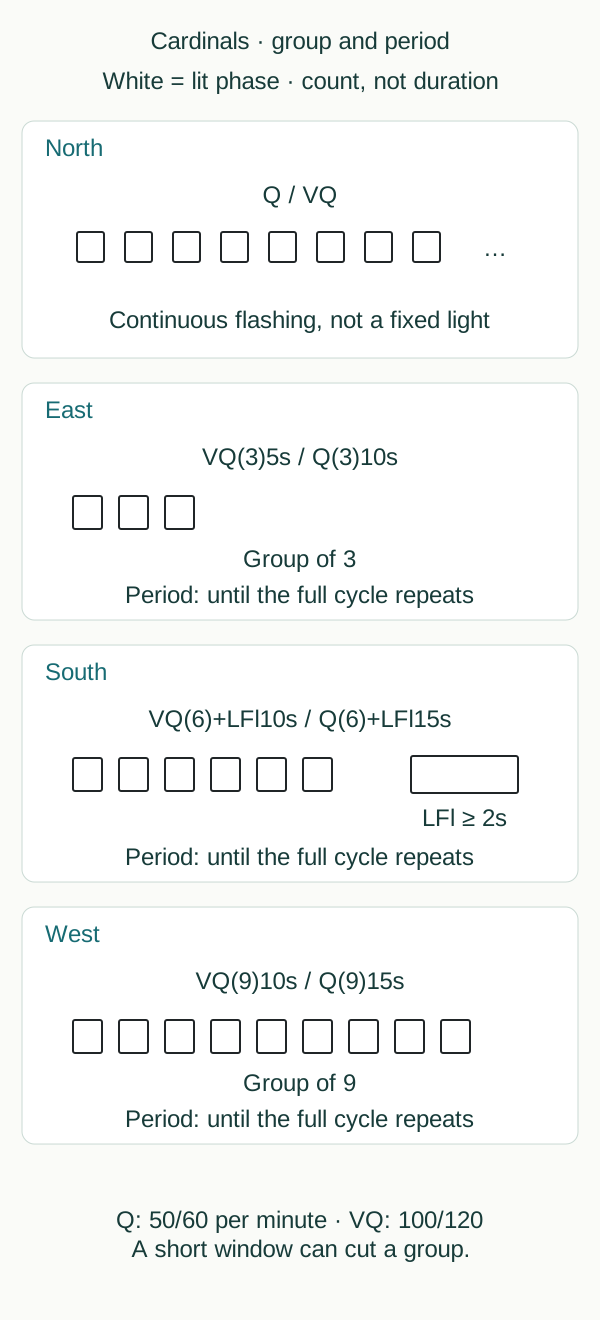
Original conceptual schematic, not to scale; fictional cases, not a manoeuvre procedure.
insideSailOriginal insideSail artwork — all rights reservedEnlarge the diagram
Cadence, group and period
Cadence is how rapidly flashes occur. Q means quick flashing: 50 or 60 per minute in the consulted recommendation.
VQ means very quick flashing: 100 or 120. These values describe cadence within a sequence; they do not mean counting fifty flashes to recognise a mark.
A group is the set that repeats. Period is the time between the start of one complete cycle and the next, including illumination and darkness.
A clock face helps recall three, six and nine for East, South and West. South adds a long flash, LFl, lasting at least two seconds.
It is deliberately different from the preceding quick flashes. The plus sign in the notation preserves that difference.
North’s continuous flashing does not mean a fixed light: it still switches on and off, without the group organisation of the other cardinals.
| Cardinal | VQ alternative | Q alternative | Distinguishing feature |
|---|---|---|---|
| North | VQ | Q | No separated groups |
| East | VQ(3)5s | Q(3)10s | Three flashes |
| South | VQ(6)+LFl10s | Q(6)+LFl15s | Six and a long flash |
| West | VQ(9)10s | Q(9)15s | Nine flashes |
Worked case: from a short window to the cycle
- Separate observation duration from light period. The first record is a window, not an established cycle.
- Identify the complete structure in the second record: six, then long flash, then darkness.
- Compare with the table: the combination matches the South cardinal Q alternative, with a fifteen-second period.
- Keep the first note as a partial observation. Do not turn it into proof of an East cardinal.
The conclusion becomes stronger when appearance, published position and light description refer to the same mark. South combines downward-pointing cones with yellow above black.
Its name still relates to the indicated true quadrant relative to the danger, rather than the boat’s side. Rhythm classification is one part of identification; the chart and current situation supply spatial context and depths.
How to read the figure
Each box belongs to a count; wider separation organises repetition. The long flash appears as its own component.
The figure compares structures and prescribed periods without simulating intensity, range or the exact duration of every flash. Starting at the third symbol demonstrates why three visible events do not establish a three-flash group.
Waves, another vessel or two sources in the same sight line can make a real record even less complete.
Common confusions
- Q(6)+LFl is not a group of seven equal flashes.
- 10s or 15s is the full period, not each flash’s duration.
- “I did not observe a light” records a limitation; “the light failed” asserts a cause.
- Identifying a cardinal does not alone determine a passing distance or course.
Remember and continue
Read the characteristic as a sentence: cadence, group, additional component and period. If part of the cycle is missing, identify the gap rather than guessing the final word.
The cardinal-identities lesson adds cones and colour bands; the incomplete-recognition lesson explains how to keep hypotheses open while retaining attributes already observed.
Sources and references
- IALA R1001 — Light rhythm identities and abbreviations ↗
IALA · Sections 2.2.2, 2.2.4, 2.4.2.2, 2.6.2.1, 4 (definitions) and 5 (abbreviations); PDF p.13 onwards and p.29; edition 2.0 June 2023.
IALA recommendation, edition 2.0 June 2023, 2.2.2, 2.2.4, 2.4.2.2, 2.6.2.1 and 4. Consulted edition does not establish individual national effective dates. Publication and jurisdiction require qualified review.
Checked on - IALA R1001 — Cardinal quadrants, topmarks, colours and light rhythms ↗
IALA · Sections 2.2.1–2.2.4; PDF p.12 onwards; edition 2.0 June 2023.
IALA recommendation, edition 2.0 June 2023, 2.2.1–2.2.4. Consulted edition does not establish individual national effective dates. Publication and jurisdiction require qualified review.
Checked on - RBMN — artigo 8: Quadrantes das marcas cardeais ↗
Diário da República · RBMN annex Article 8; printed p.1980, PDF p.3. RBMN annex Article 9; printed p.1980, PDF p.3. RBMN annex Article 10; printed p.1980, PDF p.3.
Annex RBMN Article 8, published text 24 June 2016. Commencement follows Portaria Article5; later national interpretation/updates and local directions require qualified checking. Not treated as automatic adoption of IALA2023. Annex RBMN Article 9, published text 24 June 2016. Commencement follows Portaria Article5; later national interpretation/updates and local directions require qualified checking. Not treated as automatic adoption of IALA2023. Annex RBMN Article 10, published text 24 June 2016. Commencement follows Portaria Article5; later national interpretation/updates and local directions require qualified checking. Not treated as automatic adoption of IALA2023.
Checked on
Regulatory references
- RBMN artigo 9 — Utilização das marcas cardeais ↗
Portaria 177/2016, original published annex · Defesa Nacional e Mar; technical direction Direção de Faróis / DGAM · Portugal
Verified on - Light rhythm identities and abbreviations ↗
IALA R1001 edition 2.0 June 2023 · IALA · International recommendation; competent-authority implementation
Verified on - Cardinal quadrants, topmarks, colours and light rhythms ↗
IALA R1001 edition 2.0 June 2023 · IALA · International recommendation; competent-authority implementation
Verified on - RBMN artigo 8 — Quadrantes das marcas cardeais ↗
Portaria 177/2016, original published annex · Defesa Nacional e Mar; technical direction Direção de Faróis / DGAM · Portugal
Verified on - RBMN artigo 10 — Descrição das marcas cardeais ↗
Portaria 177/2016, original published annex · Defesa Nacional e Mar; technical direction Direção de Faróis / DGAM · Portugal
Verified on
Keep discovering
The next piece of the puzzle
Discuss this concept
Loading the conversation…