By insideSail
Published without technical review · version 3 ·
Cardinals: name, cones, bands and rhythm
The cardinal reference remains the same in A and B.
In this guide
A cardinal mark uses compass directions to indicate where safer water lies relative to the mark and the danger or feature being marked. North, east, south and west refer to geographical orientation, rather than the boat’s heading.
The family keeps the same identity in Regions A and B. It is useful around shoals, dangers, bends or junctions where a north/south reference describes the situation better than channel sides.
Identity combines three clues
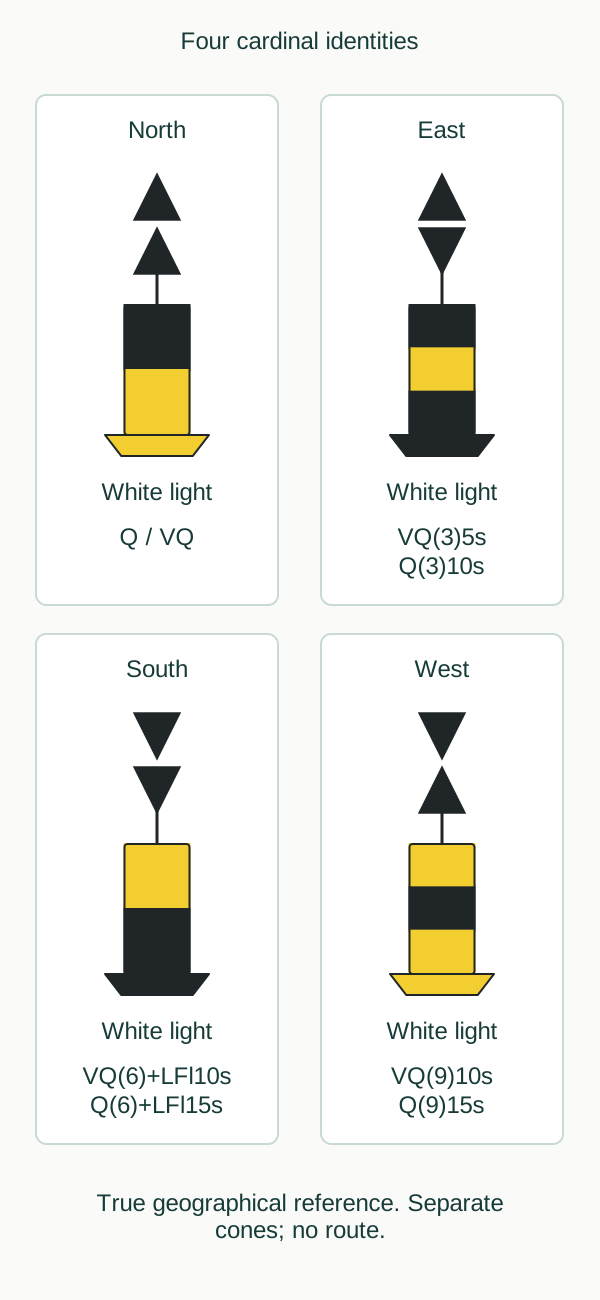
Original schematic without spatial scale; not a chart, route or navigation instruction.
insideSailOriginal insideSail artwork — all rights reservedEnlarge the diagram
All combine black and yellow horizontal bands. The distinctive topmark has two black cones, one above the other.
Their orientation distinguishes the four identities, with the bands confirming that reading. The body is normally pillar or spar, without a unique family shape.
Lights, when fitted, are white and use quick or very quick flashing, organised differently for each cardinal.
| Cardinal | Black cones | Colours from top down | White light |
|---|---|---|---|
| North | Both upwards | Black / yellow | Continuous Q or VQ |
| East | Base to base | Black / yellow / black | Q(3)10s or VQ(3)5s |
| South | Both downwards | Yellow / black | Q(6)+LFl15s or VQ(6)+LFl10s |
| West | Point to point | Yellow / black / yellow | Q(9)15s or VQ(9)10s |
Two memory aids that can be checked
Cone points indicate the black areas: north has both points upwards and black at the top; south points downwards with black below. East has outward points and black at the ends.
West has points together and black in the middle. This is a visual memory aid, rather than a replacement for the table.
An awkward photograph angle or damaged cone can make the reading difficult.
For lights, imagine a clock: east is three o’clock, south six, west nine. South adds a long flash after six quick flashes, helping distinguish it from three or nine when observation is incomplete.
North has continuous quick flashing, without these groups. Q and VQ are different classes: R1001 describes Q at 50 or 60 flashes per minute and VQ at 100 or 120.
A long flash lasts at least two seconds; complete periods are those shown in the table.
What the name indicates — and what remains unknown
Quadrants are defined by true bearings from the marked point: NW–NE, NE–SE, SE–SW and SW–NW. A north cardinal indicates its northern side for passing relative to the marked feature.
This does not declare east and west invariably unusable, or measure the danger’s extent or a passing distance. R1001 directs attention to the chart for context.
The diagram identifies the family; it contains neither depths nor a real position.
A second example separates counting from sequence: six quick flashes followed by a long flash identify south, rather than a light with “seven equal flashes”. The long flash is a different kind of phase within the same cycle.
Notation therefore writes Q(6)+LFl to preserve the structure. The table also shows why east and west cannot be distinguished by light colour: both are white but their groups differ.
- Direction is true/geographical, rather than the boat’s left or right.
- White light is insufficient: isolated danger and safe water can also use it.
- An absent or unseen topmark leaves incomplete information; it does not alone prove another family.
- Name, cones, bands and light sequence should agree.
References: IALA R1001, edition 2.0, June 2023, 2.2.1–2.2.4; Portugal: RBMN, Articles 8–10. The recommendation allows authority decisions where weather or ice makes topmarks impractical; this is not a general absence rule.
The concept in a few words
Cardinal mark
A mark whose name, black cones, black/yellow bands and fitted white light relate to its indicated quadrant independently of lateral region.
Educational recognition; provides no route or depth.
Sources and references
- IALA R1001 — Light rhythm identities and abbreviations ↗
IALA · Sections 2.2.2, 2.2.4, 2.4.2.2, 2.6.2.1, 4 (definitions) and 5 (abbreviations); PDF p.13 onwards and p.29; edition 2.0 June 2023.
IALA recommendation, edition 2.0 June 2023, 2.2.2, 2.2.4, 2.4.2.2, 2.6.2.1 and 4. Consulted edition does not establish individual national effective dates. Publication and jurisdiction require qualified review.
Checked on - IALA R1001 — Cardinal quadrants, topmarks, colours and light rhythms ↗
IALA · Sections 2.2.1–2.2.4; PDF p.12 onwards; edition 2.0 June 2023.
IALA recommendation, edition 2.0 June 2023, 2.2.1–2.2.4. Consulted edition does not establish individual national effective dates. Publication and jurisdiction require qualified review.
Checked on - RBMN — artigo 8: Quadrantes das marcas cardeais ↗
Diário da República · RBMN annex Article 8; printed p.1980, PDF p.3. RBMN annex Article 9; printed p.1980, PDF p.3. RBMN annex Article 10; printed p.1980, PDF p.3.
Annex RBMN Article 8, published text 24 June 2016. Commencement follows Portaria Article5; later national interpretation/updates and local directions require qualified checking. Not treated as automatic adoption of IALA2023. Annex RBMN Article 9, published text 24 June 2016. Commencement follows Portaria Article5; later national interpretation/updates and local directions require qualified checking. Not treated as automatic adoption of IALA2023. Annex RBMN Article 10, published text 24 June 2016. Commencement follows Portaria Article5; later national interpretation/updates and local directions require qualified checking. Not treated as automatic adoption of IALA2023.
Checked on
Regulatory references
- RBMN artigo 9 — Utilização das marcas cardeais ↗
Portaria 177/2016, original published annex · Defesa Nacional e Mar; technical direction Direção de Faróis / DGAM · Portugal
Verified on - RBMN artigo 10 — Descrição das marcas cardeais ↗
Portaria 177/2016, original published annex · Defesa Nacional e Mar; technical direction Direção de Faróis / DGAM · Portugal
Verified on - Cardinal quadrants, topmarks, colours and light rhythms ↗
IALA R1001 edition 2.0 June 2023 · IALA · International recommendation; competent-authority implementation
Verified on - Light rhythm identities and abbreviations ↗
IALA R1001 edition 2.0 June 2023 · IALA · International recommendation; competent-authority implementation
Verified on - RBMN artigo 8 — Quadrantes das marcas cardeais ↗
Portaria 177/2016, original published annex · Defesa Nacional e Mar; technical direction Direção de Faróis / DGAM · Portugal
Verified on
Keep discovering
The next piece of the puzzle
Discuss this concept
Loading the conversation…