By insideSail
Published without technical review · version 3 ·
Lights: rhythm, group and period are different questions
Read the complete sequence before mistaking a count for identity.
In this guide
A light is not identified merely by colour or by seeming to flash quickly. Its characteristic combines several kinds of information: rhythm, grouping, colour and period.
Separating these questions makes a compact description less mysterious. Fl(2)W6s, for example, describes a group of two white flashes in a complete six-second cycle.
It means neither six flashes nor a light staying on for six seconds.
Rhythm compares light and darkness
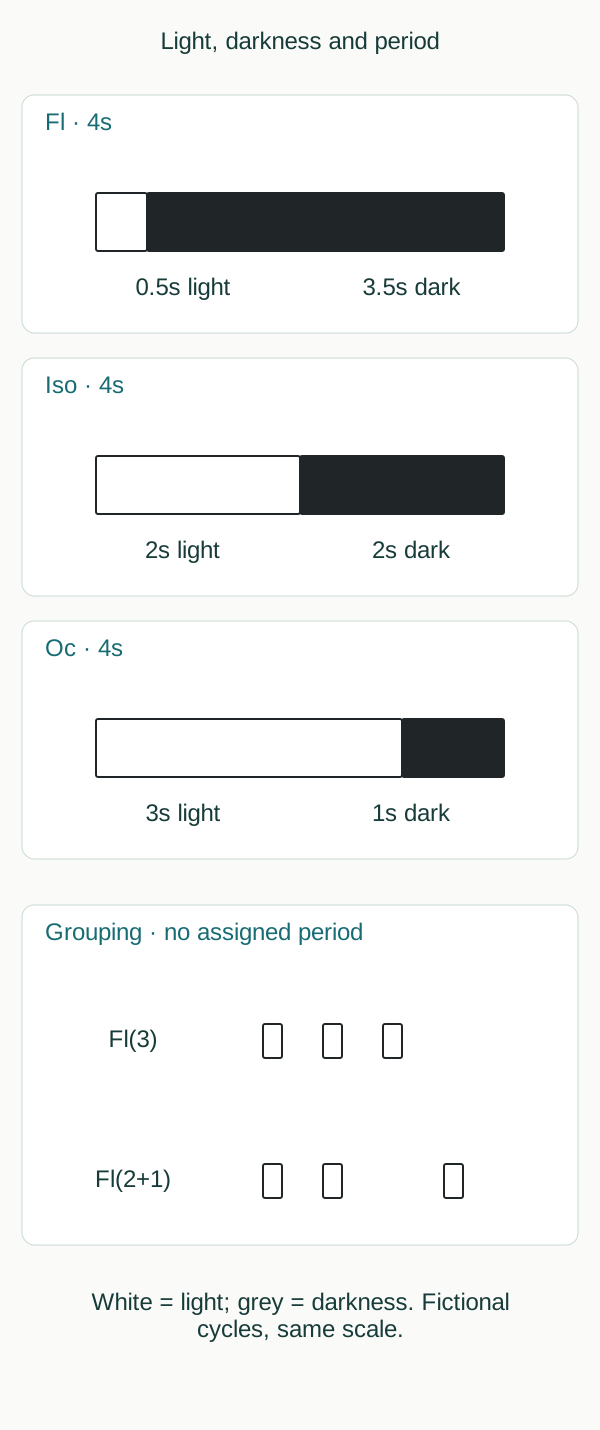
Original schematic without spatial scale; not a chart, route or navigation instruction.
insideSailOriginal insideSail artwork — all rights reservedEnlarge the diagram
| Notation | Principal property | Useful question |
|---|---|---|
| F | Fixed light, without periodic eclipse | Is there a periodic interruption? |
| Fl | Total light shorter than total darkness in the cycle | Are flashes separated by darkness? |
| Oc | Total light longer than total darkness in the cycle | Is the light interrupted by eclipses? |
| Iso | Equal light and dark durations | Do the two phases last equally long? |
| LFl | Flash of at least two seconds | How long is the flash, separately from the cycle? |
The table follows IHO charting definitions. The relationship concerns total durations within the cycle; it is not an intensity classification.
A faint light can be Iso and a bright one Fl. R1001 uses these rhythms to distinguish families, but notation alone provides neither the size of the light apparatus nor our distance from it.
Group and period are different properties
In Fl(3), three flashes form the same group before the repeating interval. Fl(2+1) has two different groups: two flashes followed by one.
The sum is also three, but the organisation differs. Period begins at one point in the sequence and ends when that same point returns; it includes flashes and every eclipse.
An observation cut short can hide part of a group without changing the published characteristic.
Quick flashing, Morse and alternation
Q and VQ are quick and very quick flashing classes. S-4 defines frequency bands: Q, 50–79 flashes per minute, usually 50 or 60; VQ, 80–159, usually 100 or 120.
R1001 uses these usual cadences for cardinals. Grouping and the additional long flash still distinguish north, east, south and west; any fast light is not automatically a north cardinal.
Mo(A) identifies dot-dash. Al indicates alternating colours, rather than merely alternation of light and darkness.
Read letters and units too
W is white, R red, G green, Y yellow and Bu blue in international notation. s denotes seconds of period. In a lighthouse description, m can indicate focal elevation and M nominal range in nautical miles: these are different fields.
Charts can abridge notation under S-4 conventions; omission of W can mean white under the specified conditions. It should not be guessed from screenshot colour.
Synchronisation and sequencing among several aids are features of a published system, rather than changes to an individual period’s definition.
A clear plain-language description can keep the same order: “group of two flashes; red light; six-second cycle”, followed by Fl(2)R6s. This progressive reading connects the observed sequence with the written record.
Period belongs to repetition of the characteristic, rather than the time someone looked at the object. A labelled static timeline can explain the phase differences without turning every characteristic into an animation or creating the appearance of an operational signal.
- Read rhythm, grouping, colour and period separately.
- Apparent intensity does not define Fl, Oc or Iso.
- An incomplete sequence can prevent identification.
- Nominal range is not guaranteed detection in fog.
References: IHO S-4, edition 4.10.0, March 2026, B-466.3–B-466.4 and B-471.2–B-471.6; IALA R1001, edition 2.0, June 2023, 2.2.2, 2.4.2.2, 2.6.2.1 and section 5.
Concepts in this lesson
Flashing / Fl
A characteristic with total light shorter than darkness in the cycle under the consulted chart definition; grouping and period are additional attributes.
Educational recognition; provides no route or depth.
Isophase / Iso
A characteristic with equal light and darkness durations in the cycle; period includes both.
Educational recognition; provides no route or depth.
Light period
Duration of a complete cycle, including lit phases and eclipses until repetition; not merely one flash’s duration.
Educational recognition; provides no route or depth.
Occulting / Oc
A characteristic with total light longer than darkness in the cycle; distinct from Fl and Iso.
Educational recognition; provides no route or depth.
Sources and references
- RBMN — artigo 14: Boias de assinalamento de emergência ↗
Diário da República · RBMN annex Article 14; printed p.1981, PDF p.4.
Annex RBMN Article 14, published text 24 June 2016. Commencement follows Portaria Article5; later national interpretation/updates and local directions require qualified checking. Not treated as automatic adoption of IALA2023.
Checked on - IALA R1001 — Light rhythm identities and abbreviations ↗
IALA · Sections 2.2.2, 2.2.4, 2.4.2.2, 2.6.2.1, 4 (definitions) and 5 (abbreviations); PDF p.13 onwards and p.29; edition 2.0 June 2023.
IALA recommendation, edition 2.0 June 2023, 2.2.2, 2.2.4, 2.4.2.2, 2.6.2.1 and 4. Consulted edition does not establish individual national effective dates. Publication and jurisdiction require qualified review.
Checked on - IALA R1001 — Lateral marks and preferred channels, Regions A and B ↗
IALA · Sections 2.1.3–2.1.5; PDF p.10 onwards; edition 2.0 June 2023.
IALA recommendation, edition 2.0 June 2023, 2.1.3–2.1.5. Consulted edition does not establish individual national effective dates. Publication and jurisdiction require qualified review.
Checked on - RBMN — artigo 3: Método de caracterização das marcas ↗
Diário da República · RBMN annex Article 3; printed p.1979, PDF p.2. RBMN annex Article 6; printed p.1979, PDF p.2.
Annex RBMN Article 3, published text 24 June 2016. Commencement follows Portaria Article5; later national interpretation/updates and local directions require qualified checking. Not treated as automatic adoption of IALA2023. Annex RBMN Article 6, published text 24 June 2016. Commencement follows Portaria Article5; later national interpretation/updates and local directions require qualified checking. Not treated as automatic adoption of IALA2023.
Checked on - Regulations for International (INT) Charts and Chart Specifications of the IHO — S-4 ↗
International Hydrographic Organization · B-460–B-466 buoy characteristics; B-471 light descriptions; B-475.1–B-475.6 sectors and leading lights; PDF pp.306–331 and 336–339.
Official 452-page PDF directly consulted; edition verified against current IHO catalogue. Original educational fragments rather than reproduced INT1 symbol plates. Paper chart conventions are not universal electronic display behaviour.
Checked on - IALA R1001 — Emergency wreck identity and other new-danger marking ↗
IALA · Sections 2.6.1–2.6.2 and 3.2.2; PDF p.20 onwards; edition 2.0 June 2023.
IALA recommendation, edition 2.0 June 2023, 2.6.1–2.6.2 and 3.2.2. Consulted edition does not establish individual national effective dates. Publication and jurisdiction require qualified review.
Checked on - RBMN — artigo 8: Quadrantes das marcas cardeais ↗
Diário da República · RBMN annex Article 10; printed p.1980, PDF p.3. RBMN annex Article 12; printed p.1980, PDF p.3.
Annex RBMN Article 10, published text 24 June 2016. Commencement follows Portaria Article5; later national interpretation/updates and local directions require qualified checking. Not treated as automatic adoption of IALA2023. Annex RBMN Article 12, published text 24 June 2016. Commencement follows Portaria Article5; later national interpretation/updates and local directions require qualified checking. Not treated as automatic adoption of IALA2023.
Checked on
Regulatory references
- Emergency wreck identity and other new-danger marking ↗
IALA R1001 edition 2.0 June 2023 · IALA · International recommendation; competent-authority implementation
Verified on - Lateral marks and preferred channels, Regions A and B ↗
IALA R1001 edition 2.0 June 2023 · IALA · International recommendation; competent-authority implementation
Verified on - RBMN artigo 12 — Marcas de águas limpas ↗
Portaria 177/2016, original published annex · Defesa Nacional e Mar; technical direction Direção de Faróis / DGAM · Portugal
Verified on - RBMN artigo 6 — Regras gerais das marcas laterais ↗
Portaria 177/2016, original published annex · Defesa Nacional e Mar; technical direction Direção de Faróis / DGAM · Portugal
Verified on - S-4 B-460–466 / B-470–475 — buoy and light charting specifications ↗
IHO S-4 edition 4.10.0 March 2026 · International Hydrographic Organization · International chart-production specification; not a local pilotage rule
Verified on - RBMN artigo 3 — Método de caracterização das marcas ↗
Portaria 177/2016, original published annex · Defesa Nacional e Mar; technical direction Direção de Faróis / DGAM · Portugal
Verified on - Light rhythm identities and abbreviations ↗
IALA R1001 edition 2.0 June 2023 · IALA · International recommendation; competent-authority implementation
Verified on - RBMN artigo 10 — Descrição das marcas cardeais ↗
Portaria 177/2016, original published annex · Defesa Nacional e Mar; technical direction Direção de Faróis / DGAM · Portugal
Verified on - RBMN artigo 14 — Boias de assinalamento de emergência ↗
Portaria 177/2016, original published annex · Defesa Nacional e Mar; technical direction Direção de Faróis / DGAM · Portugal
Verified on
Keep discovering
The next piece of the puzzle
Discuss this concept
Loading the conversation…