By insideSail
Published without technical review · version 3 ·
Isolated danger: the mark identifies without measuring clearance
Two balls, black/red and Fl(2) have a precise bounded meaning.
In this guide
An isolated danger mark identifies a limited danger with navigable water around it. It may be erected on it, moored over it or placed near it.
The name describes the relationship between the danger and surrounding water; it does not mean small, unimportant or already removed. A rock, wreck or other obstruction can seriously affect a sailboat even where the area can be passed around in appropriate conditions.
Recognition by day and night
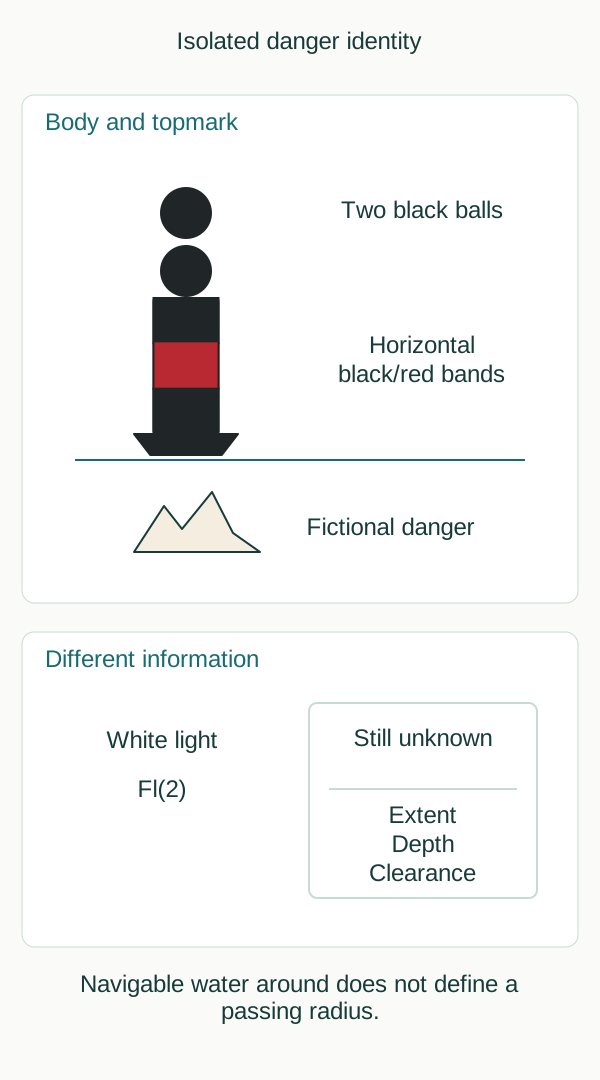
Original schematic without spatial scale; not a chart, route or navigation instruction.
insideSailOriginal insideSail artwork — all rights reservedEnlarge the diagram
| Element | Characteristic | What it contributes |
|---|---|---|
| Body | Black with one or more horizontal red bands | Separates this family from cardinal black/yellow bands |
| Topmark | Two black spheres, one above the other | Distinguishes spheres from cones |
| Body shape | No unique distinctive form; pillar or spar preferred | Height or narrowness does not determine category |
| Light when fitted | White, group of two flashes: Fl(2) | Grouping completes night identification |
An isolated danger body should not conflict with lateral identification. Preference for pillar or spar does not make all narrow bodies equivalent: topmark and colour pattern still distinguish the family.
A sphere looks circular from the side but is a volume, rather than a road-sign disc. The two black spheres are particularly important by day and should be used where practicable, with clear separation.
Not every photograph shows them: distance, framing, overlap and condition can hide details. An unseen feature should not be filled with an imagined topmark.
When fitted, grouped pairs of white flashes differ from the quick flashing of cardinals.
What isolated means
The mark indicates navigable water around the marked danger. It does not make the surrounding seabed uniform or guarantee passage for every draught.
The danger’s size and suitable passing distance vary by case. R1001 explicitly explains that no passing distance can be specified for all uses of this mark and refers to charts and nautical publications.
The generic obstruction in this lesson represents the idea of a limited danger, without a clearance scale.
The buoy’s location should not be confused with the danger’s complete geometry. A floating aid has an assigned position and a mooring system; the real object can move or be off station.
A chart may need to show the aid and obstruction separately. Mark identification, danger location and assessment of a passage are three connected but different questions.
Compare the neighbouring families
A cardinal gives a geographical side associated with passing and uses cones, black/yellow and Q or VQ. A safe water mark does not mark a danger: it uses red/white vertical stripes and, when carrying a topmark, one red sphere.
Isolated danger combines black/red with two black spheres. All three can carry white lights; night colour alone does not distinguish their function.
These identities remain the same in A and B.
A useful explanation has two parts: a danger exists here; navigable water lies around that danger. The first part distinguishes it from safe water.
The second prevents it being imagined as an endless barrier. Both are needed for the full meaning, while actual extent remains an attribute of the place that the mark does not measure.
This explains why category recognition and spatial interpretation are distinct learning steps rather than competing answers.
- Isolated describes the configuration; it is not a severity scale.
- Two black spheres and two quick flashes are not equivalent: Fl(2) is a group of flashes.
- The family supplies no universal safe radius.
References: IALA R1001, edition 2.0, June 2023, 2.3.1–2.3.2; Portugal: RBMN, Article 11. For charting separation of danger and aid, IHO S-4, B-460.1 and B-461.3(c).
The concept in a few words
Isolated danger mark
A mark on or near danger with navigable water around, recognised by black/red, two black balls and fitted white Fl(2); it sets no clearance distance.
Educational recognition; provides no route or depth.
Sources and references
- Regulations for International (INT) Charts and Chart Specifications of the IHO — S-4 ↗
International Hydrographic Organization · B-460–B-466 buoy characteristics; B-471 light descriptions; B-475.1–B-475.6 sectors and leading lights; PDF pp.306–331 and 336–339.
Official 452-page PDF directly consulted; edition verified against current IHO catalogue. Original educational fragments rather than reproduced INT1 symbol plates. Paper chart conventions are not universal electronic display behaviour.
Checked on - IALA R1001 — Isolated danger and limits of inference about passing distance ↗
IALA · Sections 2.3.1–2.3.2; PDF p.15 onwards; edition 2.0 June 2023.
IALA recommendation, edition 2.0 June 2023, 2.3.1–2.3.2. Consulted edition does not establish individual national effective dates. Publication and jurisdiction require qualified review.
Checked on - RBMN — artigo 8: Quadrantes das marcas cardeais ↗
Diário da República · RBMN annex Article 11; printed p.1980, PDF p.3.
Annex RBMN Article 11, published text 24 June 2016. Commencement follows Portaria Article5; later national interpretation/updates and local directions require qualified checking. Not treated as automatic adoption of IALA2023.
Checked on
Regulatory references
- RBMN artigo 11 — Marcas de perigo isolado ↗
Portaria 177/2016, original published annex · Defesa Nacional e Mar; technical direction Direção de Faróis / DGAM · Portugal
Verified on - Isolated danger and limits of inference about passing distance ↗
IALA R1001 edition 2.0 June 2023 · IALA · International recommendation; competent-authority implementation
Verified on - S-4 B-460–466 / B-470–475 — buoy and light charting specifications ↗
IHO S-4 edition 4.10.0 March 2026 · International Hydrographic Organization · International chart-production specification; not a local pilotage rule
Verified on
Keep discovering
The next piece of the puzzle
Discuss this concept
Loading the conversation…