By insideSail
Published without technical review · version 2 ·
Collective equipment: readiness before emergency
Inventory, location, compatibility and training need to agree.
In this guide
Collective equipment serves the group but does not operate as independent objects. Alerting needs power or batteries; recovery equipment needs access and appropriate capability; an extinguisher must suit the actual hazard.
Readiness connects function, configuration and people able to use it. Buying everything on a list does not establish those relationships.
This lesson organises accompanied assessment of the assembly without declaring a universal legal inventory.
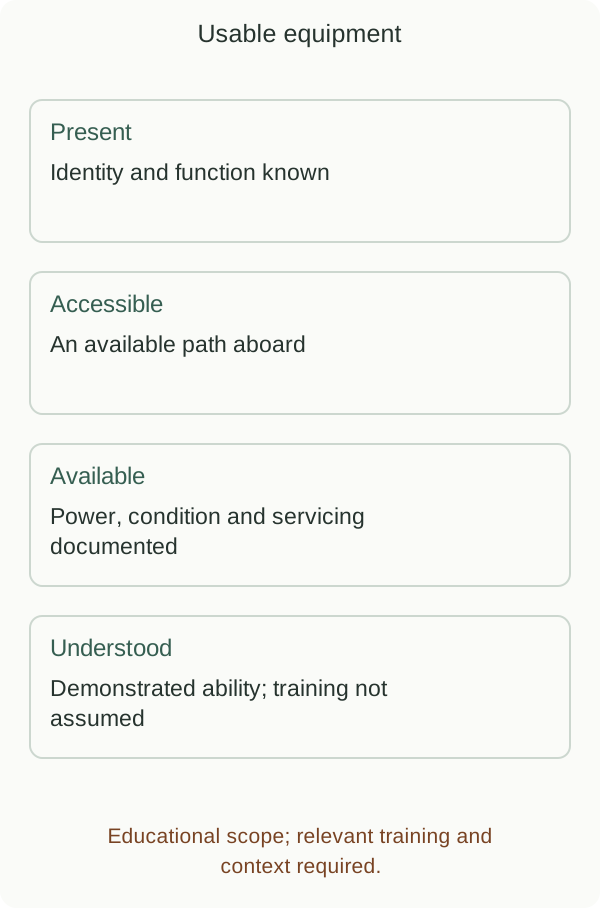
Educational scope; relevant training and context required.
insideSailOriginal insideSail artwork — all rights reservedEnlarge the diagram
Four questions for each function
| Question | Evidence example |
|---|---|
| Does it exist? | Identified product and version |
| Is it accessible? | Demonstrated location and access |
| Is it ready? | Documented condition and servicing |
| Can we use it? | Appropriate training and exercise |
The questions are not interchangeable. An invoice establishes purchase rather than current presence; presence establishes no servicing; a service date establishes no crew familiarity.
Access needs assessment in the relevant scenario: loaded boat, darkness or an unavailable exit. One clear photograph should not automatically answer all four questions.
Useful records preserve both the confirmed fact and the conditions under which it was confirmed.
Redundancy with known dependencies
Two devices may share power or information. Two screens do not guarantee two independent ways of locating the boat.
Fixed and handheld radios can offer different capabilities, but a handheld still depends on its battery and communication conditions. The drawing identifies one common dependency to explain the compromise.
It specifies neither electrical architecture nor a particular product; it helps identify a failure affecting several resources.
Training without real alerts
The route to a locker can be practised without activating its contents. Other exercises need simulators, training equipment and guidance.
A beacon or pyrotechnic signal is not activated merely to prove that crew know its location. Some devices have a specified test mode governed by instructions and applicable rules.
Training distinguishes demonstration, authorised testing and emergency activation, preventing practice from generating a false rescue mission.
Responsibility and continuity
An availability exercise gives two people different resource cards and asks them to explain one shared dependency. A display and fixed communication system may share power whose alternative is undocumented.
The exercise does not switch off real installations: it organises information and identifies an assessment question. Separate missing documentation, known failure and hypothetical failure.
Counting two boxes as two independent solutions creates misleading redundancy. Likewise, finding equipment in a locker proves no readiness when access requires moving heavy cargo.
The useful result is a specific problem, responsible person and proposed checking rather than an overall safety score. A subsequent change is recorded as proposed until its availability and limitations have actually been examined.
Preparation does not end at purchase. Identify who maintains inventory and tracks work and dates without making that person the only possible user.
If the usual responsible person becomes unavailable, the group needs to locate and understand essential resources. An equipment change requires an updated briefing: even another version from the same brand can use different controls.
Recording uncertainty and suspending use is preferable to presenting an unresolved specialist question as settled.
Sources and references
- Yacht sailing and motorboating ↗
RNLI · Safety checklist: briefing, training, weather, shore contact and means of help.
Preparedness guidance only. No statistics or comparative risk scores imported.
Checked on - Sailing grab bags: what do you keep in yours? ↗
Royal Yachting Association · Opening purpose; liferaft contents vary; accessibility; rescue/survival categories.
Selected functions only. Published packing list and buoyancy specification not reproduced; no medication recommendations.
Checked on - Distress flares ↗
Royal Yachting Association · Safe use; manufacturer-specific mechanisms; expiry and lawful disposal.
No firing recipe or universally lawful substitute. UK-specific legal references remain UK-specific.
Checked on
Keep discovering
The next piece of the puzzle
Discuss this concept
Loading the conversation…