By insideSail
Automated technical check · version 2 ·
Currents: drivers, scales and directions
Water movement is not wave propagation.
In this guide
A current is water movement. It can be described by direction and speed at a location, depth and time.
Current direction indicates where water moves to, while meteorological wind direction names where air comes from. Naming those conventions avoids reversing an arrow.
A wave propagates a disturbance and should not be confused with a current’s mean displacement.
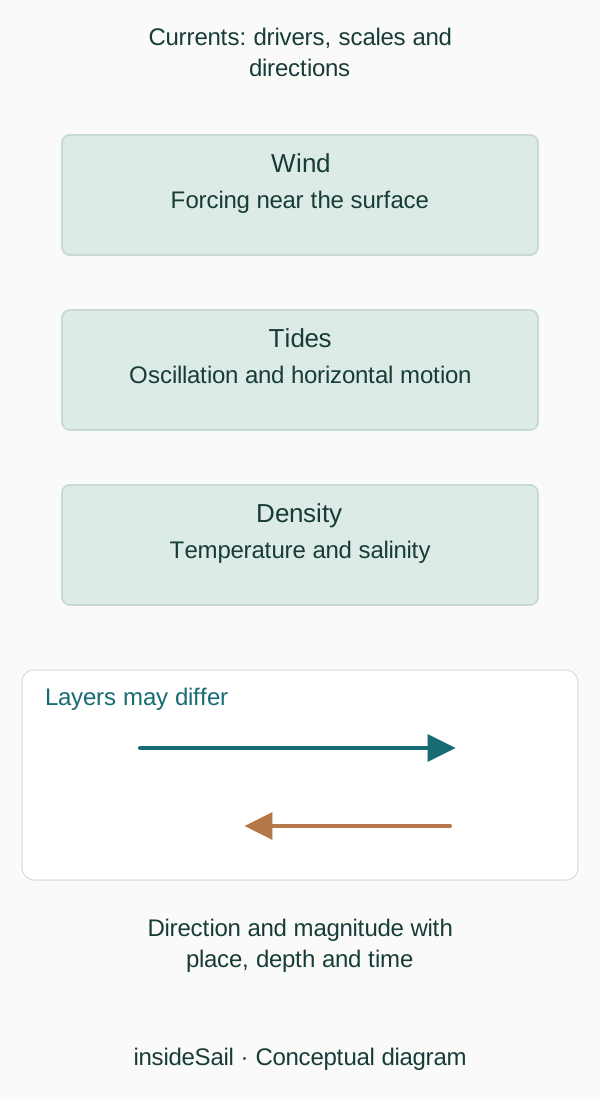
Conceptual schematic not to scale; no local forecast or operational decision.
insideSailOriginal insideSail artwork — all rights reservedEnlarge the diagram
More than one cause
Currents can relate to tides, wind forcing and density differences. Temperature and salinity influence density, while gradients and gravity contribute to circulation.
Earth’s rotation and continental and seabed geometry also modify movement. “Ocean current” does not mean the entire water column has the same velocity or that broad circulation supplies an exact value beside a quay.
Scales coexist: an area can have background circulation, tidal variation and local meteorological effects. Their combination need not follow one fixed direction.
Motion may also vary with depth, producing shear between layers. A surface drifter and a deeper instrument can observe different movements without contradiction.
Direct measurements, instrument drift and models supply different information types. A mean map describes structure or climatology rather than an instantaneous passage forecast.
The navigation lesson combines boat and water vectors; this lesson explains physical families behind water movement. The tidal-height lesson distinguishes that vertical variation from horizontal current.
Observed drifter velocity includes the object’s response to conditions rather than a universal “current” label. Submerged depth, air action and other effects can modify the relationship.
A fixed instrument and a drifter use different geometries. Method does not change velocity’s physical meaning, but changes what was actually observed and how it relates to a water layer.
Temperature and salinity help determine density, whose differences can relate to movement at depth. This does not mean every local cooling event creates a directly predictable current.
Gradients, mixing, geometry and rotation act together. Broad circulation descriptions organise large-scale processes; current at one place and time still needs data appropriate to that question.
- Current is movement TO a direction.
- Tide, wind and density can contribute.
- Location, depth and time belong to the value.
The concept in a few words
Ocean current
Water movement described by direction and speed with location, depth and time.
Sources and references
- Currents Tutorial ↗
NOAA National Ocean Service · Tidal, wind-driven and density-driven current families.
No local current prediction or universal timing rule.
Checked on
Keep discovering
The next piece of the puzzle
Discuss this concept
Loading the conversation…