By insideSail
Automated technical check · version 2 ·
Boat, water and air: three motions, three reference frames
Hypothetical examples explaining velocities and apparent wind.
In this guide
One display can show speed through water and another speed over ground. They need not agree because water moves relative to the ground.
Air also has its own motion, while wind felt aboard depends on boat motion. Start by identifying the reference of each velocity.
The drawing uses qualitative two-dimensional vectors; the numerical examples below are separate idealised situations along one direction.
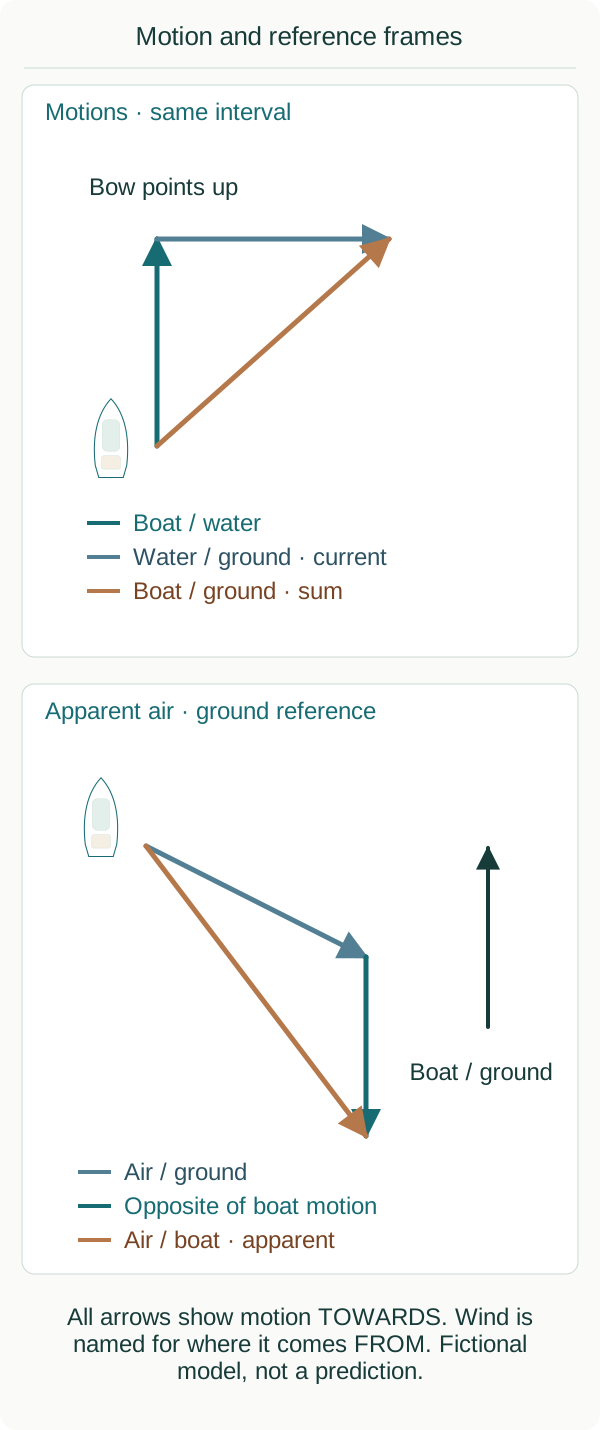
Convention: all arrows indicate motion towards. Ground frame is stated; apparent air is relative to the boat.
insideSailOriginal insideSail artwork — all rights reservedEnlarge the diagram
Speed, direction and arrow conventions
A velocity includes magnitude and direction. For one-dimensional arithmetic, choose east as positive and west as negative.
Our velocity arrows show motion towards a direction. Meteorological wind naming identifies its origin: an easterly wind means air moving west in this horizontal model.
Consequently, “wind from the east” and an arrow showing “air towards the west” can describe the same situation.
First example: boat and water
The relationship in numbers
v(boat/ground) = v(boat/water) + v(water/ground)
Velocity vectors; examples use knots.
For non-collinear directions, addition is vectorial: combine components in the same frame instead of merely adding speed magnitudes. The figure shows this relationship through a triangle without a numerical scale.
Heading is another piece of information; it is not automatically the direction of ground velocity. Someone can therefore correctly describe an easterly heading while also observing ground movement with a lateral component.
Second example: wind relative to the boat
The relationship in numbers
v(air/boat) = v(air/ground) − v(boat/ground)
Both velocities use the same ground frame before subtraction.
True wind needs an explicit reference
Water-referenced and ground-referenced wind are different descriptions when water moves. Apparent wind can be calculated using air/water and boat/water, or air/ground and boat/ground.
Results agree when each pair uses consistent data. Mixing air/ground with boat/water leaves a reference unaccounted for; adding current again to an already-converted value can count it twice.
The word true alone does not resolve that convention.
These calculations explain relationships without reproducing instrument processing. Sensors, three-dimensional motion, calibration and settings require specific documentation.
The examples assume known, constant, horizontal velocities. The aim is to recognise each field’s reference, making differing values an intelligible question rather than immediately treating them as a fault or contradiction.
Takeaways
- Combine vectors in the same frame, not only magnitudes.
- A velocity arrow points towards; a wind name identifies origin.
- Use consistent velocity pairs for apparent wind without counting current twice.
Concepts in this lesson
Apparent wind
Wind relative to the boat; in the vector model it is air velocity minus boat velocity, both expressed in the same reference frame.
Ground-referenced wind
Air movement relative to the ground; it differs from water-referenced wind when water moves.
Speed over ground
The magnitude of boat velocity relative to the ground, distinct from speed through water.
Speed through water
The magnitude of boat velocity relative to water; vector direction is additional information in the examples.
Water-referenced wind
Air movement relative to water; this reference is declared when the lesson uses water-referenced true wind.
Sources and references
- Puff response upwind — apparent wind explanation ↗
North Sails / Bill Gladstone · Apparent Wind paragraph: relation between wind and boat motion.
Relative-motion concept only; no puff-response or trimming recipe. Our worked velocities explicitly declare reference frames rather than assuming instrument settings.
Checked on - Glossary — sailing reference frames ↗
B&G · Entries Apparent Wind/AWA; Boat Speed; Ground Wind; SOG.
Only declared land/water/boat reference distinctions used. No instrument configuration, current numeric example, outdated satellite information or other glossary claims adopted.
Checked on - What is the difference between a tide and a current? ↗
NOAA National Ocean Service · Explanatory paragraphs: vertical tidal level and horizontal water movement.
Page reports updated 23 September 2026. Definitions only; not a local forecast or timing rule.
Checked on
Keep discovering
The next piece of the puzzle
Discuss this concept
Loading the conversation…